
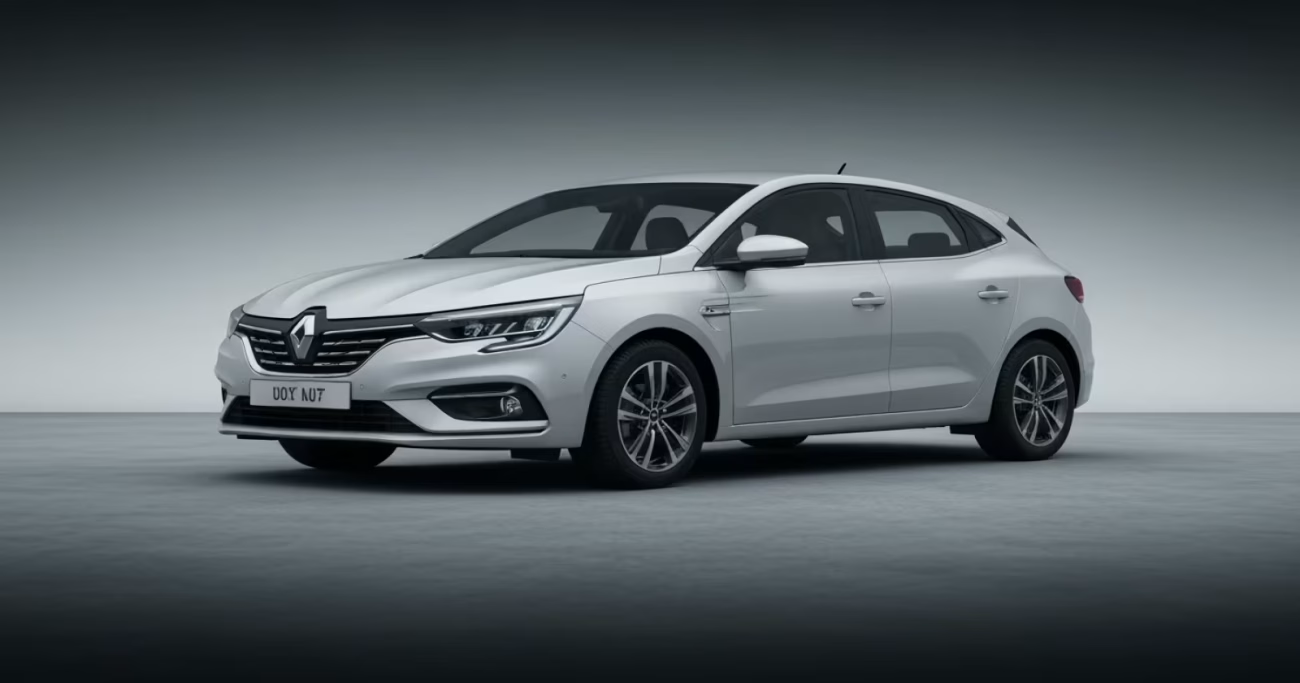
Renault has put a bold marker on India, and I think this is the kind of move that can change a brand’s entire future here. Seven new models, a premium push, and an ambitious target to become one of its top three global markets by 2030 is not a quiet plan at all.
What makes this especially interesting to me is that Renault is not just talking about selling more cars. It is treating India as a technology base, an export hub, and a long-term growth engine, which tells me the company wants much more than short-term showroom buzz.
What Renault is really trying to do
From what I see, Renault’s new India roadmap is built around three big ideas: stronger products, better local engineering, and a sharper customer experience. That matters because the Indian market is brutal right now, with buyers demanding more features, more safety, more efficiency, and better value than ever before.
The headline number is simple: seven new models by 2030. But the more important detail is the spread across segments, because Renault is planning a mix that includes compact cars, SUVs, and multi-energy options such as petrol, hybrid, and fully electric powertrains.
That tells me Renault wants to cover more of the market instead of relying on a narrow lineup. In India, that is often the difference between being remembered and being ignored.
Duster is still the emotional anchor
The new-gen Renault Duster is clearly one of the most important pieces in this strategy. I can already see why Renault is leaning on it so heavily. The Duster name still carries a lot of recognition in India, especially among buyers who remember its tough-road image and practical appeal.
Renault also showed the Bridger Concept, which previews a B-segment SUV with both ICE and electric powertrain support. That is a smart signal, because the compact SUV space in India is crowded and fiercely competitive, and any future Renault SUV will be judged against strong rivals almost immediately.
In my view, Renault is trying to avoid being seen as a one-model brand. The next few years will have to prove that it can build a proper SUV ladder, not just a single hero product.
| Strategy Area | Renault’s Plan in India |
|---|---|
| New models | 7 launches by 2030 |
| Powertrains | Petrol, hybrid, and electric |
| Core product | New-gen Duster |
| Future SUV | Bridger Concept preview |
| Platforms | RGEP and RGMP |
| Ownership focus | 7-year warranty under Renault Forever |
| Export goal | Euro 2 billion annual exports by 2030 |
Why premium positioning matters now
Renault says future products will move toward higher value positioning, and I think that is a necessary shift. Indian buyers have become far more demanding, especially in the SUV and compact car segments, where Maruti, Tata, Hyundai, Kia, Mahindra, and even MG have raised the bar on design and equipment.
A premium feel today is not just about soft-touch materials or fancy screens. It is about how the car looks, how connected it feels, how safe it seems, and how confident the brand sounds when it talks about ownership.
That is why Renault’s focus on new digital and electronic architecture is such an important detail. If the company gets the software, connectivity, and cabin tech right, it can stand out more easily in a market that is moving fast toward feature-heavy vehicles.
India is becoming Renault’s engineering base too
What really caught my attention is the role of Chennai. Renault now fully owns the facility, and the Chennai engineering centre already employs around 6,000 engineers and specialists. That is a serious capability, not just a local assembly operation.
To me, this means Renault is betting on India for design adaptation, vehicle architecture, software development, and lifecycle management. In other words, the country is no longer just a sales market. It is becoming part of the core development chain.
That shift can matter a lot if Renault wants more localised products that fit Indian road conditions, price sensitivity, and usage patterns. I think that is exactly where stronger execution could separate Renault from brands that still treat India as an afterthought.
Exports could become the hidden story
Renault’s export target is ambitious: Euro 2 billion, or about Rs 21,973 crore, in annual exports by 2030. I see this as one of the most important parts of the entire strategy because it gives the company a bigger reason to invest in India beyond domestic sales.
When a company uses India as a global export and R&D base, it usually means more scale, better localisation, and potentially stronger product economics. That can help keep future models more competitive on price while still improving technology and quality.
For Indian auto fans, this is also a sign that the Chennai ecosystem could become more globally relevant. That is something worth watching closely over the next few years.
What I expect on the road ahead
If Renault executes well, this plan could finally give it the kind of momentum it has been chasing for years. But the Indian market is unforgiving, and seven models only matter if they arrive with the right timing, the right pricing, and the right positioning against rivals.
I would watch the compact SUV space first, because that is where the volume and attention are. If Renault can make the new Duster and the Bridger-derived SUV feel genuinely desirable, it could rebuild interest much faster than people expect.
The biggest challenge, in my opinion, is consistency. Renault will need better showroom confidence, stronger after-sales trust, and products that feel locally tuned from day one.
If this plan works, Renault could move from being a familiar name to a truly serious player again. I will be watching the launches, the tech package, and the pricing very closely, and if you follow the Indian SUV space like I do, this is one strategy you should keep on your radar right now.
