
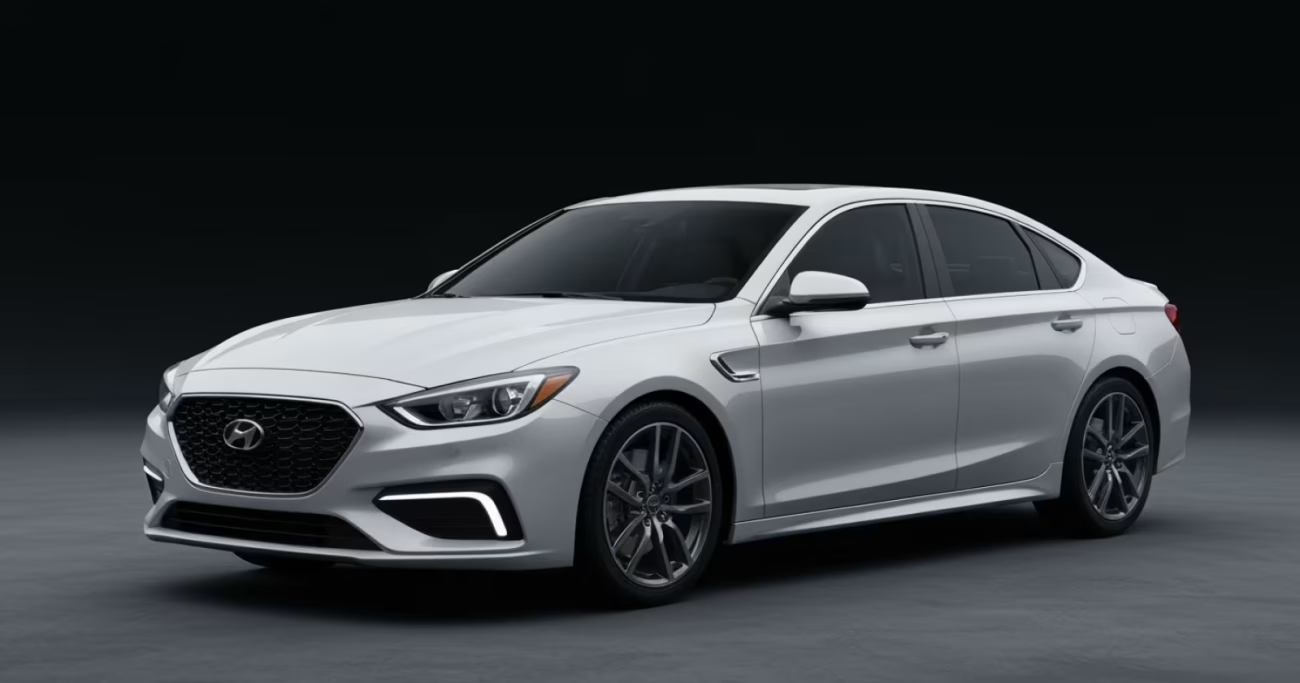
Hyundai just posted the best first quarter in its entire US history — and the car doing the heavy lifting is not the flashy EV you’d expect. The real engine behind these record numbers is a family sedan with a hybrid badge, and that says everything about where the American car market is heading right now.
In Q1 2026, Hyundai delivered 205,388 vehicles across the United States, a 1% climb over the previous Q1 record of 203,554 set just one year earlier. Even with March 2026 sales slipping 3% compared to March 2026, the quarterly total still held its record status — a testament to how strong January and February performed.
The hybrid nobody expected to outsell Hyundai’s own SUVs
Here’s the real story: Hyundai’s hybrid lineup didn’t just grow — it exploded. The Sonata Hybrid surged 150% in March year-over-year. The Elantra Hybrid jumped 92%. The Santa Fe Hybrid climbed 31%. Those are not incremental gains; those are the kind of numbers that force strategy meetings at rival brands.
What Hyundai isn’t saying loudly enough is that sedans — a segment practically every other automaker abandoned — are driving serious volume for the brand. The Elantra and Sonata hybrids are filling a gap that competitors left wide open, and consumers are walking straight through that door.
Why Hyundai’s “balanced portfolio” strategy is winning right now
Hyundai has been quietly positioning itself as the brand that covers every powertrain bet. Full EVs, plug-in hybrids, standard hybrids, and gas-only models all sit under one roof. With Middle East tensions pushing fuel prices sharply higher in 2026, that balanced approach looks less like corporate hedging and more like foresight.
Analysts are already flagging that sustained fuel price pressure could reshape new car demand significantly. Hyundai is almost uniquely positioned to absorb that shift. While competitors scramble to ramp up hybrid production, Hyundai already has the volume, the supply chain, and the consumer awareness to capitalize immediately.
| Model / Metric | Sales Figure | Change (YoY) |
|---|---|---|
| Q1 2026 Total (USA) | 205,388 units | +1% (new record) |
| Tucson (YTD bestseller) | 55,426 units | +1% |
| Sonata Hybrid (March) | Not disclosed separately | +150% |
| Elantra Hybrid (March) | Not disclosed separately | +92% |
| Ioniq 5 (12-month period) | 9,790 units | +14% |
| Venue crossover (March) | Not disclosed separately | +18% |
| Ioniq 6 (discontinued in USA) | — | -75% |
The one catch nobody is talking about in these numbers
Hyundai’s March dip deserves context that the brand conveniently buries in a single footnote. The 3% decline happened directly because March 2026 was artificially inflated — buyers rushed to purchase before the federal EV tax credit was eliminated by the current administration. Comparing against that surge was always going to look unflattering.
Here’s the catch: Hyundai didn’t break out individual hybrid model volumes. The 150% Sonata Hybrid figure and 92% Elantra Hybrid jump are percentage gains rolled into total model-line numbers. The raw unit counts remain undisclosed, which makes the optics look better than a full data set might. That said, percentage gains of that magnitude still represent real, significant momentum regardless of the base numbers involved.
The Tucson holds the crown — but the Venue is coming for attention
The Tucson remains Hyundai’s single best-selling nameplate in the USA with 55,426 units moved year-to-date and 23,721 in March alone. That 90-unit margin over March 2026 is razor-thin, but a record is a record. The compact SUV continues to prove that Hyundai’s bread-and-butter volume lives in the middle of the market, not at the premium EV tier.
The surprise mover of Q1 2026 is the Venue. The entry-level subcompact crossover recorded an 18% jump in March and a 12% year-to-date increase. As affordability pressure squeezes buyers down-market, the Venue’s low price point makes it one of the smartest bets in Hyundai’s current lineup — and it’s barely getting any attention for it.
How it stacks up
| Brand | Q1 2026 US Sales | YoY Change | Hybrid Momentum | Edge |
|---|---|---|---|---|
| Hyundai | 205,388 | +1% (record) | Very Strong | Record Q1, hybrid surge |
| Toyota | ~594,000 (est.) | Flat to slight gain | Strong (Camry, RAV4) | Volume leader, hybrid legacy |
| Honda | ~330,000 (est.) | Modest gains | Growing (CR-V Hybrid) | Reliability brand loyalty |
| Kia | ~195,000 (est.) | Positive | Moderate | EV6/EV9 expanding reach |
Why this matters
- Hybrids — not full EVs — are now Hyundai’s fastest-growing US segment
- Sedan nameplates like Elantra and Sonata are defying the SUV-only narrative
- Rising fuel costs in 2026 could accelerate hybrid demand across all brands
The verdict
Hyundai’s Q1 2026 record is not a fluke — it’s the payoff from a strategy built on covering every powertrain angle at once. The hybrid surge, particularly from the Sonata and Elantra, shows that Hyundai identified a consumer need that most legacy automakers wrote off years ago. If fuel prices stay elevated and EV adoption remains uneven, Hyundai’s position only gets stronger through the rest of 2026. This is a brand running toward a problem that its rivals are still trying to understand.
If you’re in the market for a new car right now — especially one with a hybrid badge — Hyundai’s current lineup deserves a serious look before the rest of the market catches up to what the sales numbers are already telling us.
