
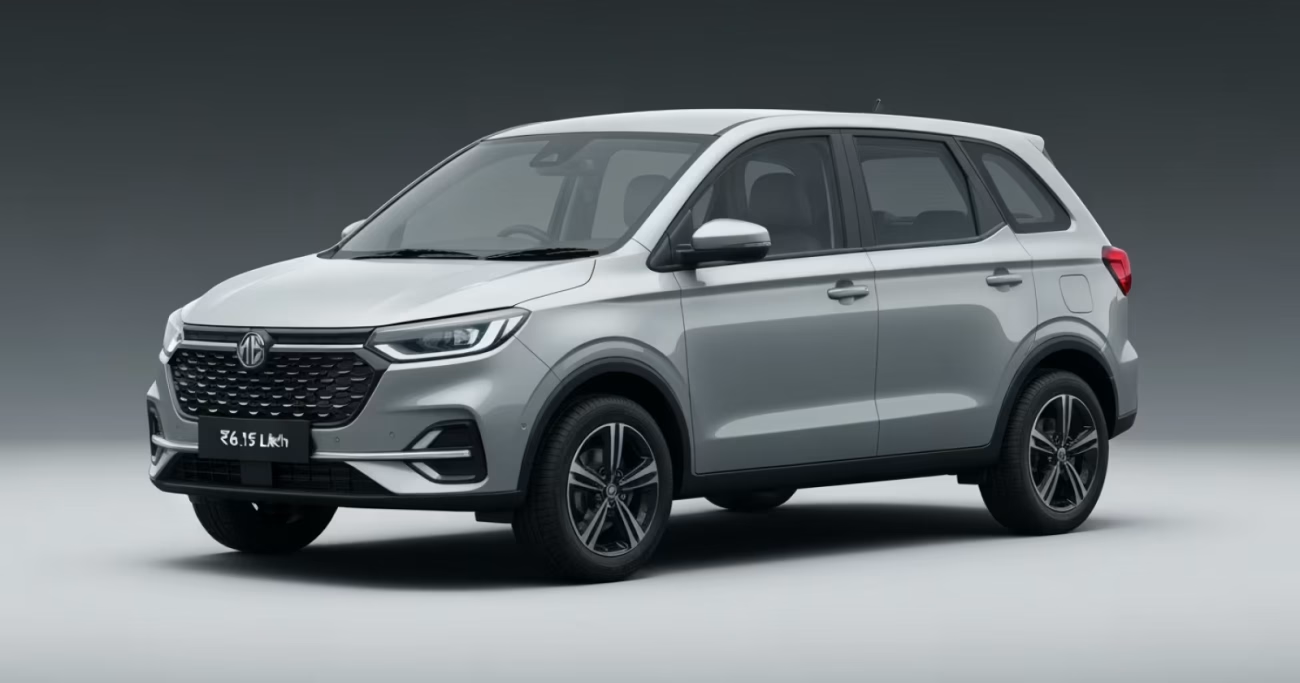
The world’s most widely sold electric vehicle just received a major refresh — and its sticker price will make every Indian EV shopper lean forward in their chair. Wuling has officially launched the 2026 Mini EV in China at CNY 45,000, which converts to approximately Rs 6.15 lakh at current exchange rates, setting a new benchmark for affordable electric mobility that India’s booming EV segment simply cannot ignore.
I have been tracking sub-compact EVs closely for the past year, and I can tell you this launch changes the conversation entirely. Here is everything you need to know — and why it matters directly to your next car purchase.
What Is the Wuling Mini EV and Why Should Indian Buyers Care?
If the Wuling name sounds unfamiliar, let me connect the dots immediately. The Wuling Mini EV is the Chinese donor vehicle behind the MG Comet EV currently on sale at Indian dealerships. SAIC-GM-Wuling — the joint venture that owns Wuling — also operates MG Motor globally, and the Comet EV that Indian city commuters are buying today shares its platform, electric architecture, and core design DNA with this very car. So when Wuling launches a 2026 Mini EV in China at a Rs 6.15 lakh equivalent price, it is not just a China story — it is a direct signal of what the next MG Comet EV for India could look and cost like.
The 2026 model builds on an already proven formula. Compact urban proportions, a tiny footprint ideal for Mumbai’s basement parkings and Bengaluru’s choked lanes, and a turning radius so tight that parallel parking stops being a nightmare altogether.
2026 Wuling Mini EV: Key Specs at a Glance
The 2026 variant arrives with a refreshed design, improved interior technology, and upgraded battery configurations. The China-spec model offers a 17.3 kWh battery with a CLTC-rated range of approximately 200–210 km, alongside a smaller 13.9 kWh pack for the entry-level variant targeting pure urban use. The electric motor produces around 30 kW — roughly 40 PS — which sounds conservative until you factor in the car’s 665 kg kerb weight. In city conditions, this powertrain is more than adequate.
| Specification | 2026 Wuling Mini EV | MG Comet EV (India) |
|---|---|---|
| Launch Price | CNY 45,000 (Rs 6.15 L) | Rs 7.98 L (ex-showroom) |
| Battery Capacity | 13.9 / 17.3 kWh | 17.3 kWh |
| Claimed Range | ~200–210 km (CLTC) | 230 km (ARAI) |
| Motor Output | ~30 kW (40 PS) | 42 PS |
| Top Speed | ~100 km/h | 100 km/h |
| Length | 2,974 mm | 2,974 mm |
| Seating Capacity | 4 persons | 4 persons |
How the 2026 Mini EV Compares to the Tata Tiago EV
The Tata Tiago EV starts at Rs 7.99 lakh and has been India’s go-to affordable EV for city buyers for some time now. At a China equivalent of Rs 6.15 lakh, the 2026 Wuling Mini EV undercuts it considerably — though Indian pricing always factors in GST, customs duties, and localisation costs that adjust final numbers upward. Even so, this launch hands MG Motor India a very clear commercial signal: get more aggressive on Comet EV pricing, or risk losing momentum.
The Tiago EV does offer a class-leading ARAI-certified range of up to 315 km on the larger battery pack, which is a genuine advantage for buyers who occasionally need to travel beyond city limits. But for pure urban commuting — IT corridors in Hyderabad, bumper-to-bumper Delhi traffic, or Pune’s daily office runs — the Mini EV and Comet form factor is arguably the smarter, more purpose-built choice. You are not paying for range you will never use.
What Is Actually New on the 2026 Model?
The 2026 Wuling Mini EV gets a noticeably sharpened exterior. The front fascia features a cleaner LED lighting signature, a more sculpted bumper, and a new two-tone paint option that gives the car real personality. The previous generation’s minimalism worked, but this update adds a layer of desirability that younger urban buyers will respond to.
Inside, there is a slightly larger infotainment display, revised seat upholstery, and meaningfully better NVH insulation — one of the most consistent criticisms of the older model in Indian reviews. Charging has been upgraded too. The 2026 car supports faster AC charging, cutting full charge time to under five hours on a standard 7.4 kW home wallbox. Regenerative braking now offers adjustable intensity levels, giving drivers more control over energy recovery in stop-start traffic — exactly the kind of driving Indian roads demand daily.
The Bigger Picture: What This Means for India’s EV Future
What genuinely excites me about this launch is the trajectory it represents. The global EV cost curve is falling rapidly, and Chinese manufacturers like Wuling sit at the very sharp end of that decline. A launch price of CNY 45,000 in China asks a critical question back home: how long before a fully-featured sub-compact EV breaks the Rs 6 lakh barrier in India?
The PM e-DRIVE scheme and the forthcoming FAME III policy framework are structurally designed to accelerate exactly this outcome. As MG Motor India deepens localisation at its Halol plant in Gujarat and battery cell costs continue their global descent, a 2026-spec Comet EV update hitting Indian showrooms under Rs 7 lakh is not speculation — it is a commercial inevitability.
If you are actively considering a city EV purchase right now, I strongly recommend visiting your nearest MG dealership and asking specifically about upcoming 2026-spec Comet EV updates. Prices are only going to get more competitive, and the buyer who is already informed will be first in line when this game-changing update officially lands in India. Do not wait on the sidelines for this one.
