
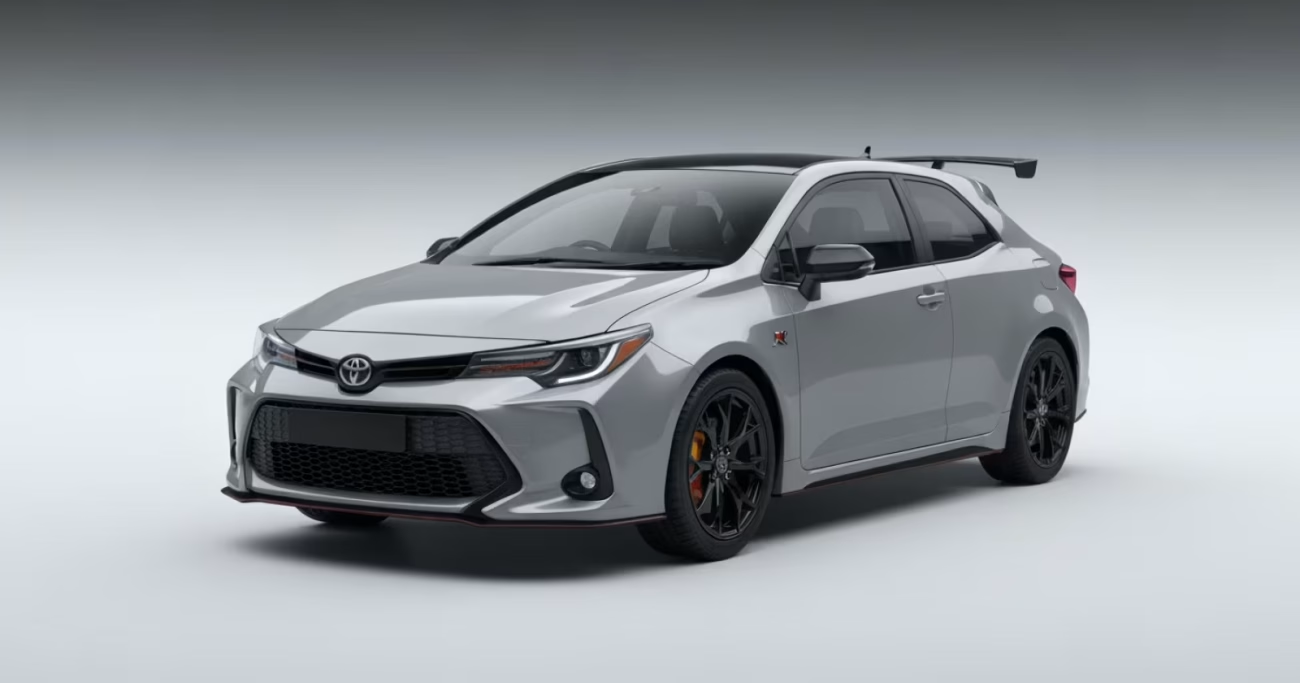
The hottest Corolla Toyota has ever built is finally headed for the U.S. market, and it brings 302 hp, Nürburgring tuning, and weight reduction straight into the mainstream hot hatch fight.
The real story is not just power. It is how far Toyota went to make a compact manual AWD hatch feel like a track tool with a license plate.
The GRMN badge changes the whole conversation
GRMN sits at the top of Toyota’s performance ladder, and that alone makes this car matter. It is short for Gazoo Racing Masters of Nürburgring, which tells you exactly where Toyota wanted this hatch to prove itself.
Here’s the catch: the standard GR Corolla was already fast enough to embarrass plenty of expensive machinery. The GRMN version is not chasing comfort or broad appeal; it is chasing sharper responses, more grip, and harder laps.
Toyota developed this car with serious punishment in mind, and that is the real story. Engineers leaned on racing experience, including lessons from the hydrogen-powered GR Corolla in Super Taikyu, to improve durability and consistency under load.
That matters because hot hatches live or die by repeat performance. A quick pull is easy; surviving lap after lap with heat, grip loss, and fade under control is where the best cars separate themselves.
302 hp is not the headline, control is
The engine still makes 300 hp, so the peak number does not move much. Torque does, rising to 302 lb-ft and arriving lower in the rev range, which should help the car hit harder when exiting corners.
That is where Toyota is being smarter than louder. I see a car tuned for usable shove rather than dyno bragging, and that is exactly the sort of change enthusiasts feel on a fast road or a circuit.
There is also an intercooler spray system to help keep performance consistent during prolonged hard driving. Add the six-speed manual, and the GRMN Corolla stays true to the kind of driver involvement that made the GR Corolla such a surprise in the first place.
What Toyota is not saying is just as interesting. The standard GR Corolla gained an automatic option in 2026, but the GRMN stays manual-only, which signals a more focused mission and a narrower audience.
| Spec | Detail |
|---|---|
| Engine | 1.6L turbocharged inline-3 |
| Output | 300 hp |
| Torque | 302 lb-ft |
| Transmission | 6-speed manual |
| Drivetrain | All-wheel drive |
| Weight change | 66 lb lighter |
| Tires | Michelin Pilot Sport Cup 2 |
Toyota spent the money where drivers feel it
The visual upgrades are not just for theater, and that is why this car lands so well. A vented hood, fender ducts, front side spoilers, and a large rear wing were all shaped and tuned for downforce and cooling at the Nürburgring.
Toyota even adjusted the rear wing angle in 1-degree steps, which tells me the aero work was treated like race engineering rather than styling decoration. That level of obsessive tuning is what gives a halo hatch its credibility.
Underneath, the GRMN gets monotube dampers, revised suspension settings, and sticky Michelin Pilot Sport Cup 2 tires. The 245/40 rubber on 18-inch forged wheels should give the car a much more serious contact patch than an ordinary compact hatch needs.
The all-wheel-drive system and electric power steering were also recalibrated, with Toyota aiming for cleaner torque distribution and greater stability at speed. In other words, this is less about headline numbers and more about making every horsepower easier to exploit.
What the cabin gives up for speed
The weight-saving effort is small on paper but meaningful in a car like this. Toyota removed the rear seats and trimmed 66 lb from the curb weight, which should help the car feel a little more eager in every transition.
That move also makes the buyer decision clearer. This is not the hot hatch for hauling friends every day; it is the one for drivers who care more about apexes than extra cupholders.
Inside, the GRMN leans into that mission with deeply bolstered sport seats, suede and synthetic leather trim, more suede on the dash and pillars, carbon fiber accents, and a numbered plaque. Morizo’s signature on the dashboard adds a final layer of internal significance for Toyota fans.
The real story is that Toyota built the cabin to remind you this is a special-edition performance tool, not just a trim package with stickers. Even the materials are there to support the driving experience by reducing glare and keeping attention on the road.
Why Honda should be watching closely
The most obvious rival is the Honda Civic Type R, because both cars are now fighting for the title of the most serious mainstream performance hatch. Honda has long owned the front-drive benchmark conversation, but Toyota is pushing a very different formula with AWD and rally-derived tuning.
That makes the comparison more interesting than a simple horsepower race. The GRMN Corolla looks built to trade laps, stability, and traction for the Civic Type R’s longstanding reputation for razor-sharp chassis balance.
Pricing has not been announced, and that is the one big unknown hanging over the car. If Toyota keeps it close to the upper edge of the compact performance segment, the GRMN could become the new choice for buyers who want exclusivity and track focus in one package.
Production will happen at Motomachi in Japan, with U.S., Japanese, and Australian buyers in mind. That global intent tells me Toyota sees this as more than a niche experiment; it is trying to redefine what a mainstream hot hatch can be in 2026.
The GRMN Corolla matters because it takes the regular GR Corolla formula and turns every dial farther toward serious speed. If Toyota prices it with intent, it could become the most desirable compact performance hatch in the room.
For enthusiasts who still believe the best performance cars are the ones you can drive every day and attack a track day with, this is the one to watch. I would keep this hatch on the radar now, before the first delivery wave makes it even harder to get.
