
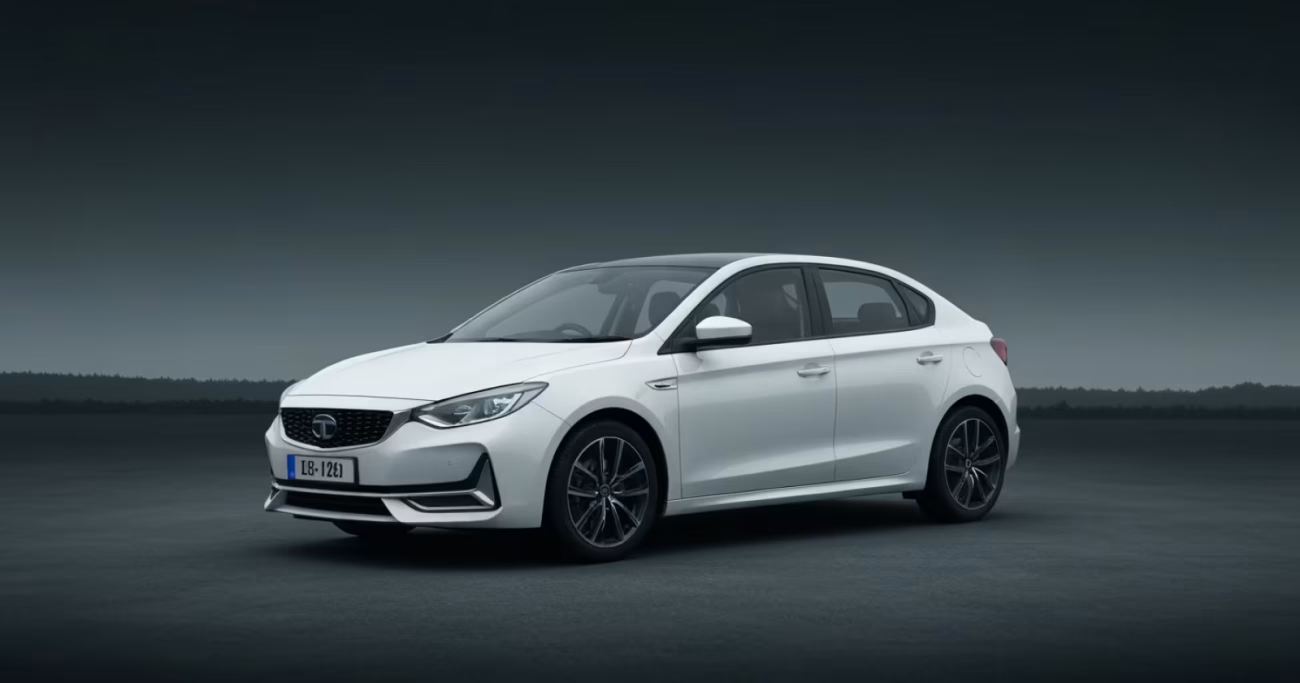
Tata’s latest numbers are the kind that make me sit up and look twice.
Crossing 10,000 electric vehicle sales in a single month is a big moment, and it says a lot about where Indian buyers are headed in 2026.
Tata Motors Passenger Vehicles Ltd. has just delivered one of its strongest monthly performances yet, and the headline is impossible to ignore: EV sales have crossed the 10,000-unit mark for the first time. I see this as more than a sales update; it is a clear signal that India’s electric passenger vehicle market is moving from early adoption to real mainstream momentum.
The company reported total passenger vehicle sales of 59,790 units in May 2026, up 42.22% from 42,040 units in May 2026. Domestic sales alone stood at 59,090 units, while exports climbed to 700 units. For me, the most striking part is how broad the growth looks, because this is not being driven by one model or one lucky month.
Strong demand across ICE and electric models
Tata Motors said its wholesale volumes rose by about 42% in the month, and VAHAN registrations were up by more than 50% year on year. That tells me the momentum is not just visible in dispatches, but also in what buyers are actually registering on the road. In India, that gap matters, because retail demand is what ultimately decides who is winning the month.
What makes this performance even more interesting is the company’s stable monthly run rate. Compared to April 2026, domestic passenger vehicle sales improved only marginally by 90 units, which translates to just 0.15% month-on-month growth. I read that as a sign of consistency at a high base, not a one-off spike.
EV sales break a fresh record
The real star of the month is Tata’s electric portfolio. Combined domestic and export EV sales reached 10,517 units in May 2026, which is up 85% from 5,685 units in the same month last year. This is the highest monthly EV total Tata has ever posted, and I think it strengthens the brand’s position as the most important name in India’s electric passenger vehicle space.
This growth also makes sense when I look at Tata’s current EV lineup. Tiago EV, Punch EV, Nexon EV, Curvv EV and Harrier EV give the company coverage across city commuters, compact SUV buyers and larger premium EV shoppers. That spread matters because it allows Tata to convert interest from different price bands into actual volume.
Exports are still small, but the trend is healthy
Exports rose to 700 units in May 2026 from 483 units a year earlier, a 44.93% increase. That number is still modest in the context of Tata’s domestic strength, but I would not dismiss it. Steady export growth usually means the company is building confidence in overseas markets while keeping its home market engine running.
For an Indian automaker, that balance is important. It shows that Tata is not relying only on domestic sentiment, and it gives the brand a longer runway if export markets continue to open up.
What these numbers mean for Tata right now
From where I stand, this report confirms three things. First, Tata’s passenger vehicle business is still growing at a very healthy pace. Second, its EV strategy is paying off in a way that now looks structural rather than temporary. Third, the brand is holding on to its strong position in India’s highly competitive market, where rivals are constantly trying to close the gap.
I also think this matters beyond the sales chart. When a brand crosses a new EV milestone like this, it helps normalize electric ownership for more Indian buyers. That can influence showroom traffic, family buying decisions, and the broader perception that EVs are no longer a niche choice.
| Metric | May 2026 | May 2026 | Growth |
|---|---|---|---|
| Total passenger vehicle sales | 59,790 | 42,040 | 42.22% |
| Domestic passenger vehicle sales | 59,090 | 41,557 | 42.19% |
| Passenger vehicle exports | 700 | 483 | 44.93% |
| Combined EV sales | 10,517 | 5,685 | 85% |
Why I think this month stands out
In the Indian auto market, big percentage growth is always exciting, but volume backed by consistency is what really lasts. Tata has managed both in May 2026. The company is not just selling more vehicles; it is doing so across multiple powertrains while also pushing EVs into a new volume bracket.
I would also point out that this comes at a time when competition in India is intense across SUVs, EVs and compact family cars. The fact that Tata can keep growing while defending its core market share makes this result especially valuable for investors, buyers and rivals watching from the sidelines.
The bigger picture for 2026
Looking ahead, I expect Tata Motors to keep leaning on its SUV-heavy lineup and expanding electric portfolio through the rest of FY2026-27. If demand for EVs stays this strong, the company could keep setting fresh monthly records, especially if new launches continue to pull buyers into showrooms.
For me, the most important takeaway is simple: Tata’s EV story is no longer about promise alone. With 10,517 EVs in one month, it now feels like a scale business, and that changes the conversation around India’s electric future.
If you follow Indian car sales closely, this is a trend worth watching every month. I would keep an eye on Tata’s upcoming numbers, because this kind of momentum can reshape the competitive picture much faster than most people expect.
