
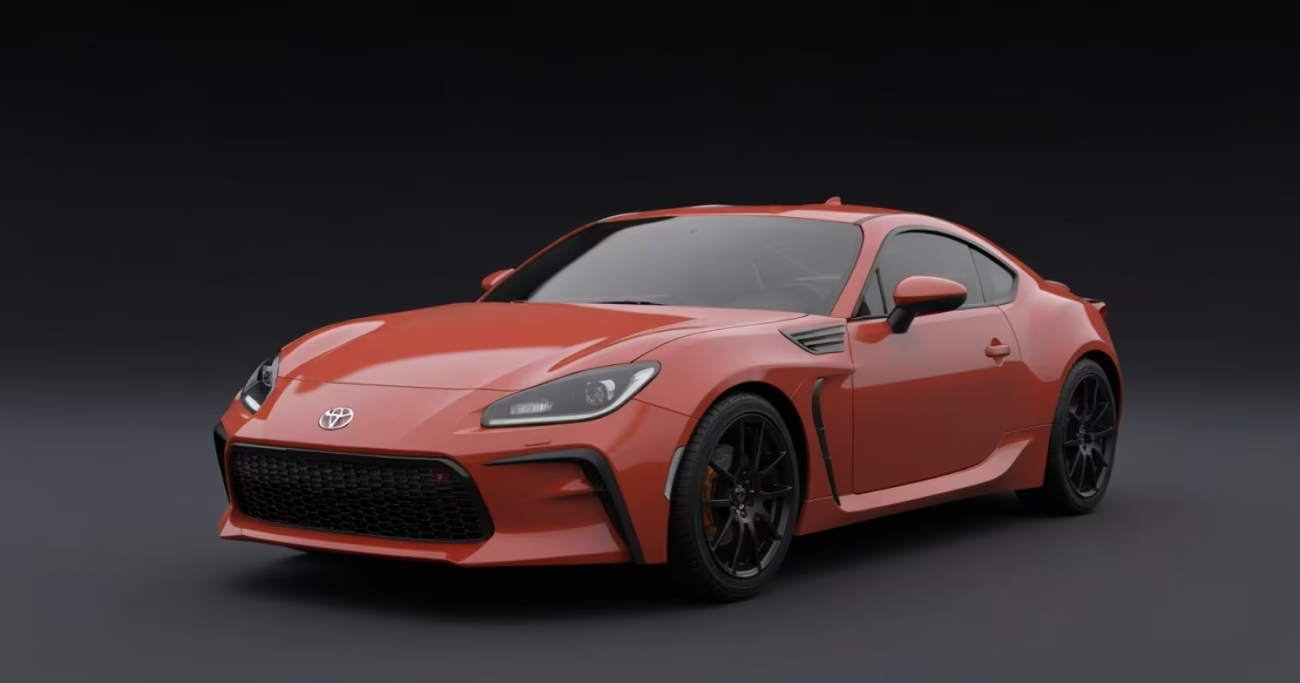
The cheapest thrills in Toyota‘s lineup just got a little sharper without getting more expensive. That matters because the GR86 is still one of the few affordable rear-drive sports cars left in the US.
Why 228 horsepower still works here
Toyota is not touching the heart of the car, and that is the point. The 2.4-liter boxer four still makes 228 hp and 184 lb-ft, sending power to the rear wheels through a 6-speed manual or an available automatic.
Here’s the catch: Toyota did not chase a bigger number because the GR86’s appeal is balance, not bragging rights. The real story is in the tuning around the engine, where throttle response has been recalibrated and the manual’s 4th-to-5th area has been tightened up for cleaner shifts.
That sounds small until you remember how little money this car costs. At just over $30,000, the GR86 remains a rare case where a manufacturer is still spending engineering effort on feel, not just features.
In a market where affordable sports cars keep disappearing, that commitment says a lot about Toyota’s priorities. It also explains why this car keeps getting better instead of just aging in place.
| Spec | 2027 Toyota GR86 | Why it stands out |
|---|---|---|
| Starting price | Just over $30,000 | One of the cheapest sports cars left |
| Engine output | 228 hp / 184 lb-ft | Enough for balance, not excess |
| 0-60 mph | 6.1 seconds | Quick enough for real-road fun |
| Drivetrain | Rear-wheel drive | Still the enthusiast formula |
| Optional upgrade | Performance Package | Brembo brakes and Sachs dampers |
| New color | Thunder | Fresh paint for the showfield crowd |
The package Toyota should sell harder
The optional Performance Package is the biggest real upgrade here. It adds Brembo brakes with 4-piston fronts and 2-piston rears, plus Sachs dampers filled with high-pressure nitrogen and oil for better control across a wider speed range.
That is the kind of hardware people usually expect on cars that cost far more. Here’s the catch: Toyota lets buyers add it to both trims, which makes the GR86 feel less like a stripped bargain and more like a tailored driver’s car.
The real story is how little compromise there is. The brakes use 12.8-inch front rotors and 12.4-inch rear rotors, so the package is not cosmetic fluff dressed up as performance.
For anyone who tracks cars or just wants sharper response on a back road, this is the version that makes the GR86 make sense. It gives the chassis the hardware it always deserved.
Premium trim gets the showpiece cabin
Toyota also refreshed the outside and inside without turning the car into something soft. The new Thunder gray paint joins the familiar bright colors, while the Premium trim gains a Cockpit Red interior with Ultrasuede, red leather accents, red floor mats, and red door trim.
The base car stays simple with black cloth seats and GR-embossed backs, which fits the mission. What Toyota isn’t saying is that the visual upgrades matter because the GR86 is now old enough to need freshness, but not so old that it needs reinvention.
There are also small tech changes that make daily life easier. Cruise control camera range is nearly doubled, and a monocular camera helps detect nearby objects at intersections, which is the sort of quiet update that improves the car without ruining its personality.
That is where Toyota still looks smarter than rivals. Instead of bloating the GR86, the company is polishing the edges people actually touch.
The real rival is the Miata’s value
The Mazda Miata is still the benchmark for low-cost fun, but the GR86 brings a different formula. It offers 2 seats less charm, more practicality, and a fixed roof, which makes it the easier daily companion for many enthusiasts.
Against pricier rear-drive coupes, the GR86’s value gap gets even more interesting. Here is the real story: Toyota is not trying to beat everything on paper, just enough to keep the car relevant and worth buying now.
Back-to-back driving at Sonoma Raceway showed why this approach works. Toyota’s updates are subtle, but they sharpen the car where drivers notice it most, and that is exactly what keeps the GR86 from fading into the background.
My take is simple: this is the kind of development affordable sports cars need if they are going to survive into the next cycle. Toyota is proving that cheap does not have to mean careless.
Model | Power | 0-60 mph | Starting price | Edge
Toyota GR86 | 228 hp | 6.1 sec | Just over $30,000 | Best all-around balance
Mazda Miata | 181 hp | 5.7 sec | About $29,000 | Lighter and more playful
Subaru BRZ | 228 hp | 6.1 sec | Around $31,000 | Closest mechanical rival
Ford Mustang EcoBoost | 315 hp | 5.1 sec | Around $33,000 | More power, less purity
Why this matters is easy to see. Toyota is still investing in a low-volume enthusiast car. That helps keep manual sports cars alive, and it shows the brand still understands what makes a driver care. The updates also widen the gap between the GR86 and ordinary coupes that only look sporty.
The verdict is that this is exactly the right kind of update for the GR86. It stays affordable, gains real chassis hardware, and gets the kind of fine-tuning enthusiasts notice immediately. I would watch this space closely, because Toyota is clearly building the kind of sports car culture other brands have mostly abandoned.
If affordable rear-drive fun matters, this is the car to follow and the trim to study before it lands at dealers. The GR86 is getting sharper in all the ways that count, and that makes it one of the most important entry-level sports cars on sale in 2026.
