
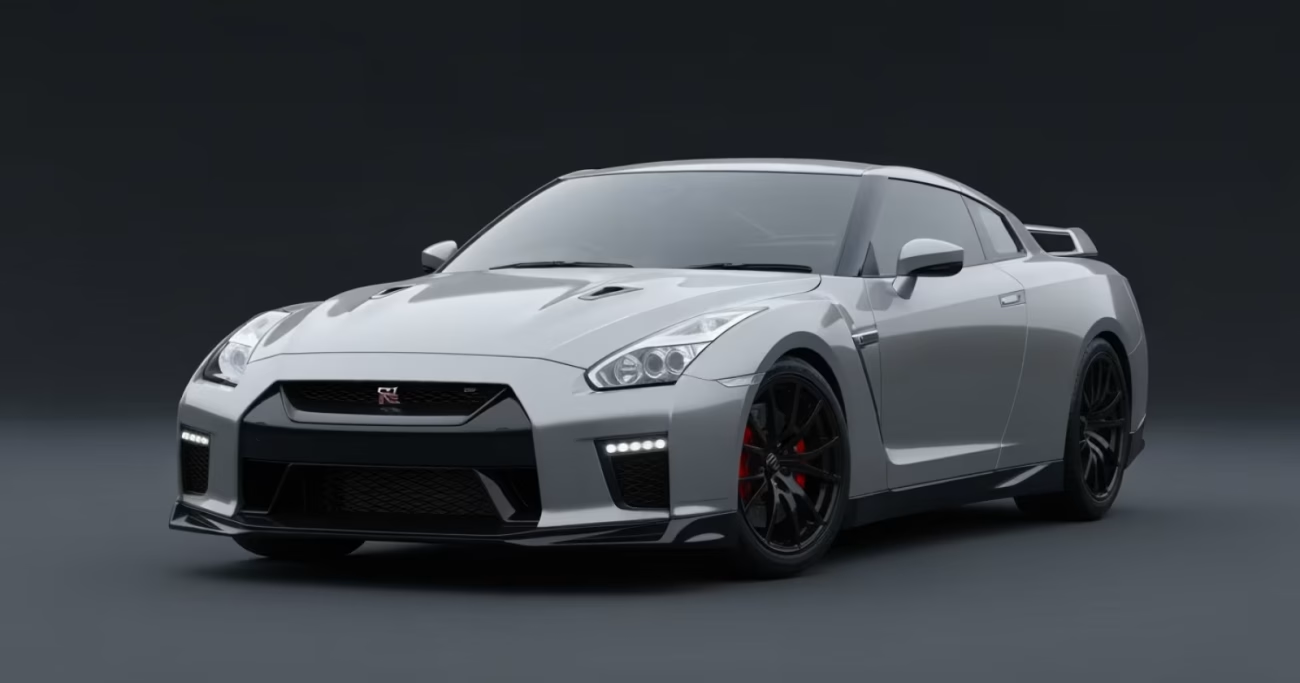
For years, the Nissan GT-R successor felt less like a confirmed project and more like automotive folklore — something enthusiasts hoped for but quietly feared would never arrive. Now, a senior Nissan executive has gone on record with details that finally make the R36 feel real, and the most important news is what they are not throwing away.
The iconic VR38 twin-turbo V6 — the engine that made the R35 GT-R a legend — appears to be coming back. Not in its current form, but evolved, electrified, and potentially pushing well past 800 hp. I have been following this story closely since rumours first surfaced about an all-electric GT-R direction, and this latest development is genuinely the best possible outcome for fans of the nameplate.
The engine Nissan refused to kill
At the 2026 New York Auto Show, Ponz Pandikuthira — Nissan’s senior vice president and chief planning officer for North America — spoke openly about the R36’s powertrain direction. His words were careful, but the message was clear: the VR38 block is simply too good to abandon. “Why would you throw that away?” he said, referring to the 3.8-litre unit that has earned a cult following among tuners and track drivers worldwide.
The catch is that the engine cannot survive emissions regulations in its current state. To sell the R36 globally, Nissan will need to electrify it. That means the heads, pistons, and combustion architecture may change significantly, even if the core block survives. Think of it less as the same engine and more as the same DNA — rebuilt for a new era of performance.
What a hybrid GT-R could actually mean for output
Here is where it gets genuinely exciting. The R35 GT-R’s production output topped out at around 600 hp in its Nismo Final Edition trim. Add a serious hybrid system to an evolved VR38 platform and 800 hp becomes a conservative estimate. Depending on the motor configuration Nissan selects, numbers north of 900 hp are entirely plausible — putting it in direct conversation with the Porsche 918 successor territory and Ferrari’s hybrid V8 world.
The real story is that hybridisation does not have to compromise the GT-R’s character. Porsche proved with the 918 Spyder and again with the current 911 GTS hybrid that an electric motor can sharpen throttle response rather than blunt it. If Nissan executes this right, the R36 could be faster off the line and more exploitable on track than any R35 ever was — and that is a significant statement given what the R35 achieved at the Nurburgring in its prime.
| Detail | R35 GT-R (Final) | R36 GT-R (Expected) |
|---|---|---|
| Engine | 3.8L VR38 Twin-Turbo V6 | Evolved VR38 + Hybrid System |
| Power Output | 600 hp (Nismo Final) | 800+ hp (estimated) |
| Chassis | R35 platform | All-new platform |
| Announcement | 2007 Tokyo Motor Show | Solid announcements by 2028 |
| Launch Timeline | 2007 | Before end of decade (pre-2030) |
| Emissions Compliance | Increasingly difficult | Global compliance via electrification |
Why the all-electric route was quietly dropped
Earlier reports had floated the idea of a fully electric GT-R — a direction Nissan had openly explored as it repositioned itself around the Leaf and Ariya EV platforms. For a brand that invented the modern performance EV conversation with the original Leaf, going full-electric with the GT-R seemed like a logical brand statement. Many assumed it was inevitable.
What those reports missed is the cultural weight of the GT-R powertrain. The RB26 inline-six defined an era. The VR38 defined another. An electric GT-R with no engine note, no turbo spool, and no connection to that lineage would have been a GT-R in name only. Pandikuthira’s comments suggest Nissan understood that. The decision to retain and evolve the VR38 is not just an engineering choice — it is a statement about what the GT-R is supposed to mean.
The 2028 timeline and what comes next
Pandikuthira confirmed that “solid concrete announcements” are expected by 2028, with a production launch targeted before 2030. In an industry where development timelines slip constantly, that is a relatively tight window — especially for a ground-up redesign on a new chassis. It tells me Nissan is further along in development than public commentary has suggested.
The new chassis detail is significant on its own. The R35 ran on the same basic platform for nearly two decades, which is extraordinary by any standard. A clean-sheet architecture means Nissan is not trying to stretch an ageing platform into the hybrid era — they are building something purpose-designed for what the R36 needs to be. Combined with the evolved VR38 and an electrified assist system, the foundations for something genuinely special are in place. Now Nissan simply has to deliver.
If the R36 GT-R is landing before 2030 with 800-plus hybrid horsepower and a brand-new chassis, this is the kind of announcement that deserves your full attention right now. I would strongly recommend bookmarking this story and following Nissan’s official channels ahead of the 2028 reveal window — because when the covers come off, the automotive conversation is going to shift fast. Do not be the last person in the room when it happens.
