
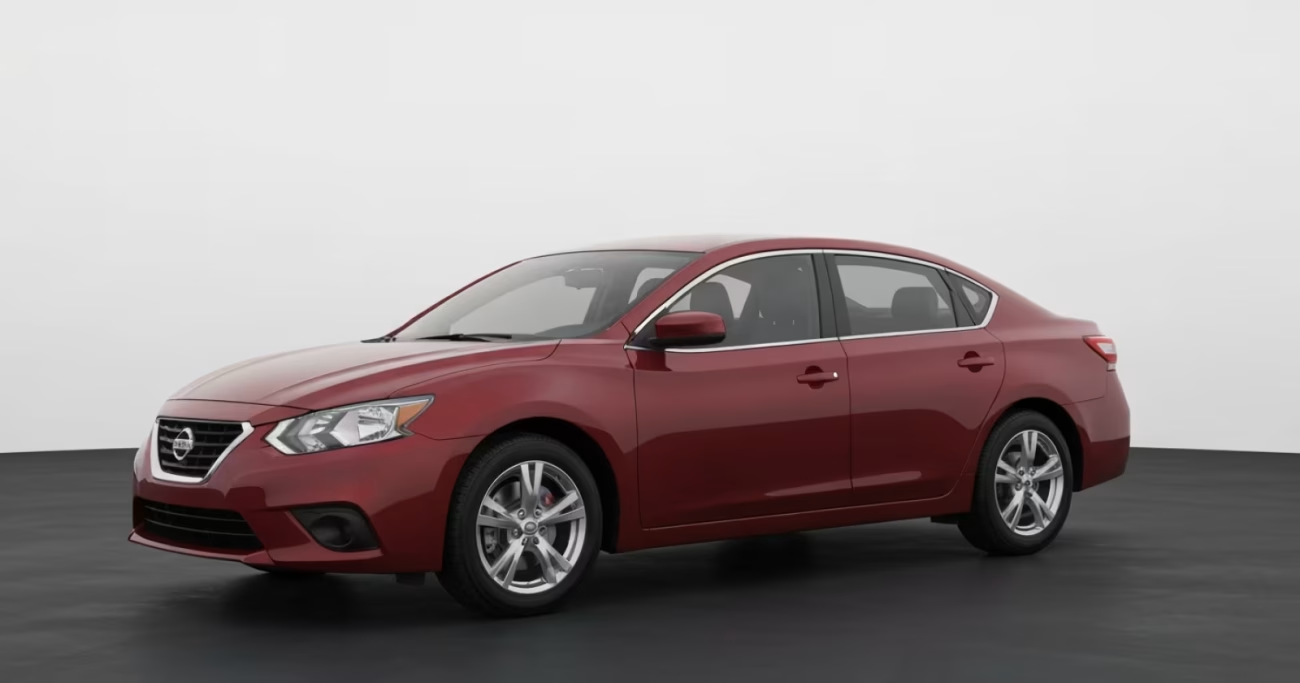
The average new car in America now costs $49,353. The Nissan Sentra costs $22,600 — and it might not exist much longer at that price.
Nissan has issued one of the clearest warnings yet about what Trump’s tariff agenda actually costs real buyers. If the administration forces production of affordable models to shift from Mexico to the United States, the math simply doesn’t work — and Nissan’s Americas chairman said so out loud at the New York Automotive Forum.
Nissan’s most affordable cars live or die in Mexico
The Sentra and the Kicks are Nissan’s last line of defense against an industry that has quietly abandoned the budget buyer. Both models are assembled in Mexico, where labor costs are low enough to keep sticker prices under $23,000. The Sentra opens at $22,600. The Kicks starts even lower at $22,430. These aren’t just cheap cars — they’re nearly the only cheap cars left on American dealer lots.
Before the Versa was discontinued in the US, it held the title of last new car sold under $20,000, starting at $17,390. That car is gone now. The Sentra and Kicks are what’s left for buyers who can’t stomach a $49,000 average transaction price, and both of them are built south of the border. That’s the core of Nissan’s problem with the current political climate.
Tariffs already add $3,000 before a single negotiation happens
Here’s the catch: tariffs on Mexican-built vehicles are already biting. According to Nissan’s own figures, the current tariff burden adds roughly $2,500 to $3,000 per vehicle on models coming from Mexico. That cost doesn’t vanish. It either gets absorbed by a manufacturer with razor-thin margins on entry-level cars, or it gets handed to buyers who chose that car specifically because they couldn’t afford anything pricier.
Nissan Americas chairman Christian Meunier didn’t mince words at the forum. “We couldn’t build these entry-level cars in the US at the same cost, we couldn’t do it,” he told Bloomberg, pointing directly at the margin problem. Moving production northward isn’t just logistically complex — it structurally breaks the pricing model these vehicles depend on. The real story is that “made in America” and “affordable for Americans” may be mutually exclusive goals when it comes to sub-$23,000 cars.
The USMCA review is the last real pressure valve
There is one mechanism that could ease this standoff. The US-Mexico-Canada Agreement — the trade framework that governs cross-border auto manufacturing — is up for a mandatory review ahead of a potential July 1 extension. If all three countries agree, the deal stays in place for another 16 years. That would give Nissan and other automakers a runway to plan around predictable tariff conditions rather than scrambling under political uncertainty.
The problem is Trump has signaled zero interest in preserving it. In January, he called the USMCA “irrelevant” and said it has “no real advantage.” He added that the US doesn’t need cars made in Canada or Mexico — it wants them made here. Nissan has reportedly held discussions with lawmakers who have shown some sympathy for the affordability argument, with Meunier saying “they understand our concerns.” But understanding concerns and changing policy are very different things, and the clock on the USMCA review is ticking.
What this means for buyers who are already stretched thin
One in five new car buyers is now paying more than $1,000 a month. That number tells you everything about where the market has drifted. Affordable cars weren’t just a convenience — they were the only viable entry point for millions of buyers. Removing them, or pricing them out of reach through tariff-driven cost increases, doesn’t make those buyers disappear. It pushes them into the used car market, into longer loan terms, or out of the new car market entirely.
Nissan’s warning isn’t abstract policy positioning. Mexico accounted for more than one-third of Nissan’s total US sales volume last year. If those vehicles get hit with full tariff costs and prices jump by $3,000 overnight, the sales impact would be severe. Nissan is already navigating a difficult financial stretch globally. Adding a structural pricing crisis on its most volume-sensitive models in its most important market is the kind of double pressure that reshapes product lineups permanently.
At a glance
| Spec | Detail |
|---|---|
| Nissan Sentra starting price | $22,600 |
| Nissan Kicks starting price | $22,430 |
| Tariff cost added per vehicle | ~$2,500–$3,000 |
| Average new car price (2026) | $49,353 |
| Nissan US sales from Mexico production | Over one-third of total volume |
| Last new car under $20,000 (discontinued) | Nissan Versa at $17,390 |
| USMCA extension deadline | July 1, 2026 |
If you’re currently shopping in the under-$25,000 segment, the time to buy may genuinely be now. Tariff outcomes could shift prices sharply in the next few months, and the Sentra and Kicks represent some of the last remaining value in the new car market. Watch the USMCA review closely — it’s the single policy decision most likely to determine whether affordable new cars survive in America or quietly disappear from dealer lots for good.
