
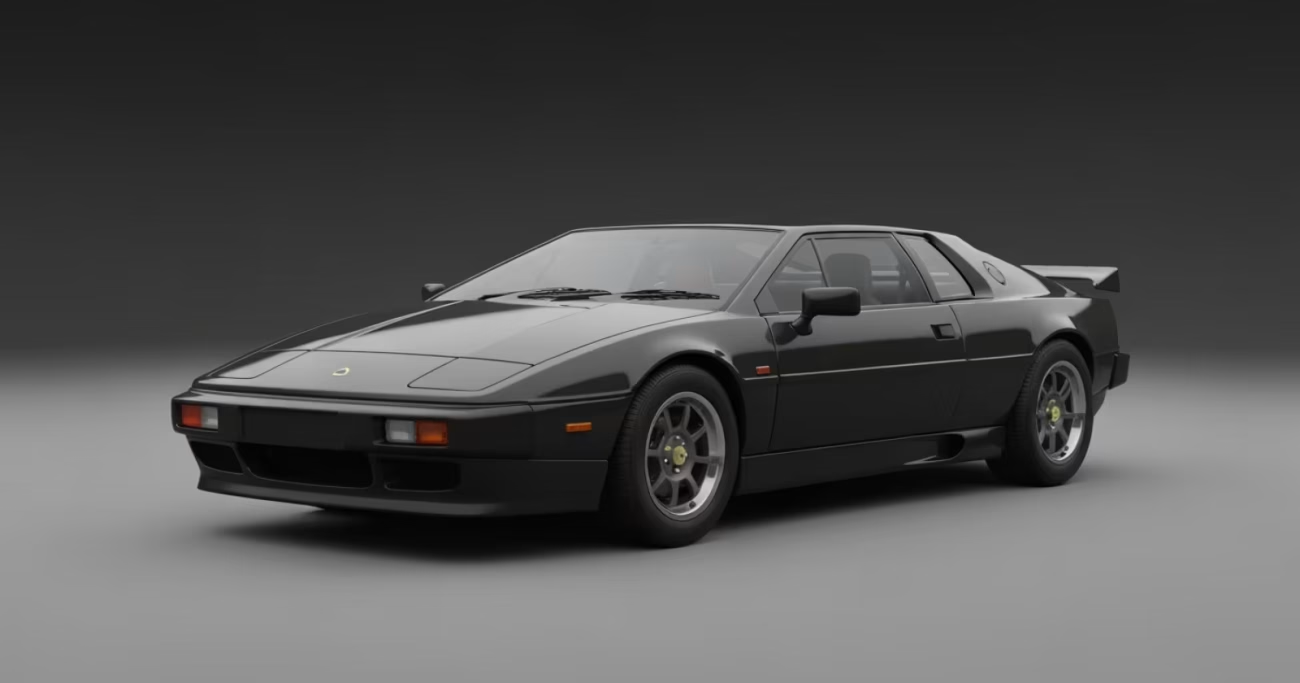
A 47-year-old wedge-shaped icon just got a twin-turbo heart transplant, a carbon fiber body, and a price tag that makes most supercars look affordable. Encor’s Series 1 restomod is now accepting orders, and only 50 people on earth will ever own one.
The social media clip that surfaced recently says more than any spec sheet could. That V8 burbling to life at idle — thick, guttural, unhurried — is the kind of sound that reminds you why the Lotus Esprit spent decades living rent-free in the imaginations of car enthusiasts worldwide.
At a Glance
| Spec | Detail |
|---|---|
| Engine | Lotus Type 918 3.5L twin-turbo V8 (rebuilt) |
| Power Output | 400 hp |
| 0–62 mph | 4.0 seconds |
| Top Speed | ~175 mph |
| Curb Weight | 2,645 lbs (projected wet) |
| Price | £430,000 (~$568,331) before options |
| Production Limit | 50 units worldwide |
Why Encor putting a V8 in this wedge changes the whole conversation
The original 1976 Lotus Esprit Series 1 was a 160 hp four-cylinder machine — beautiful, fragile, and barely adequate by modern standards. Encor looked at that history and decided to skip straight to the end of the story. The company sourced the Lotus Type 918 twin-turbocharged V8 that only appeared in the final generation Esprit from 1996 to 2004, then rebuilt it from the ground up with forged internals, upgraded turbochargers, and high-flow fuel injectors.
The result is 400 hp sitting in the middle of a body that weighs just 2,645 pounds — because every panel is carbon fiber. That power-to-weight ratio is genuinely serious. The real story here is that Encor isn’t just restoring a car; it’s completing an evolution Lotus itself never fully finished.
The $568k price tag tells you exactly who this is for
Here’s the catch that will stop most readers cold: you don’t just write a check for £430,000 and wait for delivery. You also need to source your own donor Esprit and hand it over. That means the total cost of entry — factoring in a clean donor car — could push well past $600,000 depending on the market. Encor is not pretending this is accessible.
But the scarcity math is ruthless. Fifty units. Ever. No second run. No waiting list overflow. Buyers at this level aren’t comparing cost per horsepower — they’re buying a guarantee that they’ll never pass themselves on the street. At that price, the exclusivity is the product as much as the machine itself.
How it stacks up against the restomod competition
| Model | Power | Weight | Price (approx.) | Edge |
|---|---|---|---|---|
| Encor Series 1 | 400 hp | 2,645 lbs | $568k+ | Lightest, most exclusive |
| Singer DLS (Porsche 911) | 500 hp | 2,712 lbs | $1.8M+ | More power, higher cost |
| Pogea Classics R107 | ~450 hp (AMG) | ~3,200 lbs | Undisclosed | Open-top drama |
| Emory Motorsports 356 | ~270 hp | ~2,200 lbs | $400k+ | Lighter, less power |
What Encor got right that most restomods completely miss
The interior decisions here are quietly brilliant. Most restomods make the mistake of flooding the cabin with screens and stitched leather until it stops feeling like the original car at all. Encor kept the 1970s aesthetic — plaid fabric seat options, a two-spoke steering wheel, supportive-but-period-correct chairs — and then added a digital instrument cluster and a center console tablet so carefully integrated that neither feels out of place. That balance is genuinely hard to execute.
Mechanically, the suspension sourced from the ultra-rare 1999 Esprit Sport 350 is a detail that signals how deep this research goes. Hydraulic-only power steering — no electronic assist — means the driver gets real road feel, a choice most modern manufacturers have abandoned entirely. The backbone chassis has been galvanized and reinforced, so this isn’t a showpiece that crumbles after three spirited drives.
Why this matters
- Ultra-low-volume restomods are now competing directly with new hypercar pricing.
- Carbon fiber body construction is becoming the baseline expectation in this segment.
- The donor-car model shifts financial risk entirely onto the buyer, not the builder.
The verdict: The Encor Series 1 is one of the most complete restomod propositions to emerge in 2026 — not because it’s the most powerful machine in its price bracket, but because it understands exactly what made the original Esprit iconic and amplifies it without apology. Serious collectors with a Lotus obsession and access to a donor car have a genuinely compelling reason to call Encor right now. With only 50 slots available and no indication of a follow-up model, hesitation is the only real risk. The Esprit’s legend was always bigger than its production numbers — and Encor just made sure that legacy has a proper final chapter.
If the sound of a rebuilt twin-turbo V8 burbling through a carbon fiber wedge is enough to make you want to track down a donor Esprit, now is the time to move. Orders are open, the build count is fixed, and 50 is a number that disappears faster than you’d expect at this level of the market.
