
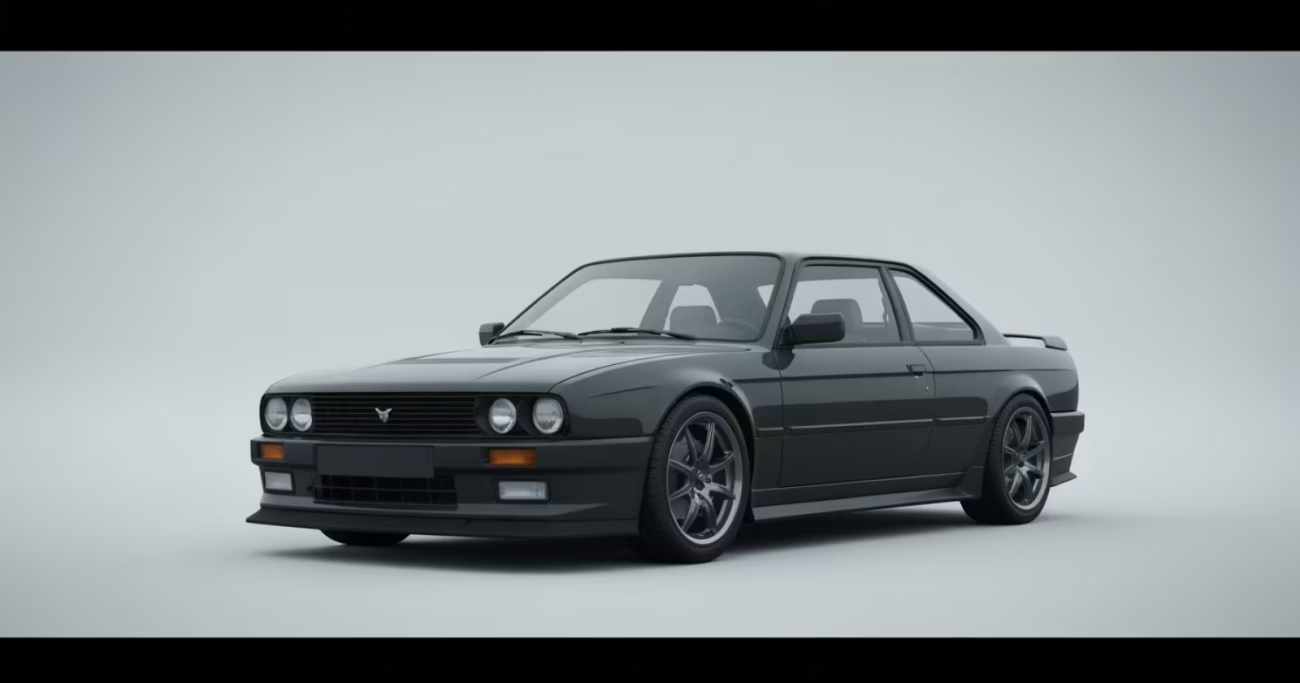
Mate Rimac once converted a beat-up 1988 BMW E30 into an electric car in his parents’ garage. Today, his company is building the single most expensive component inside BMW’s flagship electric sedan. That arc — from basement tinkerer to tier-one supplier for one of the world’s most storied automakers — is the kind of story the automotive industry rarely produces.
BMW has officially confirmed that Rimac Technology will supply the high-voltage battery systems for the upcoming facelifted i7, set to debut at Auto China 2026 in Beijing later this month. The partnership runs deep: five years of co-development, a dedicated €130 million ($150 million) production line, and a purpose-built facility that Rimac himself calls the largest industrial project in Croatian history.
A $150 million production line that cost more than the campus itself
Here’s the detail that stops you cold. The dedicated production line for the BMW i7 battery system carries a price tag of €130 million — roughly $150 million USD. That figure actually exceeds the €120 million ($139 million) it cost to build Rimac’s entire 90,000 square meter campus in Zagreb. The battery line alone cost more than the building that houses it.
That campus in the Jankomir district now produces completed battery packs at a rate of 300,000 modules per year, translating to around 50,000 full battery systems annually. Each pack is then shipped directly to BMW’s Dingolfing plant in Germany for final vehicle assembly. The logistics chain is seamless by design — Croatia to Bavaria, startup DNA to legacy automaker precision.
The cell technology gives the i7 a genuine performance jump
The new battery architecture combines BMW’s Gen6 cell chemistry with a Gen5 module-based structure. It uses 4695-format cylindrical lithium-ion cells — a larger-format cylinder that has been gaining ground across the premium EV segment. Compared to the prismatic cells in the current i7, the new pack delivers a 20% improvement in energy density.
BMW says the result will be “significantly increased range” and “much faster” charging. Those aren’t just marketing phrases in this context. The 4695 cell format enables tighter packaging and better thermal management, and the module architecture allows BMW to push closer to Neue Klasse-level performance without waiting for an entirely new platform. It’s a meaningful upgrade, not a cosmetic one.
At a glance
| Spec | Detail |
|---|---|
| Battery supplier | Rimac Technology, Zagreb, Croatia |
| Cell format | 4695-format cylindrical lithium-ion |
| Energy density gain | 20% vs current prismatic cell i7 |
| Production line cost | €130 million ($150 million) |
| Annual output | 50,000 full battery systems |
| Co-development period | 5 years |
| Global debut | Auto China 2026, Beijing |
Why Mate Rimac’s origin story makes this deal impossible to ignore
In 2009, a 21-year-old Mate Rimac converted an E30 BMW 3-Series to electric power because he wanted to prove the technology was faster than people assumed. That project went viral, attracted investors, and eventually became the foundation of a company that now controls Bugatti through the Bugatti Rimac joint venture. The full-circle moment with BMW isn’t just sentimental — it’s structurally significant.
Rimac Technology is no longer a niche hypercar builder. It is now a volume-capable tier-one battery supplier for one of the world’s largest premium automakers. The real story here is that a Croatian startup founded on a YouTube-famous E30 conversion has out-executed virtually every legacy supplier on battery technology. That’s not a fluke — it’s a structural shift in who controls the EV supply chain.
How it stacks up
| Model | Cell Format | Energy Density | Charging Speed | Edge |
|---|---|---|---|---|
| BMW i7 (facelifted, 2026) | 4695 cylindrical | +20% vs prior gen | Significantly faster | Rimac-developed Gen6 chemistry |
| Mercedes EQS 450+ | Prismatic pouch | Baseline | 200 kW peak | Larger pack capacity |
| Lucid Air Grand Touring | Cylindrical (proprietary) | Industry-leading | 300 kW peak | Longest range in class |
Why this matters
- Startups can now outpace legacy suppliers on core EV technology
- Croatia is emerging as a serious hub for advanced battery manufacturing
- BMW is accelerating Neue Klasse thinking without waiting for a new platform
The verdict
The facelifted BMW i7 was already going to be a notable update. With Rimac’s cylindrical cell architecture under the floor, it becomes something more — a test case for whether a boutique technology firm can deliver Neue Klasse-level performance inside a legacy platform. For BMW, the partnership buys time and technology simultaneously. For Rimac, it validates an entire industrial strategy built around being taken seriously at volume.
Enthusiasts and EV buyers paying close attention to the flagship luxury sedan segment should watch this debut closely. The real winner at Auto China 2026 in Beijing might not be the car itself — it might be the 21-year-old’s garage project that quietly became BMW’s most important supplier. If the range and charging numbers hit as promised, every competitor in the segment will feel the pressure immediately.
I’d strongly encourage anyone shopping in the large luxury EV space to wait for the official i7 specs before committing — the upgrade here is substantial enough to change the calculus entirely. Follow Rimac’s next moves too, because this company is nowhere near done disrupting the industry it helped reshape.
