
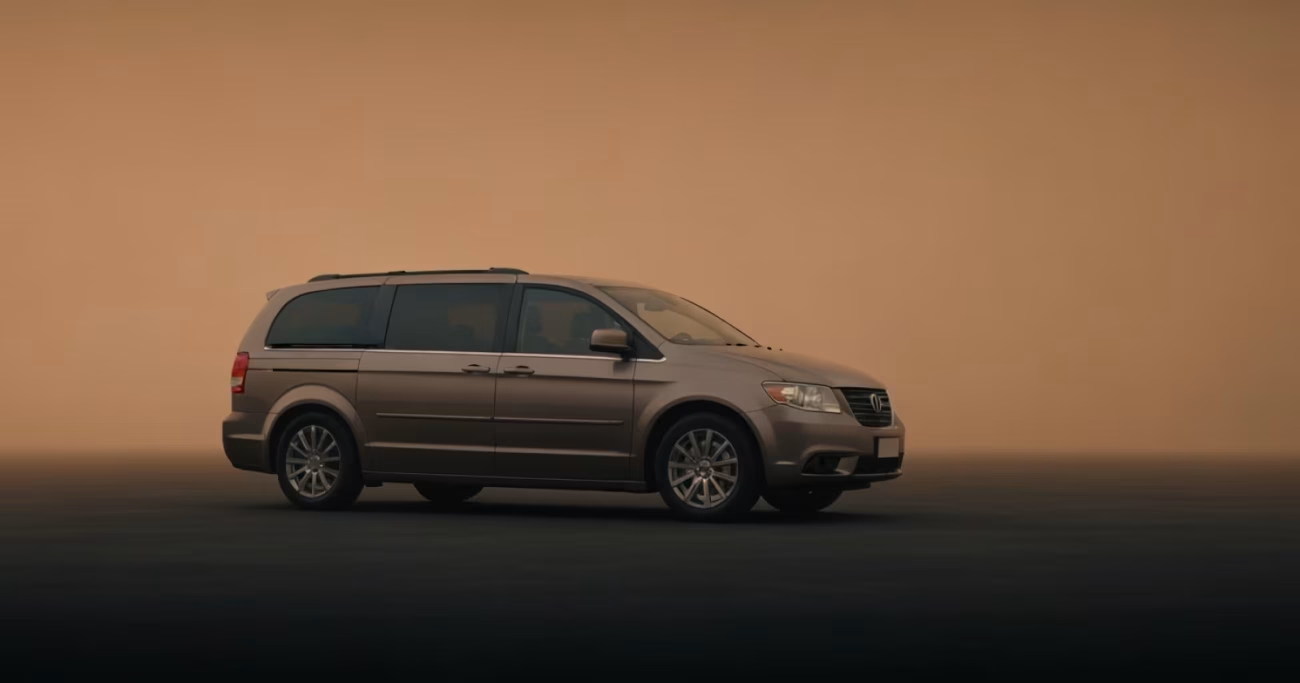
Chrysler’s new CEO just went on national television to tell America the minivan is back — and the brand’s own sales numbers immediately told a different story. In Q1 of 2026, Chrysler moved just 25,423 Pacifica and Voyager units combined, a 28% collapse compared to the same quarter a year earlier.
That’s the reality Matt McAlear is working against. And yet, he’s not just defending the minivan — he’s betting Chrysler’s entire future on one.
A single product brand is a risky bet in any market
When most automakers talk about a product strategy, they’re juggling sedans, crossovers, trucks, and EVs. Chrysler’s current strategy fits on a Post-it note: sell the Pacifica, hope the Voyager helps, repeat. That’s not a lineup — that’s a lifeline.
The brand hit its lowest sales volume in more than a decade back in 2024. Yes, there was a small recovery in 2026, but let’s be honest — growing off a historic low isn’t momentum, it’s math. McAlear framing that as a “resurgence” is optimistic to the point of being aspirational rather than analytical.
To his credit, McAlear didn’t dodge the challenge entirely. He acknowledged that Chrysler has “a lot of things in the works” and promised more details at Stellantis’ investor day on May 21. That’s something. But until those plans become real products, the brand is functionally a minivan company in a market that doesn’t really want minivans.
The minivan actually makes more sense than most people admit
Here’s where the story gets genuinely interesting. McAlear made a compelling case for the Pacifica that has nothing to do with press releases or brand positioning. He talked about a racecar driver friend who hauls a shifter kart in the back seat — no trailer needed. Another friend who keeps kiteboarding gear safely inside instead of strapped to a roof rack.
These aren’t niche use cases. They’re exactly the kind of practical scenarios where a three-row SUV simply cannot compete, no matter how much chrome trim it has. The sliding doors, the flat floor, the cavernous interior — a Pacifica does things a $77,000 Chevrolet Suburban cannot, and it does them for $48,269 on average.
Edmunds data backs that up hard. The average large SUV now costs nearly $29,000 more than the average minivan. In a market where affordability is increasingly the conversation, that gap matters. The real story is whether enough buyers can get over the stigma to notice it.
The numbers reveal how small this market really is
Minivans went from 1.7% of the U.S. market in 2017 to 2.4% in 2026. That’s nine years of growth resulting in less than a 1-point gain. You don’t build a brand revival — let alone an entire company identity — on a segment that moves that slowly.
What McAlear isn’t saying plainly is that Chrysler doesn’t just need minivan buyers to come back. It needs conquest sales from SUV owners, it needs younger families who’ve never owned a minivan to consider one, and it needs to do all of that without the marketing firepower of a Toyota or Honda. That’s a steep hill.
The 2027 Pacifica refresh is real, and the updates are meaningful. But a refreshed version of the same vehicle in the same tiny segment isn’t a transformation. It’s maintenance.
What happens on May 21 could change everything — or confirm the worst
Stellantis’ investor day is the event to watch. McAlear was careful not to reveal specifics, but the implication is clear: Chrysler is not content being a one-product brand indefinitely. Whether that means a new SUV, an EV play, or something else entirely, the May announcement could either energize the brand or expose just how thin the pipeline really is.
The pressure is real. Chrysler’s parent company Stellantis has been restructuring aggressively, and brands without a clear growth story don’t survive those conversations unscathed. McAlear knows this. His confidence in the minivan isn’t just marketing — it’s a survival argument dressed up as optimism.
| Metric | Detail |
|---|---|
| Q1 2026 Pacifica + Voyager Sales | 25,423 units |
| Year-over-Year Sales Change | -28% |
| Average Minivan Price (Edmunds) | $48,269 |
| Average Large SUV Price (Edmunds) | $77,215 |
| Minivan U.S. Market Share (2017) | 1.7% |
| Minivan U.S. Market Share (2026) | 2.4% |
| Next Major Chrysler Announcement | Stellantis Investor Day, May 21 |
If I’m being straight with you, I think McAlear is onto something real about minivan utility — and completely right that the SUV obsession has made people pay more for less practicality. The Pacifica genuinely is the smarter family vehicle in most real-world scenarios. But being right about a product and being right about a business strategy are two different things.
Chrysler needs more than a refreshed Pacifica to survive the next five years. If you’re in the market for a family hauler and you haven’t looked at the 2027 Pacifica yet, the investor day on May 21 is the perfect moment to pay attention — because what Chrysler announces next will tell you whether this brand is building toward something or holding on for dear life.
