
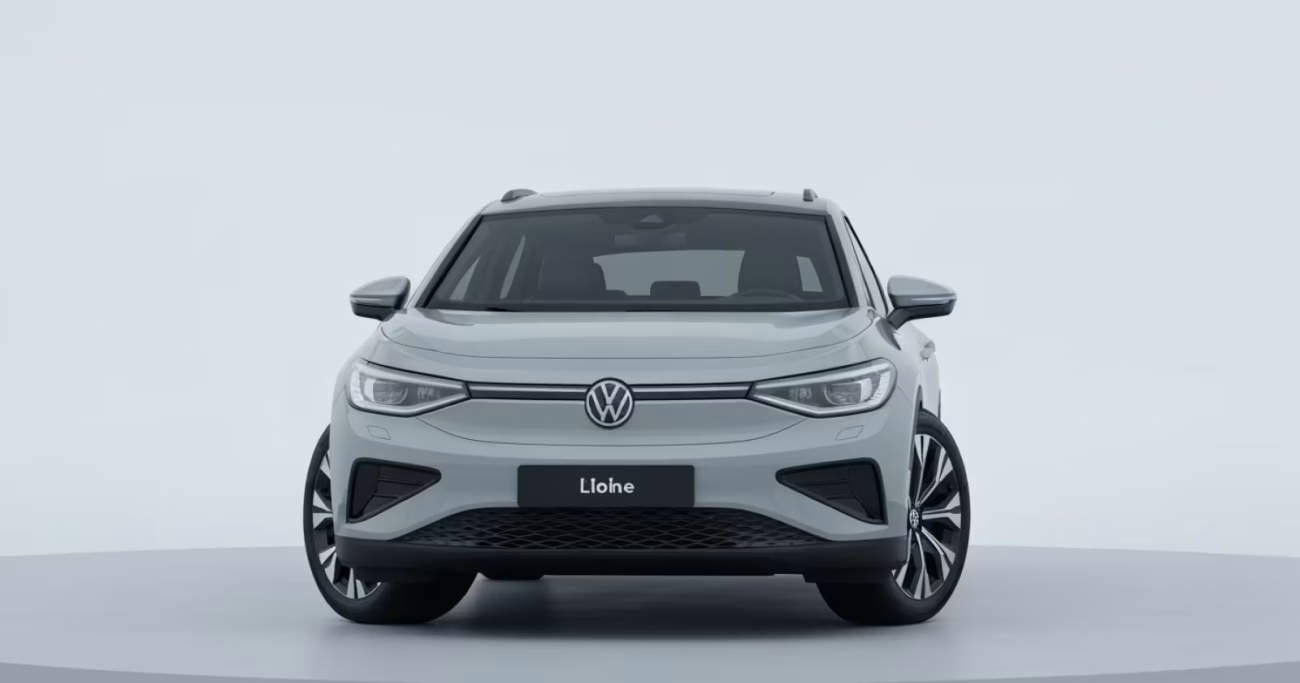
Only 248 people bought a Volkswagen ID.4 in the entire final quarter of last year. That number — not a typo, not a monthly figure, a full quarter — tells you everything you need to know about why VW just pulled the plug on its first long-range electric vehicle in America.
The Chattanooga, Tennessee assembly plant that builds the ID.4 is being cleared out to make room for the second-generation 2027 Atlas, and the last ID.4 will roll off that line within days. I’ve been watching this slow-motion story unfold for months, and honestly, the end feels both shocking and completely inevitable.
When 22,000 sales still isn’t enough to survive
Here’s what makes this story genuinely fascinating. VW actually grew ID.4 sales in 2026 — from 17,021 units to 22,373. That’s a real improvement, and under normal circumstances, you’d call that momentum. But the auto business doesn’t grade on a curve.
The Atlas, selling in two body styles, moved over 102,000 units in the same period. The three-row Atlas alone hit 71,044, and the Atlas Cross Sport added another 31,564. Against those numbers, even a healthy year for the ID.4 looks like a rounding error. Volkswagen had to make a choice, and the math wasn’t close.
Hyundai selling 47,000 Ioniq 5s is the real gut punch here
What stings most isn’t the Atlas comparison — that’s apples and oranges in terms of segment and buyer profile. What stings is the Hyundai Ioniq 5 number. In the same market, facing the same headwinds of reduced EV tax incentives and an increasingly crowded segment, Hyundai moved 47,000 Ioniq 5s. That’s more than double the ID.4’s full-year total.
Even in the brutal fourth quarter — when the ID.4 managed only 248 sales — the Ioniq 5 found 5,900 buyers. I’m not saying the Ioniq 5 is definitively a better vehicle, but the market is sending an unmistakable message about consumer preference, and Volkswagen no longer has the luxury of ignoring it.
| Metric | VW ID.4 (2026) | Hyundai Ioniq 5 | VW Atlas (2026) |
|---|---|---|---|
| Starting Price | $38,995 | ~$43,450 | ~$36,990 |
| 2026 US Sales | 22,373 | ~47,000 | 71,044+ |
| Q4 2026 Sales | 248 | ~5,900 | Not disclosed |
| Range (EPA) | 263 miles | 266 miles | N/A (gasoline) |
| Horsepower | 335 hp | 320 hp (AWD) | 269 hp |
| Future status | Discontinued (2026) | Continuing | New gen 2027 |
What Volkswagen isn’t saying about its EV retreat
VW is being careful with its language here, and I think that’s worth paying attention to. Executives at the New York International Auto Show went out of their way to confirm the ID. Buzz is not dead — it’s just skipping 2026 and coming back for 2027. They’ve also dangled the promise of “a future version of the ID.4” for America, with details to come later. That’s a lot of vague reassurance for a brand that just ended production of its flagship American EV.
The real story is cost. The ID.4 sits on a purpose-built EV platform with an expensive battery pack. The new Atlas shares significant DNA with its predecessor, keeping development and production costs lower. From a pure business standpoint, VW is retreating to where the margins make sense. The question is whether that retreat becomes permanent or just a strategic pause.
The ID. Tiguan rumor is the most important part of all this
Here’s the catch that most coverage is glossing over: there’s strong reason to believe the ID.4’s successor won’t even carry that name. I suspect — and industry pattern strongly suggests — that VW will rebrand it as the ID. Tiguan, aligning with the same naming logic that turned the ID.2 concept into the ID. Polo. That would be a smarter move than many people are giving VW credit for right now.
Concepts like the ID. CROSS and the tiny ID. EVERY1 hatchback have shown that VW’s design language is genuinely improving. If a properly styled, better-ranged ID. Tiguan arrives with competitive pricing and Volkswagen’s EV fundamentals sorted out, the brand could stage a real comeback in this segment. That’s a big if, but it’s not an unrealistic one. I’ll be watching that product reveal very closely when it eventually comes.
Why this matters
- EV tax credit reductions are visibly reshaping which models survive in America.
- Hyundai’s Ioniq 5 dominance signals a widening gap in EV brand trust.
- Dedicated EV platforms lose to shared platforms when margins tighten.
The verdict
The ID.4’s end isn’t a surprise, but the speed of the collapse in Q4 — just 248 sales — should shake Volkswagen’s leadership hard. This is a brand that spent years and enormous capital building an American EV narrative, and right now that narrative is on hold. The Atlas pivot is the right short-term call, but VW needs a credible, fast-tracked successor to prove this is a pause and not a retreat. If you’re shopping for an ID.4 right now, remaining dealer stock gives you negotiating power you rarely see on any EV. And if you’re watching VW’s electric future — keep your eyes on that ID. Tiguan announcement, because that vehicle will define whether Volkswagen matters in America’s EV market or fades into the background.
