
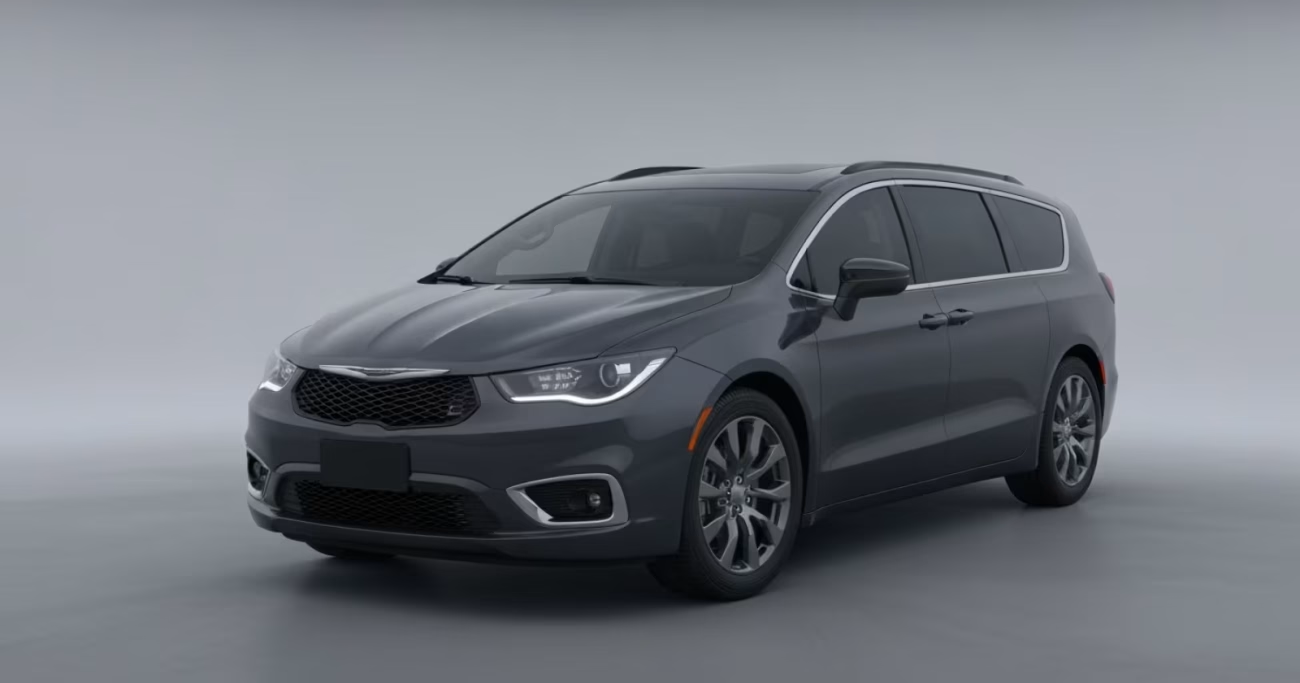
A major American automaker is about to sell exactly one vehicle — and its new CEO is calling that a winning strategy. The 2027 Chrysler Pacifica just debuted at the New York Auto Show, and whether Chrysler survives the next five years may genuinely depend on how well this single minivan sells.
I’ve been watching Chrysler struggle through years of product drought, leadership changes, and canceled concepts. But what’s happening right now feels different — and not entirely in a bad way. Here’s the full picture.
One car, one brand, no safety net
After the 2026 model year, the Chrysler Voyager is gone. That leaves the Pacifica as the only vehicle wearing the Chrysler badge in any showroom across the country. That’s not a product strategy — that’s survival mode. Most brands have entire lineups to absorb a slow quarter. Chrysler will have nothing to fall back on.
New CEO Matt McAlear, who also runs Alfa Romeo and Dodge simultaneously, spoke to CNBC during the Pacifica’s launch and projected genuine confidence. He pointed to year-over-year sales growth and a minivan segment that’s quietly gaining momentum. Whether that confidence holds when the Voyager disappears and the pressure lands entirely on one nameplate is the real question I keep coming back to.
Why $41,495 is actually a weapon in 2026
Here’s where things get interesting. Full-size SUVs with three-row seating — the vehicles that most families consider instead of a minivan — now routinely cost above $60,000, even from mainstream brands like Chevrolet and Toyota. The Pacifica starts at $41,495. That’s a gap of nearly $20,000 for comparable family hauling capacity.
The real story isn’t that minivans are making a comeback out of nostalgia. It’s that SUV prices have climbed so aggressively that the value equation has flipped. Every single minivan on the market posted sales growth last year, despite the broader SUV obsession that’s dominated the industry for a decade. Chrysler remains the segment’s biggest player — and the refreshed Pacifica is now positioned to press that price advantage harder than ever.
What the new logo and refresh actually signal
The 2027 Pacifica didn’t just get a mid-cycle nip and tuck. Chrysler introduced a redesigned version of its iconic winged logo alongside the reveal — and right now, that logo appears on exactly one vehicle. That’s either a bold branding statement or a reminder of how thin the lineup has become, depending on your perspective.
The refresh keeps the 3.6-liter Pentastar V6 producing 287 horsepower, paired to a 9-speed automatic transmission. The interior and cargo scores remain among the highest in the segment, and the feature set has been meaningfully updated. For a vehicle that’s been around since 2017 in its current generation, the Pacifica is holding up better than its critics expected — and the numbers back that up.
| Model | Starting Price | Engine | Horsepower | Segment Edge |
|---|---|---|---|---|
| 2027 Chrysler Pacifica | $41,495 | 3.6L V6 | 287 hp | Lowest price, largest brand |
| 2026 Toyota Sienna | ~$39,985 | 2.5L Hybrid | 245 hp | Only hybrid option |
| 2026 Honda Odyssey | ~$40,290 | 3.5L V6 | 280 hp | Reliability reputation |
| Chevy Tahoe (3-row SUV) | ~$62,000 | 5.3L V8 | 355 hp | Off-road, towing |
The future plans that may or may not actually exist
McAlear teased that more Pacifica variants are in development, pointing to last year’s Grizzly Peak Concept — an off-road-focused Pacifica that generated real buzz. A Stellantis investor presentation scheduled for May 21 is supposed to reveal more about Chrysler’s broader roadmap. I’ll believe it when I see a production date attached to something.
Here’s the catch: former CEO Christine Feuell had already confirmed plans for a Halcyon Concept-inspired sedan and a large three-row SUV. Stellantis then canceled the Airflow-based electric SUV at the last minute under new leadership. With Carlos Tavares out and Antonio Filosa now running Stellantis, every plan from 12 months ago has to be treated as tentative. An electric Pacifica was also on the roadmap — its status right now is genuinely unclear, and McAlear didn’t commit to it during his CNBC appearance.
Why this matters
- Minivan segment is growing as 3-row SUV prices push past $60,000
- Chrysler’s entire US brand identity now rests on one vehicle
- Stellantis leadership changes have put every future model plan in flux
The verdict
The 2027 Pacifica is a genuinely solid minivan carrying an impossible amount of weight for a historic brand. McAlear’s optimism isn’t baseless — the numbers and the pricing math actually support a real opportunity here. But a refreshed version of a 2017-generation vehicle, with an uncertain electric future and a canceled SUV in the rearview mirror, is a thin foundation for a brand revival. If you’re a family buyer who’s been priced out of the three-row SUV market, the Pacifica deserves serious attention right now. And if Chrysler doesn’t use this window to fund and launch new models quickly, no amount of minivan momentum will be enough to save it.
If you’re shopping for a three-row family vehicle in 2026, I’d strongly recommend getting behind the wheel of the 2027 Pacifica before you sign on a $60,000 Tahoe. Book a test drive, compare the sticker prices side by side, and let the math make the decision for you — because on pure value, the Pacifica’s argument is hard to dismiss.
