
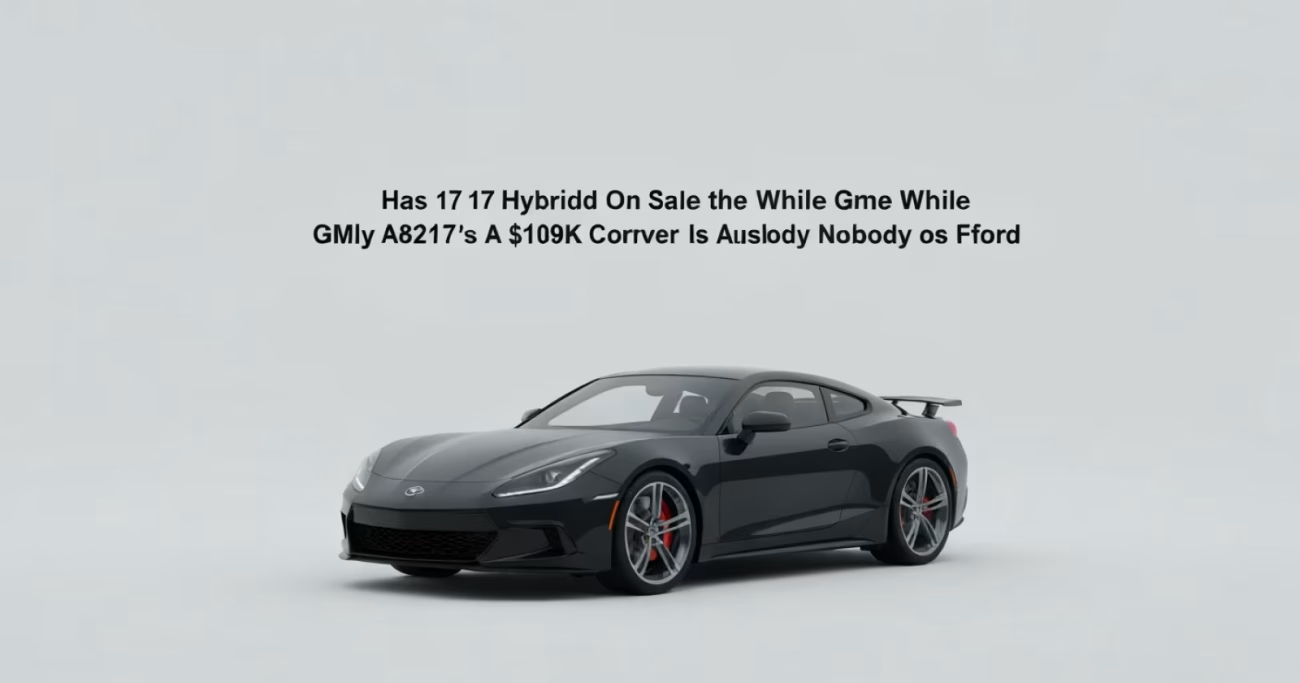
Gas just crossed $4 a gallon nationally, and in some states it’s creeping toward $6. If you’re a GM customer shopping for a fuel-efficient vehicle right now, the company’s answer is a two-seat sports car that starts at $108,600.
That’s not a joke. That’s the actual state of General Motors’ hybrid lineup in America in 2026 — and it tells a brutal story about where the company placed its bets and how badly those bets went wrong.
The Corvette E-Ray is GM’s entire hybrid strategy
The Corvette E-Ray is genuinely impressive as a performance machine. It makes 655 horsepower, does 0-60 in 2.5 seconds, and uses electric motors to power the front axle. But it returns just 16 mpg city. It seats two people. And it costs more than most Americans earn in two years.
That is GM’s only hybrid on sale in the United States. Not one compact crossover hybrid. Not one hybrid sedan. Not one plug-in hybrid of any kind. Just a six-figure sports car that almost nobody shopping for fuel efficiency will ever consider. The strategic hole here isn’t just embarrassing — it’s expensive.
Toyota’s 17-hybrid lineup is looking like pure genius right now
While GM was slashing hybrid development budgets and pivoting hard toward EVs, Toyota was quietly building the most comprehensive hybrid portfolio in automotive history. The company currently offers 17 hybrid models in the U.S. market — and that number deserves a moment to sink in.
That list includes the Camry, Corolla, Crown, Corolla Cross, Prius, Crown Signia, Highlander, Grand Highlander, Land Cruiser, RAV4, 4Runner, Tacoma, Tundra, Sequoia, and Sienna. Two of those — the Prius and RAV4 — are also available as plug-in hybrids. As gas prices surge, Toyota doesn’t need to pivot. It already built the pivot.
| Brand | U.S. Hybrid Models | PHEV Options | Cheapest Hybrid Entry | Best Hybrid MPG (Combined) |
|---|---|---|---|---|
| Toyota | 17 | 2 (Prius, RAV4) | ~$27,000 (Corolla Hybrid) | 52 mpg (Prius) |
| Hyundai | 5+ | Yes (Tucson, Santa Fe, Ioniq) | ~$28,000 (Elantra Hybrid) | 54 mpg (Elantra) |
| Kia | 5+ | Yes (Sportage, Niro) | ~$27,500 (Niro Hybrid) | 53 mpg (Niro) |
| Ford | 2 (Maverick, F-150) | None currently | ~$23,000 (Maverick) | 42 mpg (Maverick) |
| GM | 1 (Corvette E-Ray) | None | $108,600 | 16 mpg city |
Hyundai and Kia are capitalizing on exactly this moment
I’ve been watching hybrid sales numbers roll in over the past few months, and the Hyundai-Kia data is staggering. Kia reported hybrid sales surged 73% in a recent quarter — a new record. Hyundai had its best-ever March for hybrid sales, with the Elantra Hybrid up 141% year-over-year and the Sonata Hybrid up 107%.
The Santa Fe Hybrid alone jumped 47%. These aren’t marginal gains — they’re category-defining moments. While GM sits on the sidelines with a $109K halo car, Korean automakers are writing quarterly records because they had the foresight to build products people can actually afford and fill up without wincing.
Ford and Stellantis aren’t much better — but GM is worst
To be fair, GM isn’t suffering alone. Ford’s hybrid lineup is thin: the Maverick pickup and the F-150 Hybrid. The Escape Hybrid was killed off, and the Explorer Hybrid is reserved for police fleets and the occasional papal visit. Stellantis recently axed plug-in hybrids entirely, now offering only the new Cherokee Hybrid, though range-extended versions of the Ram 1500 and Grand Wagoneer are reportedly coming.
But GM’s position is uniquely precarious. At least Ford has the Maverick — a legitimately affordable hybrid at around $23,000 that speaks to everyday commuters. GM has nothing in that space. A customer walking into a Chevy dealership today asking for a fuel-efficient hybrid crossover walks back out empty-handed. That customer then walks across the street to a Toyota or Hyundai dealer and probably doesn’t come back.
Why this matters
- GM has zero hybrid options below $100K as gas climbs toward $6 in key states.
- Toyota’s 17-model hybrid buffer means high gas prices actually strengthen its sales position.
- Kia and Hyundai are converting this moment into record-breaking quarterly results right now.
The verdict
The EV pivot was supposed to be a leap forward. For GM, it turned into a gap — a massive, $4-per-gallon gap where an entire product category should exist. The Corvette E-Ray is a spectacular machine, but it is not a strategy. Families shopping compact crossovers, commuters calculating monthly fuel costs, and budget-conscious buyers looking for relief at the pump have nowhere to go inside GM’s showrooms.
Toyota built its ark before the flood. Hyundai and Kia built theirs too. GM is still looking for lumber. If gas prices hold above $4 through 2026 — and there’s no strong reason to believe they’ll fall quickly — every week without a mainstream hybrid offering is another week of market share quietly walking out the door.
If you’re in the market for a fuel-efficient vehicle right now, the math is simple: compare what Toyota, Hyundai, and Kia are offering at every price point, and then check what GM can offer you. The answer you get tells you everything about where these companies will stand two years from now.
