
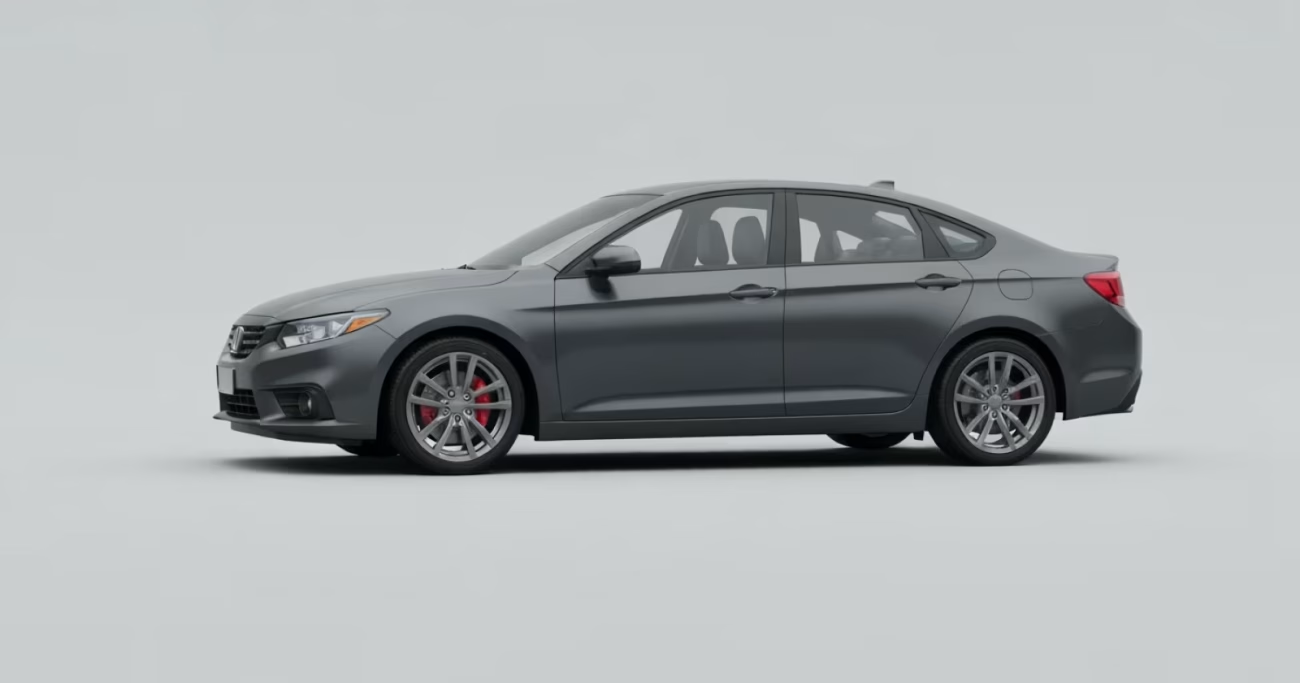
Honda and Acura just posted a car-sales rebound that stands out in a market dominated by SUVs. The real surprise is that sedans and hatchbacks are still doing the heavy lifting.
Affordable cars are suddenly getting attention again
Honda’s passenger-car lineup just reached its best month since 2021, and that matters because the market has been writing cars off for years. In May, Civic and Accord numbers moved hard enough to remind buyers that value still wins.
The real story is affordability. As prices keep climbing, a sedan like the Accord can still cover family duty without crossing into SUV money, and that’s exactly why buyers are coming back.
| Spec | Detail |
|---|---|
| Honda cars sold in May | 46,001 |
| Year-over-year change | +15.5% |
| Honda YTD car sales | 183,181 |
| YTD growth | +11.5% |
| Honda Accord sales | 18,688 |
| Accord year-over-year change | +33.3% |
| Accord hybrid sales | 9,414 |
Accord is still a family car bargain
The Accord’s 18,688 sales were its strongest month since 2023, and that is a very loud answer to the idea that midsize sedans are dead. Honda is moving them at a pace that still puts the car ahead of most of its own SUV lineup, with only the CR-V clearly out front.
Here’s the catch: the Accord isn’t winning because it is flashy. It is winning because buyers see a 192 hp turbo sedan with 32 mpg combined and room for real people, then compare it with what a similarly priced crossover delivers.
The Civic proves hatchbacks still matter
Civic sales reached 26,995 units, up 4.6% from a year ago and the best month since June 2021. That includes sedan, hatchback, and Type R variants, which means the nameplate is still broad enough to catch different buyers.
What Honda isn’t saying outright is that the Civic hybrid is now part of the formula too. Hybrid volume was nearly flat at 8,450, but it still gives the car line a fuel-saving edge that many shoppers want before they even step into an SUV showroom.
Acura shows buyers still want sedans
Acura’s car story is smaller, but it is still important. The TLX is essentially gone, with just 48 sales as production winds down, while the Integra pulled 2,968 buyers last month, up 67% year over year.
The real signal is that Acura’s only remaining car is growing while the brand’s smallest crossover, the ADX, beat it with 3,179 sales. That says sedan interest is alive, but it also shows how hard crossovers still press against every car in the showroom.
Why this matters beyond Honda and Acura
This is bigger than one Japanese brand having a good month. Toyota’s Camry is also surging, Hyundai sedans are improving, and the market is clearly responding to price pressure and fuel costs rather than styling trends alone.
That matters because automakers spent years assuming shoppers had permanently abandoned cars. Honda’s latest numbers suggest that when SUVs get expensive enough, the sedan and hatchback start looking smart again.
How it stacks up
| Model | May Sales | Power | Combined MPG | Edge |
|---|---|---|---|---|
| Honda Accord | 18,688 | 192 hp | 32 | Best blend of price, space, efficiency |
| Honda Civic | 26,995 | Up to 315 hp | Up to 48 | Broader lineup, stronger volume |
| Toyota Camry | Not disclosed here | 225 hp hybrid base | Up to 51 | Segment benchmark for sedan demand |
| Hyundai Elantra | Not disclosed here | 147 hp base | Up to 54 | Low-cost efficiency play |
Honda’s surge tells me the car market is not done with practical, lower-cost body styles. The buyers are still there, and they are reacting to real-world budgets instead of brand mythology. If SUVs keep climbing in price, sedans and hatchbacks like these will keep looking smarter.
If you follow the auto market, this is the kind of shift worth watching closely. The brands that keep affordable cars alive may be the ones that stay relevant when shoppers finally start comparing monthly payments instead of badges.
