
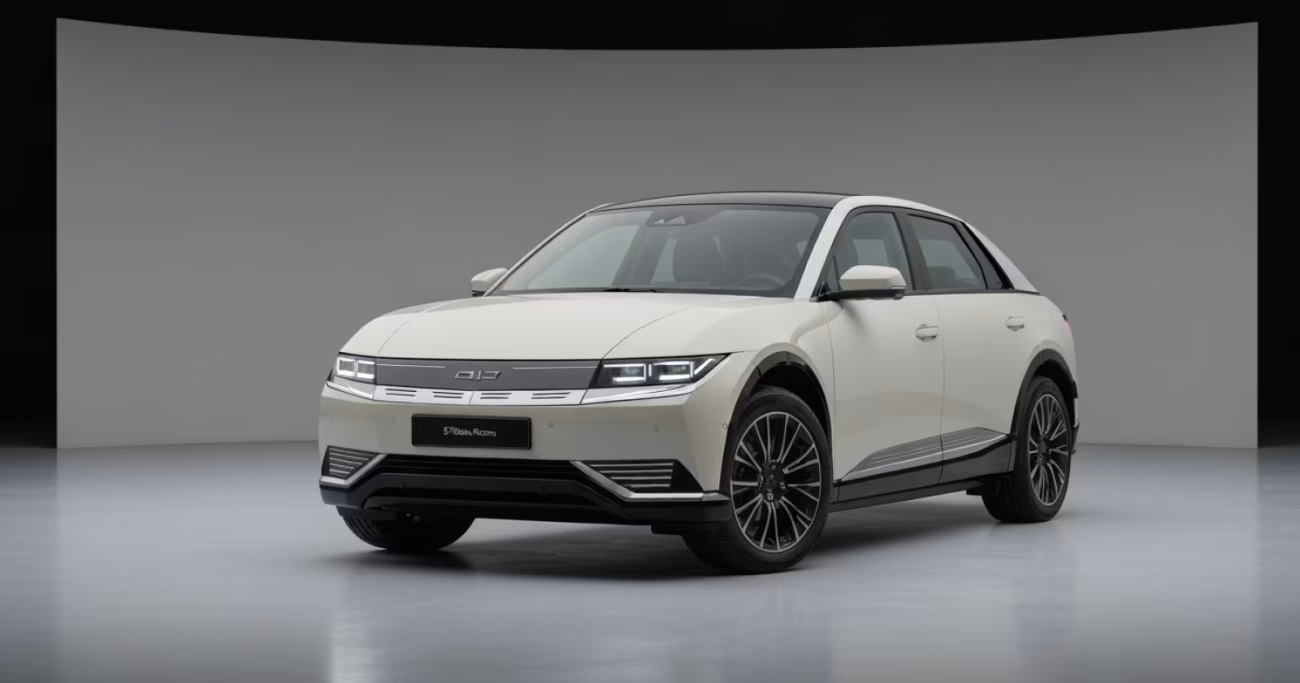
There is a certain electric thrill in spotting a near-production-ready test mule rolling quietly through Indian streets with barely a strip of camouflage to hide behind. The 2026 Hyundai IONIQ 5 facelift just gave us exactly that moment — and from what these fresh spy shots reveal, the wait for Indian buyers is measured in weeks, not months.
I have been tracking Hyundai India’s EV pipeline for a while now, and this facelift feels like a genuinely thoughtful upgrade rather than a routine cosmetic exercise. Here is everything the spy shots — shared by automotive enthusiast KarThik — tell us about what is coming.
What the Spy Shots Actually Reveal
When a manufacturer allows a test vehicle to roam Indian roads with minimal masking, it is almost always a sign that the design is fully locked and regulatory approvals are in their final stages. The IONIQ 5 facelift test mule caught in India wears very little disguise, and that candid confidence is itself a strong signal of an imminent launch.
The overall silhouette remains unmistakably IONIQ 5 — bold, boxy and refreshingly different from the rounded crowd. But look at the nose and you notice a revised front bumper with a wider air intake and a new V-shaped garnish that sharpens the character considerably. Around the back, the bumper has been reworked and the rear spoiler is now 50 mm longer than on the current model — a change that actively improves aerodynamic efficiency rather than just looking good. A new set of aero-optimized alloy wheels is also expected to complete the exterior story.
Dimensions: Bigger But Not Dramatically So
Globally, the updated IONIQ 5 measures 4,655 mm in length, 1,890 mm in width and 1,605 mm in height. The wheelbase remains unchanged at 3,000 mm, so the cabin space experience you already know is preserved. The length increase over the outgoing model is marginal — enough to improve aerodynamics and proportions without fundamentally changing the car’s footprint in tight Indian parking lots.
The parametric pixel design language that made the original such a head-turner is fully intact. This is still one of the most visually distinctive EVs you can park in any Indian metro city, and the facelift only refines that identity further.
Interior: Physical Buttons Are Finally Back
If there is one interior update I want to highlight personally, it is the return of physical buttons on the centre console. The earlier touch-sensitive controls for parking assist, heated steering wheel and ventilated seats were a genuine usability frustration — particularly on India’s characteristically uneven roads where hitting the right touch zone mid-bump is more luck than precision. Hyundai has listened, and that matters.
The wireless charging pad has also been relocated to the upper section of the centre console for easier access. The infotainment system steps up to Hyundai’s latest Connected Car Navigation Cockpit platform, bringing sharper graphics, over-the-air update support and wireless Android Auto and Apple CarPlay. A redesigned 3-spoke steering wheel with pixel-style lighting completes the cabin refresh.
Ride Quality, Refinement and Safety
Under the skin, Hyundai has done meaningful work that Indian buyers will feel on a daily basis. The facelift receives structural reinforcements alongside revised suspension tuning targeted at improving ride stability, reducing vibration and making the already-impressive cabin noticeably quieter. Long highway runs and Mumbai’s infamous pothole-riddled stretches should both benefit.
Internationally, the updated model also gets enhanced side-impact protection and a revised active safety suite. Whether every element of that safety upgrade reaches the India specification is still to be confirmed, but Hyundai India has historically been responsible about localizing the IONIQ 5 with meaningful equipment.
The Battery and Range: The Question That Matters Most
This is where things get genuinely exciting — and where the biggest uncertainty remains. Globally, the IONIQ 5 facelift introduces an 84 kWh battery pack with a claimed WLTP range of up to 570 km in rear-wheel-drive form. That is a substantial leap over the current India-spec model’s 72.6 kWh pack, which produces 217 PS and 350 Nm.
Whether Hyundai India will offer the larger battery at launch is the question every prospective buyer is asking. Given the IONIQ 5’s positioning at the premium end of India’s EV market, I cautiously expect at least one variant to carry the bigger pack — but official confirmation is the only thing that counts here.
| Specification | Current IONIQ 5 (India) | IONIQ 5 Facelift (Global) |
|---|---|---|
| Battery Pack | 72.6 kWh | 84 kWh (new option) |
| Power Output | 217 PS | TBA for India |
| Torque | 350 Nm | TBA for India |
| Claimed Range | ~481 km (est. WLTP) | 570 km (WLTP, RWD) |
| Overall Length | 4,635 mm | 4,655 mm |
| Wheelbase | 3,000 mm | 3,000 mm |
| Infotainment | Previous-gen system | ccNC — OTA, wireless AA/ACP |
Part of a Much Bigger Hyundai India Push
The IONIQ 5 facelift is not arriving in isolation. Hyundai India is executing one of its most aggressive product offensives in years. Updated versions of the Verna and Exter have already landed in 2026, and the pipeline ahead looks even more loaded — a new-gen i20, an i20-based crossover reportedly called the Bayon, a new India-manufactured electric SUV, next-gen Creta, a fresh MPV and even a lifestyle off-roader taking aim at the Mahindra Thar are all reportedly in various stages of development.
This is Hyundai playing the long game across ICE, hybrid and full EV segments simultaneously. The IONIQ 5 facelift arriving now keeps the brand’s premium EV credibility sharp while that larger India-made EV SUV is prepared for a more volume-oriented push later.
So When Is It Coming to India?
With testing clearly in its advanced final stages and the model already retailing in multiple international markets, a launch in the coming weeks is a reasonable and well-supported expectation. The minimal camouflage on these spy shots and the confidence with which Hyundai is running it on open Indian roads both suggest final approvals may already be through.
Pricing will be the decisive factor for most buyers. The current IONIQ 5 sits at the premium end of India’s EV landscape, and the facelift’s richer equipment list — especially if the 84 kWh battery makes it — will logically push numbers upward. But the value case strengthens in equal measure, and that is the trade-off worth watching closely.
If the IONIQ 5 facelift is on your radar, now is the perfect time to walk into your nearest Hyundai dealership, experience the current model one last time and get your name on a waiting list before the launch rush begins. Tell me in the comments which update excites you most — the longer range, the physical buttons or the new infotainment system — because this one is shaping up to be a genuinely compelling upgrade for India’s premium EV buyer.
