
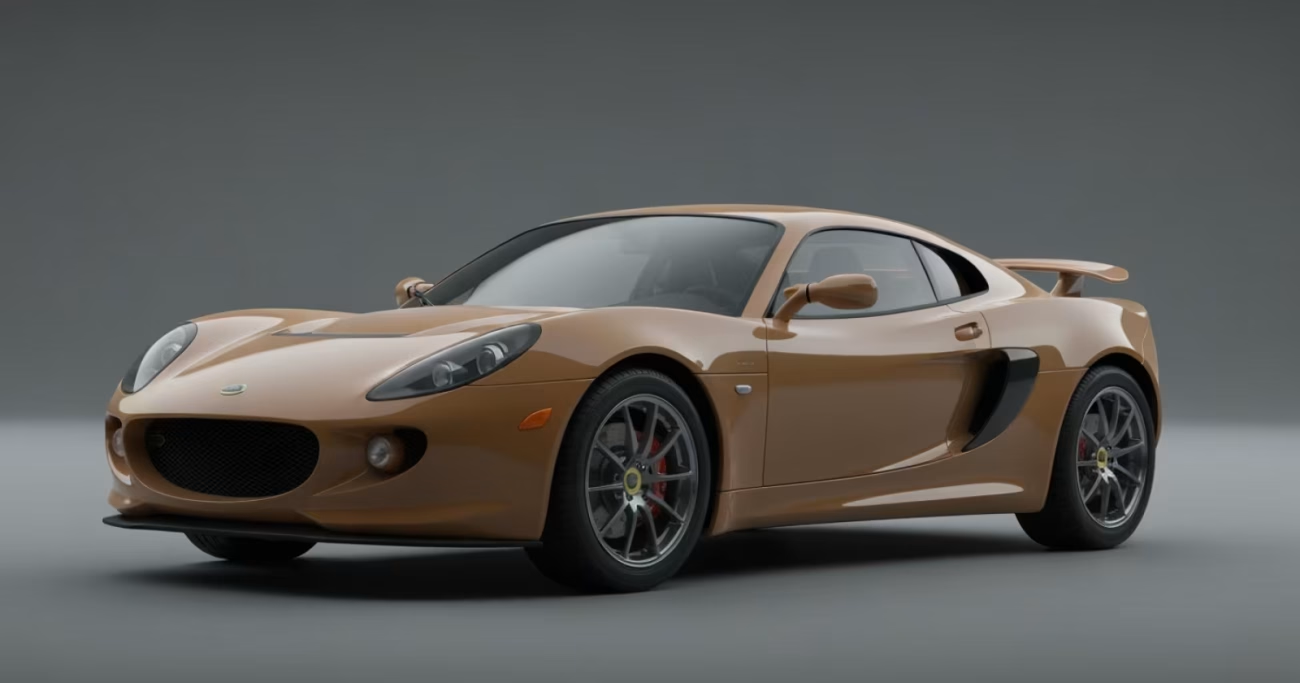
Most people think of Kia as a maker of sensible sedans and family crossovers — and for most of the brand’s history, that’s exactly right. But tucked inside one of the strangest chapters in 1990s automotive history is a genuine two-seat sports car that Kia actually built, badged, and sold to real customers.
It wasn’t a concept. It wasn’t a rebodied hatchback with a bodykit. It was a Lotus. Or rather, it was the next best thing — and right now, one pristine example is sitting on an auction block for less than the price of a decent used family sedan.
How Kia ended up with a British sports car in its lineup
The story starts in the early 1990s when Lotus decided to kill off the Elan M100. The car had been a commercial disappointment despite being technically brilliant — lightweight, sharp-handling, and fitted with double-wishbone suspension at all four corners. Lotus moved on. Kia did not.
The Korean automaker purchased the M100 production tooling outright and continued building the car under its own roof. In South Korea it was sold as the Kia Elan, a name that wore its origins openly. In Japan, however, the same car was marketed under a completely different identity: the Vigato. Same platform, same bones, different badge — and one of the more obscure automotive footnotes you’ll find anywhere in this era.
This specific Vigato has a story that makes it even rarer
The car currently listed on Bring a Trailer is a Japanese-market Vigato that was later imported to Canada in 2026. It shows just 53,000 kilometers on the clock — roughly 33,000 miles — which is a genuinely low number for a roadster pushing 30 years old. Most lightweight sports cars from the 1990s have either been thrashed or neglected. This one appears to have been neither.
There’s a catch worth knowing upfront: a previous owner swapped the original Kia badges for Lotus items, which is why the car looks, at first glance, like a standard Elan. Underneath those borrowed badges is something more interesting. It’s a Vigato — a car that most Lotus collectors have never seen and most Kia fans didn’t know existed. That combination of obscurity and authenticity is exactly what makes it fascinating.
The specs tell a story of compromises Lotus itself already made
| Spec | Detail |
|---|---|
| Engine | 1.8-liter DOHC naturally aspirated four-cylinder |
| Power output | 151 hp (113 kW) |
| Transmission | Five-speed manual |
| Drive layout | Front-wheel drive |
| Suspension | Double-wishbone all four corners |
| Odometer | 53,000 km (approx. 33,000 miles) |
| Current bid | $7,100 USD |
| Wheels | 16-inch OZ Racing, Yokohama tires |
The front-wheel-drive layout is the most controversial element here, and it’s honest to say that’s the reason the original Elan didn’t connect with the Lotus faithful. Purists wanted rear-wheel drive. What they got instead was razor-sharp steering, a genuinely low curb weight, and a chassis that Lotus engineers had actually tuned — which is more than most front-drivers of the era could say.
The 151 hp figure sounds modest in 2026 terms, but in a car this light, it works. Pair that with the double-wishbone geometry that Lotus carried over directly from its own design brief, and the Vigato drives nothing like a typical economy-based roadster. It’s a legitimate driver’s car wearing a very unusual name tag.
Why this auction matters beyond the bidding war
The real story here isn’t just about one low-mileage roadster. It’s about what gets forgotten when small-volume cars slip through the cracks of automotive history. The Vigato was never exported to the United States, never reviewed in major Western publications at scale, and never became a collector darling the way its Lotus twin did. It existed in a narrow window of time in two markets and then quietly disappeared.
I find it telling that the car needs its story explained before most enthusiasts even recognize what it is. The exterior is clean — white paint, black soft top, pop-up headlights, a subtle rear spoiler, and a single exhaust outlet. The interior is unapologetically 1990s: black seats with colorful cloth inserts, a Mitsubishi-branded stereo, and an aftermarket wood-rim steering wheel with a MOMO horn button. None of it tries to be something it isn’t. That honesty, paired with the mechanical substance underneath, is what makes the $7,100 current bid feel almost absurdly low for what’s on offer.
Whether it closes at $10,000 or pushes past $20,000, the Vigato represents a piece of automotive history that most people had no idea existed until this auction surfaced it. It belongs in a collection that values the genuinely strange over the conventionally desirable — and it carries a story that will outlast whatever hammer price it eventually reaches.
If you’re the kind of buyer who wants something that sparks a 20-minute conversation at every car meet, this is it. Search the Bring a Trailer listing now before the auction closes, because cars this specific and this well-preserved don’t surface twice.
