
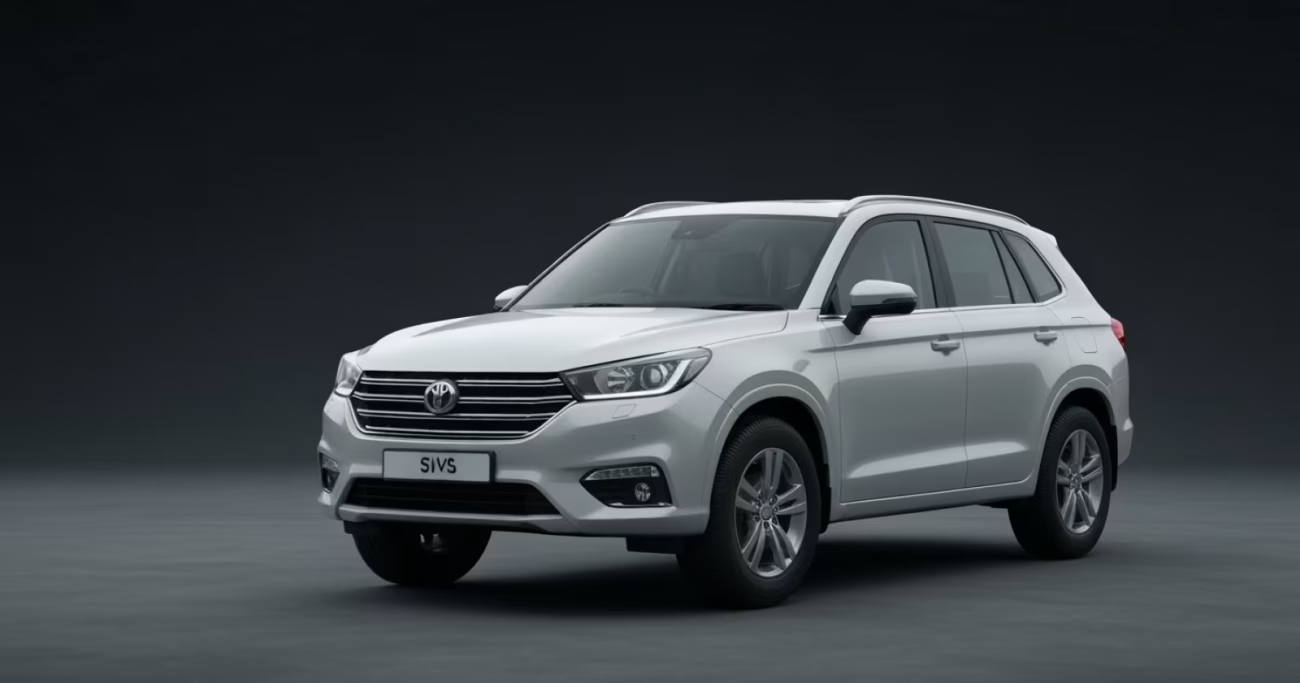
I keep seeing the same pattern in India’s car market: when Maruti moves, the whole market feels it. In May 2026, that movement turned into a record-breaking month that showed just how powerful SUV demand and export momentum have become.
Maruti Suzuki’s latest numbers are not just big, they are the kind that reset the conversation around volume leadership. The company crossed 2.42 lakh total sales in a single month, and that is the sort of figure that tells me demand is still running hot across hatchbacks, sedans, MPVs and utility vehicles.
What drove the record month
The biggest takeaway for me is that Maruti did not rely on one pocket of the market. It posted 2,42,688 total units in May 2026, which is 34.8% higher than the same month last year. Domestic passenger vehicle sales alone came in at 1,90,337 units, and that shows how strong its core India business remains.
I also find the export number especially interesting. Maruti shipped 41,914 units overseas in May 2026, up 34.3% year on year, which means the company is not only winning at home but also building serious global scale. For a brand so deeply tied to Indian roads, that is a meaningful signal.
SUVs and MPVs are doing the heavy lifting
When I look at the segment split, the story becomes even clearer. Maruti’s utility vehicle portfolio recorded 79,267 units in May 2026, growing 44.4% from last year. That is the engine room of the current success story, and it confirms that Indian buyers still want tall, practical, feature-rich family vehicles.
Models such as Brezza, Ertiga, Fronx, Grand Vitara and XL6 continue to keep Maruti competitive in an extremely crowded space. Add in Jimny, Invicto, Victoris and e Vitara, and the brand now has a much wider SUV and MPV footprint than it did a few years ago.
| Category | May 2026 Sales | Growth vs May 2026 |
|---|---|---|
| Total sales | 2,42,688 | 34.8% |
| Domestic passenger vehicles | 1,90,337 | 40.0% |
| Utility vehicles | 79,267 | 44.4% |
| Exports | 41,914 | 34.3% |
| Compact car segment | 97,830 | Strong year-on-year rise |
Compact cars are still very relevant
Even with SUVs stealing most of the attention, I would not ignore Maruti’s compact car strength. The compact car segment, which includes Alto, S-Presso, Baleno, Celerio, Ciaz, Dzire, Ignis, Swift and WagonR, delivered 97,830 units in May 2026. That is a huge number and proof that affordability, ease of use and efficiency still matter across Indian cities.
Within that group, Alto and S-Presso together contributed 16,275 units. The broader compact and mid-size set accounted for 81,555 units, which tells me Maruti still owns the everyday commuter space in a way very few brands can challenge consistently.
Why I think this matters for the market
For me, this sales report says a lot about where Indian buyers are heading in 2026. They want vehicles that can handle city traffic, weekend highway trips and family duties without making ownership complicated. That is exactly why Maruti’s mix of hatchbacks, sedans, SUVs and MPVs keeps finding takers.
I also see a broader industry message here. If a company with such a deep legacy can still post record monthly sales while pushing exports sharply higher, then competitors have to work harder on value, features and product freshness. The market is not waiting for anyone.
The first two months of FY2026-27 look strong
The company’s April-May 2026 performance also gives me confidence that this was not a one-off spike. Maruti recorded 4,82,334 total sales in the first two months of FY2026-27, compared with 3,59,868 units in the same period last year. That is a strong start, and it suggests the brand has entered the year with momentum on its side.
Domestic passenger vehicle sales for the period stood at 3,78,041 units, while exports reached 81,968 units. Those numbers show that Maruti’s strength is spread across India and overseas, which is exactly the kind of balanced growth investors and buyers both like to see.
My take on Maruti’s current position
What stands out to me is how Maruti has evolved beyond just being the go-to hatchback brand. Today, its growth is being powered by SUVs and MPVs just as much as by compact cars, and that is a smart response to how India is changing. Buyers want more road presence, more space and more versatility, and Maruti is giving them plenty of choice.
At the same time, the export rise tells me the company is staying globally competitive. In an industry where scale matters, Maruti’s ability to post record domestic numbers while sending out more than 41,000 vehicles overseas in one month is impressive.
If you are tracking the Indian auto market closely, this is the kind of performance worth watching month after month. I would keep an eye on how Maruti’s SUV lineup, especially its newer and faster-growing nameplates, continues to shape the rest of 2026.
If this kind of sales momentum interests you, keep following the monthly numbers closely and compare them with rival brands as the year goes on. I believe the next few months will reveal whether Maruti can keep this pace or whether the competition starts closing the gap.
