
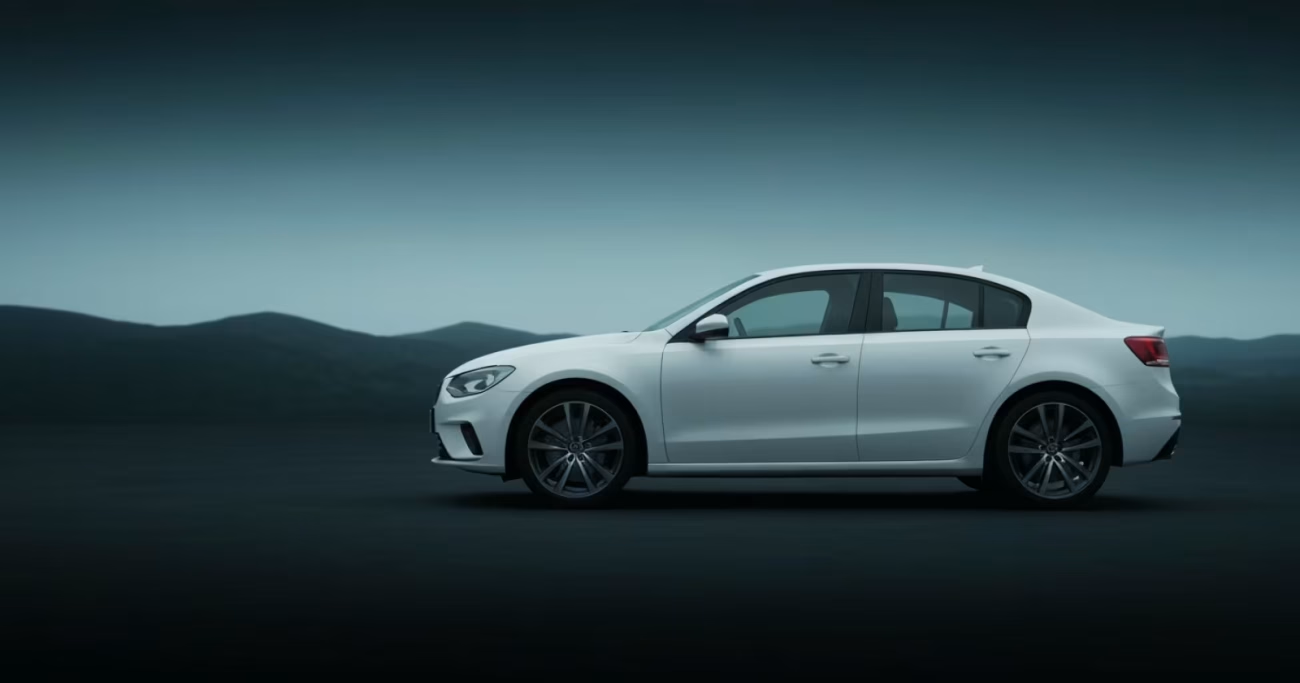
A company that builds everything from tiny 3-cylinder hatchbacks to a Lamborghini V12 somehow went an entire decade without offering a single full hybrid. That drought just ended, and the way Volkswagen engineered its comeback powertrain tells you exactly where the industry is heading.
VW just pulled the covers off a brand-new full-hybrid system, its first since the Jetta Hybrid quietly disappeared from showrooms back in 2016. The setup launches in Europe later this year in 2 vehicles, and the architecture borrows heavily from a playbook that Honda has been perfecting for years.
At a glance
| Spec | Detail |
|---|---|
| Hybrid type | Full hybrid, series-parallel |
| Gas engine | 1.5-liter TSI Evo2 turbo 4-cylinder |
| Electric motors | 2 (1 generator, 1 drive motor) |
| Battery | 1.6 kWh, floor-mounted |
| Transmission | Single-speed integrated module |
| Launch models | Golf Hybrid, T-Roc Hybrid (Europe) |
| US timeline | Unconfirmed, likely Tiguan and Atlas |
Why 2 electric motors change the formula for VW
Here’s the real story. Volkswagen didn’t just bolt an electric motor onto an existing transmission. The company packaged the gas engine, both electric motors, power electronics, a differential, and a single-speed gearbox into one compact module. That level of integration is what separates a serious hybrid effort from a half-hearted compliance play.
In daily driving, the second electric motor handles most of the wheel-spinning duties on its own. The 1.5-liter turbo engine cycles on and off in the background, acting more like a generator feeding that small 1.6 kWh battery tucked into the floor. When highway speeds make it more efficient, the gas engine takes over as the primary power source and the electric motor shifts to a boost role during acceleration. If that sounds familiar, it should. Honda’s been running a nearly identical strategy across its lineup for years.
What Volkswagen isn’t saying about power and efficiency
VW confirmed 2 power levels will be available and that both will beat the fuel economy of its existing 48-volt mild hybrids. Beyond that, the company has stayed quiet on actual horsepower and efficiency numbers. The 1.5-liter TSI Evo2 engine makes between 129 and 158 horsepower in other applications, so combined system output with the electric motors should push well beyond that. But until VW releases official figures, I’m left doing math on napkins.
The 3 drive modes offer some clues about the system’s range of capability. Eco mode caps output at 70% of maximum and disables the electric boost entirely, prioritizing efficiency above all else. Sport mode brings the gas engine online earlier and more aggressively, keeping more total power on tap. Comfort sits in the middle. An electric A/C compressor and electric brake servo mean the engine can stay off longer in city traffic, which should make low-speed driving noticeably quieter.
The one catch nobody in America is talking about
Neither the Golf Hybrid nor the T-Roc Hybrid is coming to the United States. Both are built on platforms that VW doesn’t sell here, so American buyers are watching from the sidelines for now. VW’s US arm confirmed last year that 2 hybrid models are planned domestically, and the smart money says those will be the Tiguan and Atlas. The Taos is an outside possibility.
Here’s the catch. CEO Kjell Gruner has stated that hybrid systems destined for the US market would need to be built domestically. That adds a manufacturing hurdle on top of the engineering work. The 3-row Atlas might also be too large for this particular powertrain module, which could mean a different, beefier hybrid system for VW’s biggest crossover. I wouldn’t expect anything on US dealer lots before late 2027 at the earliest, and even that feels optimistic given the production requirements Gruner outlined.
A decade-long gap that handed rivals the entire market
Think about what happened while VW sat out the hybrid segment. Toyota sold millions of RAV4 Hybrids. Honda refreshed the CR-V Hybrid into one of the best-selling vehicles in America. Hyundai and Kia built an entire hybrid empire across the Tucson, Sportage, and Santa Fe. Volkswagen watched all of it happen with nothing but mild hybrids and a growing EV portfolio that hasn’t caught fire with mainstream buyers the way the company hoped.
The integrated powertrain module approach is smart engineering, but VW is playing catch-up against rivals who have been refining their hybrid systems through multiple generations. Toyota is on its 5th generation hybrid architecture. Honda has years of real-world data on the exact series-parallel layout VW is now adopting. Coming in late means VW needs to be better, not just competitive, and the company hasn’t shown its cards on the specs that matter most.
How it stacks up
| Model | Engine | Electric motors | Battery | Edge |
|---|---|---|---|---|
| VW Golf Hybrid | 1.5L turbo 4-cyl | 2 | 1.6 kWh | Compact integrated module |
| Toyota Corolla Hybrid | 1.8L 4-cyl | 2 | 0.9 kWh | Proven reliability, massive scale |
| Honda Civic Hybrid | 2.0L 4-cyl | 2 | 1.0 kWh | Strong real-world efficiency |
| Hyundai Elantra Hybrid | 1.6L 4-cyl | 1 | 1.3 kWh | Aggressive pricing |
Why this matters
- VW finally competes in the fastest-growing powertrain segment globally
- US-built hybrid requirement signals long-term domestic manufacturing commitment
- Compact module design could scale across VW Group brands quickly
The verdict
Volkswagen’s return to full hybrids is overdue but architecturally promising. The dual-motor, single-module design shows the company studied what works at Honda and Toyota before drawing up its own system. American buyers who have been waiting for a hybrid Tiguan or Atlas should temper expectations on timing, because domestic production requirements add real complexity. If VW nails the efficiency numbers and gets this powertrain into US crossovers by 2027, it becomes a legitimate threat to the RAV4 Hybrid’s dominance. If it takes longer, the window keeps shrinking.
I’d keep a close eye on VW’s next round of announcements for official power and fuel economy figures. If you’re shopping for a hybrid crossover right now, Toyota and Honda still own this space. But if you’re the type who plans 18 months ahead, Volkswagen just gave you a reason to wait. Bookmark this page and check back when VW drops the US-spec details.
