
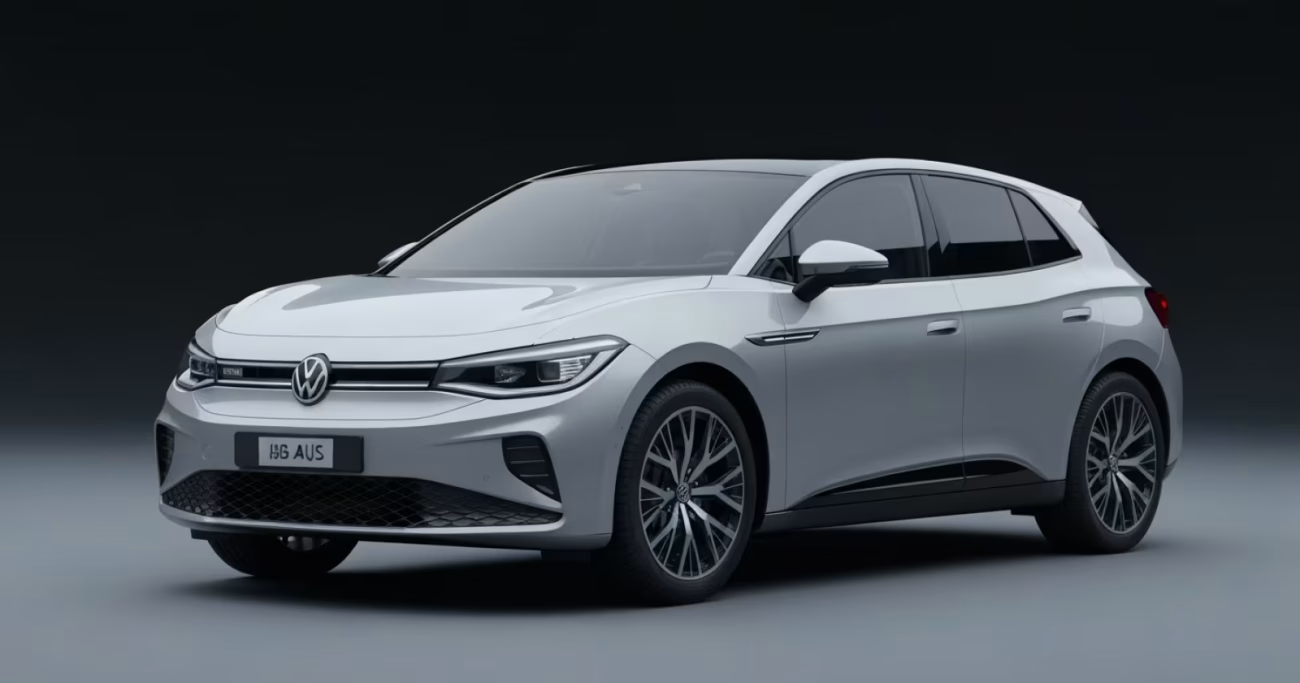
For most of the past three decades, Volkswagen called the shots in China — deciding what cars to build, what tech to include, and what Chinese buyers should want. That dynamic has quietly, completely reversed. The new ID.Aura SUV is the clearest proof yet that VW now needs China far more than China needs VW.
Spy photos released in early 2026 show a large electric SUV prototype carrying VW badges, a LiDAR pod above the windshield, and split headlights that feel far more Xpeng than Wolfsburg. Because in a very real sense, it is. This vehicle exists because a Chinese company handed Volkswagen the architecture it couldn’t build fast enough on its own.
The platform VW couldn’t develop fast enough itself
The ID.Aura SUV rides on the CEA platform — a next-generation electric architecture that VW co-developed with Xpeng, not with any European engineering partner. It supports 800-volt charging, which means dramatically faster replenishment times compared to VW’s older MEB-based models. That gap matters enormously in China, where competitors like BYD and NIO have offered 800V tech for years.
This isn’t a side project or a localized variant. The CEA architecture is what VW is betting its entire Chinese future on. The same platform underpins the ID. Unyx 08, which came through VW’s separate joint venture with JAC under the Volkswagen Anhui banner. The ID.Aura SUV, however, is a FAW-Volkswagen product — meaning VW is running parallel electric strategies through two different Chinese partners simultaneously.
What the prototype photos actually reveal about VW’s priorities
Looking at the images closely, the design language is more deliberate than revolutionary. There’s a fairly upright front fascia, bulging fenders, and what appears to be either a sunroof or full panoramic glass roof. Roof rails are visible, and the tailgate reads as conventional — which tells me VW is deliberately not trying to out-weird the local competition.
The LiDAR unit above the windshield is the most telling detail. It confirms that advanced driver assistance is built into the vehicle’s identity from the ground up, not bolted on as an afterthought. That system is called Carizon, developed jointly by VW and Horizon Robotics. This is the same Horizon Robotics that Chinese automakers have been partnering with for years — VW is buying into an ecosystem it didn’t create.
How the ID.Aura fits into VW’s scramble to stay relevant in China
China is no longer a growth market for Volkswagen — it’s a survival market. The brand’s Western EV lineup, anchored by the aging MEB platform, is losing ground to domestic brands that refresh faster and price more aggressively. The ID. series that impressed European buyers in 2021 looks slow, dated, and expensive compared to what BYD or Li Auto offers a Chinese buyer today.
The ID.Aura family is VW’s attempt to leapfrog that credibility gap in one move. A sleek low-slung sedan was previewed last year to establish the nameplate’s premium positioning. The large SUV follow-up — sitting above the Unyx 08 in the lineup — is clearly aimed at the segment where Chinese premium buyers actually spend money. VW knows the volume is in the SUV, not the sedan.
| Detail | Specification |
|---|---|
| Platform | CEA architecture (VW x Xpeng co-developed) |
| Charging voltage | 800V system |
| ADAS system | Carizon (VW x Horizon Robotics) |
| Sensor suite | LiDAR unit above windshield |
| Joint venture | FAW-Volkswagen |
| Body style | Large SUV (above ID. Unyx 08) |
| Market | China exclusive (for now) |
The uncomfortable truth about where VW’s best ideas now come from
There’s a version of this story VW’s PR team would prefer to tell — one where this is a visionary partnership between equals. The reality is harder to spin. Xpeng contributed the core electric architecture. Horizon Robotics contributed the AI backbone. FAW contributed the manufacturing scale. VW contributed the badge and the distribution network.
That’s not nothing. Brand equity and dealer infrastructure are genuinely valuable in China. But it does mean that VW’s most technically advanced cars in 2026 aren’t being engineered in Germany — they’re being engineered in Guangzhou and Beijing. And I think that shift is more permanent than most European auto executives are willing to acknowledge publicly.
The powertrain details, driving range figures, and pricing haven’t been confirmed yet. Those numbers will determine whether the ID.Aura SUV is a genuine competitive threat or just a well-dressed attempt to hold market share. But the architecture underneath it is already more advanced than anything VW is selling in Europe right now.
If you’ve been watching the European EV market wonder why VW’s Chinese lineup seems to be pulling ahead, this is exactly why. The talent pipeline, the tech partnerships, and the pace of iteration have all shifted east. Following the ID.Aura’s development closely isn’t just interesting from a car enthusiast perspective — it’s a window into how fast legacy automakers are having to reinvent themselves to stay in the game.
