
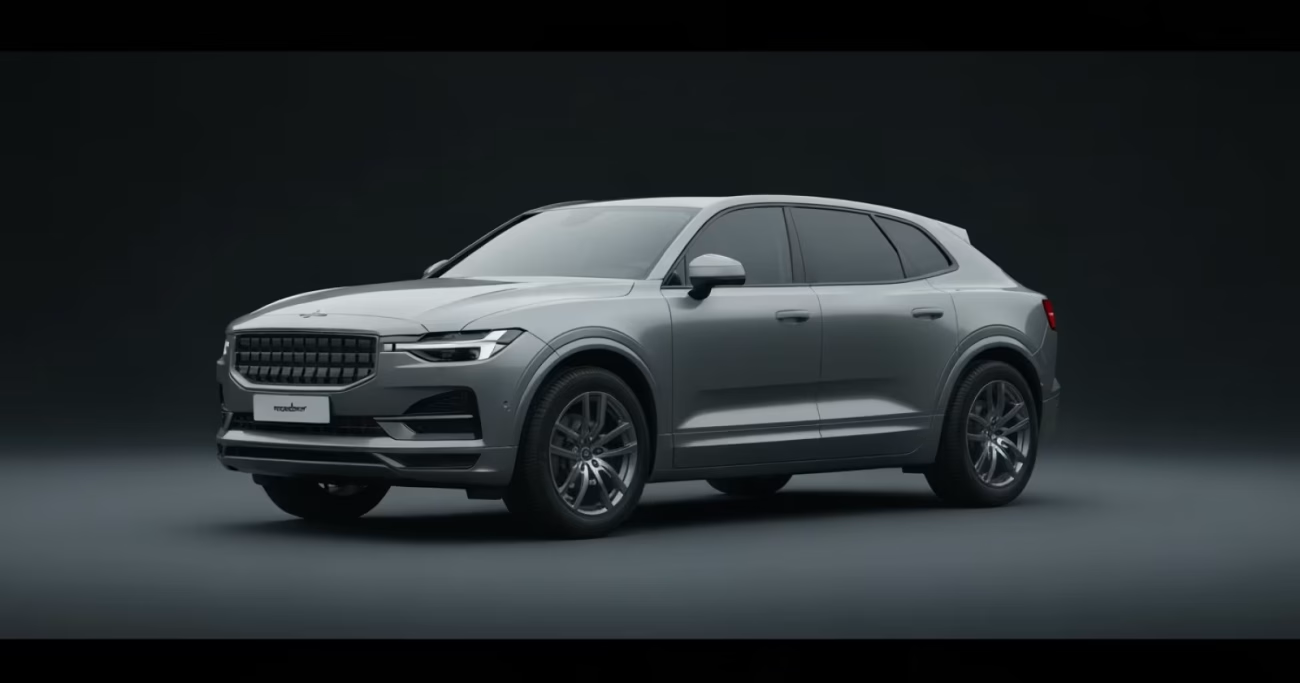
The United States just became the only country building one of Europe’s most talked-about electric SUVs. And the reason has everything to do with a tariff wall so steep, keeping Chinese production running simply stopped making financial sense.
Polestar has confirmed it will shut down Polestar 3 manufacturing at Geely’s Chengdu facility in China before the end of 2026, consolidating all production at Volvo’s Ridgeville plant in South Carolina. For a brand already drowning in red ink, this isn’t just a logistics update — it’s a survival move.
A $73,400 SUV caught in a trade war crossfire
The Polestar 3 has been built simultaneously in China and South Carolina since mid-2024. That dual-continent setup made sense when global trade was predictable. It makes zero sense now, with the current US administration slapping 100–102.5% tariffs on vehicles and auto parts imported from China.
Polestar officially describes the consolidation as a bid to “drive efficiencies.” That’s a carefully worded way of saying: selling a $73,400 electric SUV while absorbing triple-digit import taxes on half your production is not a viable business model. The math forced the decision, not corporate strategy.
| Detail | Spec / Figure |
|---|---|
| Base Price | $73,400 |
| Horsepower | 489 hp |
| Torque | 620 lb-ft |
| Drivetrain | All-Wheel Drive |
| US Production Site | Ridgeville, South Carolina |
| China Tariff Rate | 100–102.5% |
| Volvo Plant Investment | $1.3 billion over 10 years |
| Polestar Cumulative Losses | $8 billion since founding |
Volvo’s $1.3 billion bet on American manufacturing is finally paying off
Volvo’s Ridgeville facility has quietly become one of the most strategically important EV plants in North America. The Swedes have poured $1.3 billion into it over the last decade, and it already produces the Volvo EX90 electric SUV on the same SPA2 platform shared with the Polestar 3. Adding full Polestar 3 volume gives the plant a reason to keep scaling.
Current annual capacity sits at 150,000 units, but that number is expected to grow. Volvo has plans to add the midsize XC60 and an unnamed next-generation hybrid model to the Ridgeville line before 2030. The real story here isn’t just Polestar dodging tariffs — it’s Volvo quietly building one of the most diversified EV and hybrid production hubs in the American Southeast.
What Polestar isn’t saying about its $8 billion hole
Here’s the catch: this production shift was buried inside a much more alarming announcement. Volvo is converting $274 million into additional Polestar shares to help cover the brand’s mounting financial losses. That follows $300 million in fresh financing already confirmed last year. In total, Geely and Volvo have committed to a $661 million shareholder loan expected to be fully drawn by December 2031.
Polestar has accumulated an estimated $8 billion in cumulative losses since it was founded. It posted $1 billion in operating losses in 2026 alone. Low consumer EV demand, rising MSRPs, a crowded premium market, and the cost of expanding its model lineup have all hit simultaneously. A further $65 million debt-to-equity conversion from Volvo is expected in Q2 2026 — none of which changes Volvo’s stake in Polestar, which holds steady at around 19.9%.
The one model keeping Polestar’s US ambitions alive
With production shifting to South Carolina, the Polestar 3 becomes the only Polestar model built in the United States. The Polestar 2 is made in China. The Polestar 4’s US-spec version comes from South Korea. The upcoming Polestar 5 will be built in China, and the Polestar 7 is slated for production in Slovakia. That makes the Polestar 3 the brand’s sole American-made product — a fact that carries real weight in today’s political and trade environment.
For buyers already considering the Polestar 3, “Made in USA” is now a genuine part of the pitch. With 489 hp, 620 lb-ft of torque, and a sharp interior loaded with tech, the SUV has always had the hardware to compete. The South Carolina stamp gives it an argument its rivals built overseas simply can’t make right now.
If you’ve been watching the Polestar 3 from the sidelines — waiting to see whether the brand stabilizes and whether US production makes long-term ownership more practical — this move deserves your attention. The tariff math now works in buyers’ favor, and Volvo’s continued financial commitment signals this isn’t a brand quietly preparing to exit the market. Get familiar with what Ridgeville is building, because the next chapter of American EV manufacturing is being written in South Carolina.
