
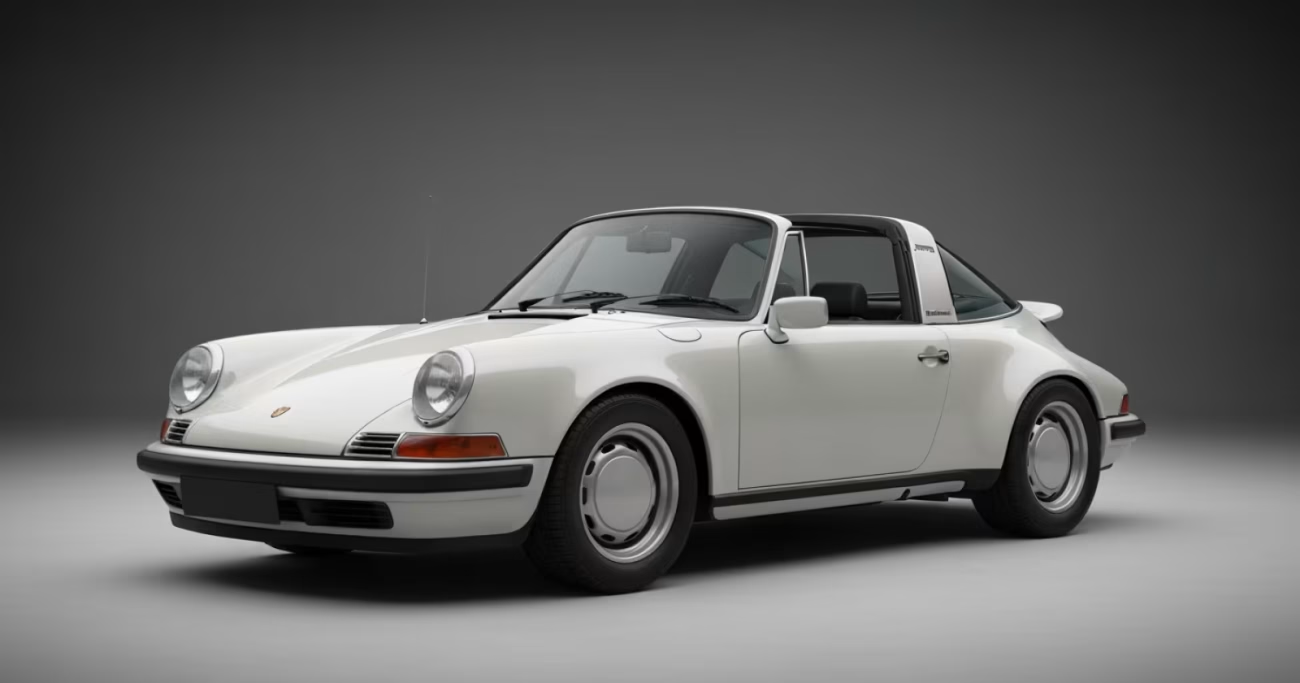
Long before restomods became a trend and boutique Porsche builders became fashionable, there was one name serious collectors already knew. That name was Ruf — and this particular car is proof of why it still commands reverence decades later.
A 1985 Porsche 911 Carrera Targa, converted by Ruf to BTR III specification in 1990, has surfaced for sale through PCarmarket in La Verne, California. It is, according to the seller, the only example of its kind ever produced. After a comprehensive restoration completed just recently, it looks and drives like Ruf intended it to all those years ago.
Ruf was doing this before it was cool to do this
Most enthusiasts today associate Ruf with the legendary CTR Yellowbird — the car that famously lapped the Nürburgring faster than anything else in 1987 and later sold for $6.1 million, a staggering 41 times its original value. But Ruf’s story goes much deeper than one headline car. Founded in the late 1930s, the firm spent decades quietly transforming Porsches into something far beyond what Stuttgart sent out the factory door.
The BTR III specification was part of that broader mission. When Ruf converted this Targa in 1990, they weren’t just bolting on cosmetic parts. They fitted a new front spoiler, a Turbo-inspired rear spoiler, and a set of 17-inch Ruf Speedline wheels. Under the rear lid, a 3.4-liter turbocharged flat-six replaced the standard unit, pushing output to 408 hp — substantial by any standard for an air-cooled 911 of that era, and genuinely savage by 1990 benchmarks.
One owner held this car for over three decades — that matters
What makes this Targa particularly compelling isn’t just the specification. It’s the ownership history. The original owner kept the car from new all the way until 2024 — a span of roughly 39 years. In the world of collector Porsches, that kind of provenance is increasingly rare and increasingly valuable. Single-owner cars tell a cleaner story, and buyers pay a premium for that story.
In 2024, the car changed hands and went straight into a restoration by SV Automotive Engineering. The scope of that work was thorough. The exterior received a full repaint. Suspension upgrades were made throughout. The brakes were overhauled. Inside, new carpeting was installed and multiple components were either refreshed or replaced. The engine received arguably the most intensive attention — rebuilt with new pistons, cylinders, valves, valve springs, retainers, bearings, fuel and oil lines, and revised timing. Even the turbocharger and wastegate were rebuilt from scratch.
The original details they kept tell a story all on their own
Here’s what separates a great restoration from a merely thorough one: knowing what not to touch. SV Automotive Engineering preserved several key original features that define the car’s character. The Ruf air conditioning system remains. The Blaupunkt cassette stereo — fitted with upgraded speakers — is still in place. The leather-wrapped Ruf steering wheel sits exactly where it always has. These details aren’t just charming period pieces. They’re authentication markers that confirm this car’s identity in ways no document alone can.
The odometer tells its own story too. Since new, the Targa has covered just 46,100 km — approximately 28,645 miles. Since the restoration was completed, it has been driven a mere 48 km, or around 30 miles. For a car built to be driven hard, that restraint is either admirable or agonizing depending on your perspective. Either way, the mechanical condition reflects those conservative numbers.
At a glance
| Spec | Detail |
|---|---|
| Base vehicle | 1985 Porsche 911 Carrera Targa |
| Conversion year | 1990 by Ruf Automobile |
| Specification | BTR III — the only one ever built |
| Engine | 3.4-liter turbocharged flat-six |
| Output | 408 hp |
| Transmission | 5-speed manual |
| Total mileage | 46,100 km (28,645 miles) |
| Miles since restoration | 48 km (30 miles) |
| Current location | La Verne, California |
| Seller | PCarmarket |
Why a one-of-one tag carries real weight in this market
The phrase “one of one” gets thrown around loosely in the collector car world, but in this case it carries genuine weight. The BTR III conversion was not a production run. It was a singular commission — this car and no other. When Ruf did the work in 1990, there was no second example built to the same specification. That exclusivity, layered on top of Ruf’s increasingly blue-chip collector status, makes this Targa something the market rarely sees.
For context, consider what the CTR Yellowbird fetched at auction: $6.1 million, against an original value that made the result look almost absurd. The BTR III is a different animal — less famous, more obscure — but that obscurity has a way of becoming an asset once the right buyer finds the right car. The real story here is that Ruf’s lesser-known conversions are starting to get the same serious attention as its headline models, and a fully restored, single-owner, one-of-one example is precisely the kind of car that drives that reappraisal.
I’d argue this Targa sits at the intersection of everything the serious air-cooled market is chasing right now: documented provenance, mechanical integrity, Ruf credentials, and a body style — the Targa — that has its own devoted following. If you’ve been watching the Ruf collector market develop over the past five years, this one should already be on your radar. Don’t let the relative obscurity of the BTR III spec fool you — that’s exactly the kind of detail that tends to look very obvious in hindsight.
