
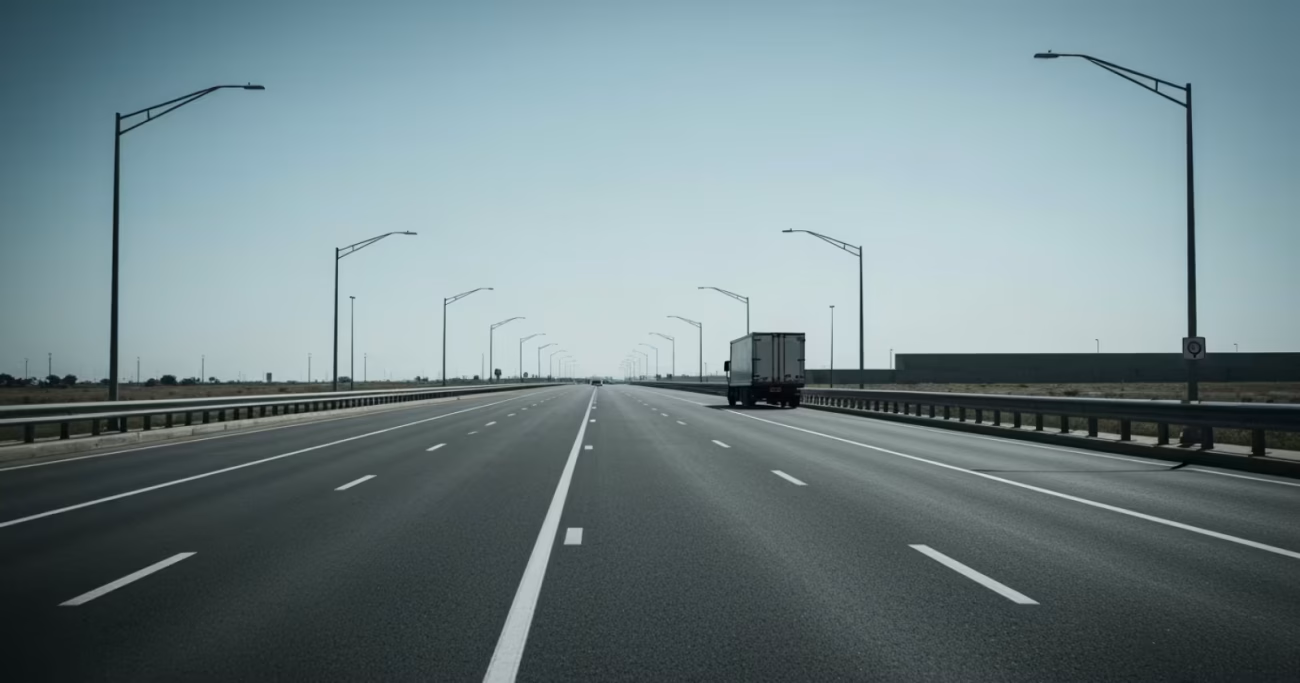
There is exactly one road in the United States where you can legally drive 85 mph, and right now, some of the most aggressive technology companies in the world are quietly moving in on it. What started as a quirky Texas toll road experiment back in 2012 is turning into something far bigger — a real-world proving ground for driverless freight, and the first American highway that might become more famous for robots than for speed.
I’ve been following the autonomous vehicle space for years, and Texas State Highway 130 is the story that keeps coming back around. It deserves a lot more attention than it’s getting.
America’s fastest legal road sits between Austin and Seguin
Texas SH-130 is a 41-mile toll road connecting Austin to Seguin. It’s not exactly a tourist destination. But in 2012, the state gave it something no other American highway has ever had — an 85 mph posted speed limit, the highest in the country. Safety advocates predicted chaos. The data never backed them up.
Instead, the road quietly built a reputation as a reliably fast, lower-traffic alternative to the congested I-35 corridor. That combination — high legal speeds, lighter traffic density — turns out to be exactly what autonomous vehicle developers are looking for when they want to push their systems hard in the real world.
Einride, Aurora, and Waymo are already circling this corridor
Companies like Einride, Aurora Innovation, and Waymo aren’t just theorizing about SH-130. They’re either already operating autonomous vehicles along the corridor or actively planning deployments in the near future. That’s not a small thing. These are Level 4 and Level 5 systems — meaning no human required to take the wheel, not just a driver with their hands hovering nervously above it.
According to research from Kavout, the SH 130 Concession Company is developing a next-generation rest stop specifically engineered for autonomous trucks. We’re talking high-capacity EV charging infrastructure and specialized docking systems built around the needs of unmanned freight vehicles. That kind of dedicated infrastructure investment signals this isn’t a short-term experiment.
| Feature | Detail |
|---|---|
| Highway | Texas State Highway 130 |
| Posted Speed Limit | 85 mph (137 km/h) — highest in the US |
| Length | 41 miles |
| Route | Austin to Seguin, Texas |
| Speed Limit Established | 2012 |
| Autonomy Level Targeted | Level 4 and Level 5 (no human driver required) |
| AV Authorization Applications | Texas DMV accepting from May 2026 |
| Key Infrastructure Planned | Autonomous truck rest stop with EV charging and docking |
The Texas DMV just opened the door in May 2026
Here’s where the timeline gets interesting. The Texas DMV began accepting applications for commercial automated vehicle authorization in May 2026. That’s the regulatory green light that changes everything. Before that date, fully driverless freight operations on public roads existed in a gray area. Now there’s a formal pathway, and SH-130 is positioned directly in front of it.
Most autonomous trucking companies are still running safety drivers onboard — that’s the honest reality of where the technology sits today. Fully driverless freight at scale is still limited. But the authorization framework now exists in Texas, and SH-130’s unique speed profile gives operators something no other American highway can offer: a legally fast environment where autonomous systems can be stress-tested at the kind of speeds that actually matter for long-haul freight efficiency.
What this road is really becoming is a blueprint
I think the bigger story here isn’t just about one toll road in Texas. It’s about what happens when regulatory permission, purpose-built infrastructure, and aggressive private investment land in the same place at the same time. SH-130 is starting to look less like a highway and more like a controlled experiment running at highway speed.
For more than a decade, Texas 130 held a single, simple record: fastest legal road in America. That was its whole identity. But the infrastructure being built around it now — dedicated autonomous truck stops, EV charging at scale, formal state authorization — points toward a different kind of legacy. The road that was built for humans to go fast is quietly being retrofitted for machines that don’t need permission to be precise.
Why this matters
- Texas just created the regulatory framework that could make SH-130 the first fully autonomous freight corridor in the US.
- High-speed, low-traffic roads are exactly the environment autonomous systems need to prove real-world capability.
- Dedicated AV infrastructure investment signals long-term commercial commitment, not just a pilot program.
The verdict
If you drive SH-130 today, it still feels like a regular toll road with an unusually generous speed limit. But the companies quietly setting up operations along that 41-mile stretch are playing a much longer game. Aurora, Einride, and Waymo aren’t here for the scenery — they’re here because this road lets them push systems to speeds that most American highways still legally prohibit. The next time you see a truck on SH-130, look twice. The seat behind the wheel might already be empty.
