
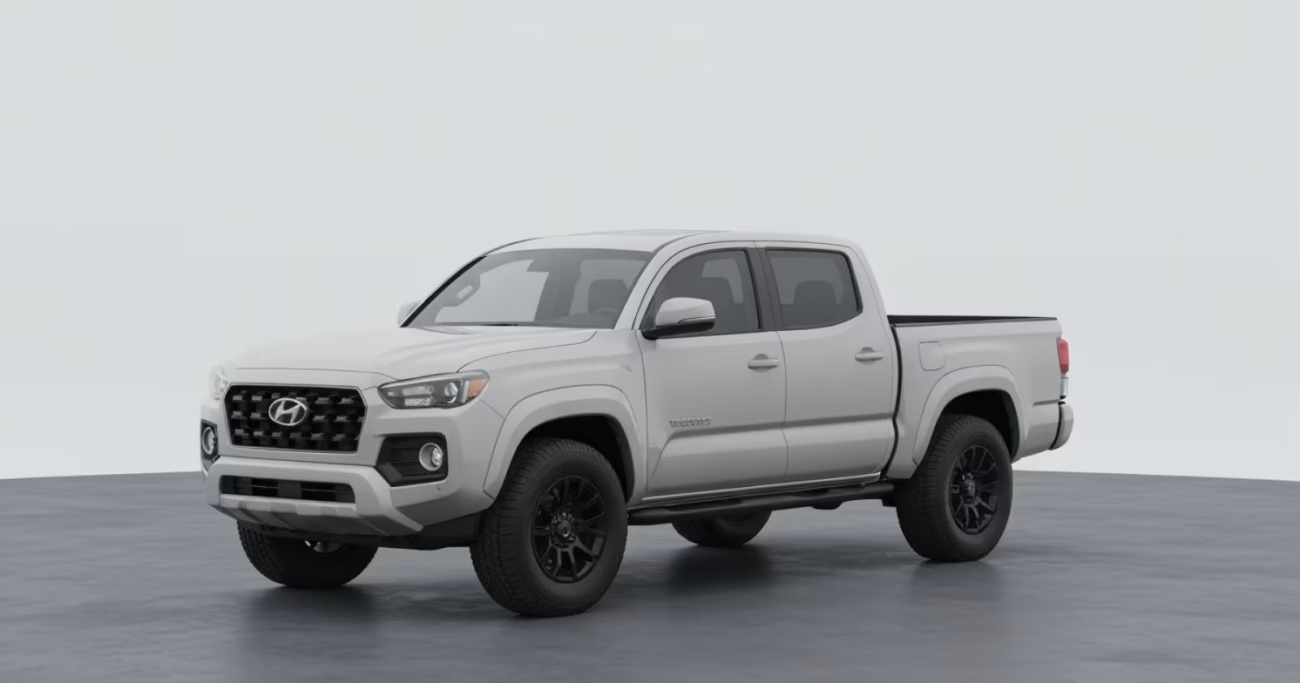
Hyundai just showed the world a blocky, retro-futuristic SUV concept that borrows its soul from a vintage Land Rover Defender — and now a new rendering imagines what happens when you stretch that same wild design into a proper midsize pickup truck. The result is one of the most compelling truck renders in years, and Toyota should be paying very close attention.
Hyundai confirmed late last year that a body-on-frame pickup is in development, something far more serious than the unibody Santa Cruz crossover-truck hybrid that came before it. The Boulder concept debuted recently as the first physical preview of that direction, and I have to say — the truck version of that concept looks absolutely right.
Why the Boulder’s truck form factor works better than the SUV
The Boulder concept SUV is already a striking piece of design, with chunky fender flares, safari-style roof windows, geometric LED lighting, and an exterior-mounted spare tire that screams vintage off-roader. But when HotCars extended that language into a crew-cab pickup format, something clicked. The longer wheelbase gives those rear fender flares more room to breathe, and they flow into the bodysides with far more elegance than on the short-tailed SUV concept.
The rendering also adds wraparound C-pillar portholes — a direct nod to classic Land Rover Defender pickups — and a roof-mounted light bar with realistic individual LED clusters. The upright windshield and blocky profile give this imagined truck the visual presence of a lunar lander. It shouldn’t work, but it absolutely does.
The one feature that puts this above every rival truck
Here’s the detail that got me most excited: the Boulder concept retains a roll-down rear window, a feature currently offered on the Toyota Tundra and 4Runner but almost nowhere else in the segment. Combine that with removable safari roof windows — which would be a first in this class — and you’re suddenly looking at the most open-air midsize truck available outside of a Jeep Gladiator.
The Gladiator is the only convertible-adjacent truck on the market right now, and Jeep charges a premium for that privilege. If Hyundai delivers genuine open-air capability on a body-on-frame platform at a competitive price, that’s not just a feature win — that’s a segment-defining move. The real story here is that Hyundai may have found the one thing Jeep thought it owned.
| Spec / Feature | Hyundai Boulder Pickup (Projected) | Toyota Tacoma | Jeep Gladiator |
|---|---|---|---|
| Platform | Body-on-frame | Body-on-frame | Body-on-frame |
| Estimated Power | ~320 hp (projected) | 278 hp (2.4L turbo) | 285 hp (3.6L V6) |
| Rear Suspension | Solid axle + coil springs | Leaf spring solid axle | Solid axle + coil springs |
| Tire Size (Concept) | 35-inch | Up to 30-inch OEM | Up to 33-inch OEM |
| Open-Air Capability | Safari windows + roll-down rear (projected) | Roll-down rear only | Full removable roof/doors |
| Expected Arrival | ~2030 | Available now | Available now |
What the suspension tells us about Hyundai’s real ambitions
The Boulder concept isn’t a runner — Hyundai was clear about that — but it does reveal meaningful engineering intent. The rear solid axle is suspended on coil springs with remote-reservoir shock absorbers, the kind of setup you find on serious off-road machines like the Ford Bronco Raptor or the Mercedes G-Class. That’s not styling-department spec. Someone in engineering signed off on that.
Up front, the independent suspension geometry points toward a double-wishbone design, which is the smart choice for a truck that needs to handle both trail duty and daily highway commutes. Coil-sprung solid rear, double-wishbone front — that’s a recipe that works. The Jeep Gladiator uses a similar formula, and enthusiasts have loved it for years.
Hyundai’s powertrain mystery is the biggest unanswered question
What goes under the hood remains completely unknown, and that’s both exciting and slightly frustrating. Hyundai’s turbocharged 2.5-liter four-cylinder already puts out 277 horsepower and 311 pound-feet of torque in the Santa Fe — nearly identical to the non-hybrid Tacoma’s output. A next-generation version of that same engine could realistically hit 320 horsepower or more, which would immediately leapfrog the Tacoma’s base power figures.
An electric variant is possible given Hyundai’s strong EV portfolio, but the more likely scenario is an evolved combustion engine arriving first. What Hyundai isn’t saying is whether a hybrid option — the kind that already powers the Santa Fe with devastating efficiency — will make it into the lineup. Given how competitive the hybrid Tacoma has become, skipping that option would be a mistake Hyundai can’t afford to make.
Why this matters more than another concept truck
- Hyundai’s body-on-frame commitment signals direct competition with Ford, Toyota, and Stellantis in the most profitable US segment
- A 320hp output projection would outscore the base Tacoma and Gladiator immediately at launch
- Open-air capability beyond the Gladiator would give Hyundai a unique segment identity no rival currently holds
I’ve watched a lot of concept-to-rendering exercises over the years, and most of them feel like wishful thinking. This one feels different. The underlying platform logic is sound, the design language is coherent, and Hyundai has already committed publicly to building the real thing. The Boulder pickup rendering isn’t just a fun fantasy — it’s a preview of a truck that could genuinely scramble the midsize segment before 2030 arrives.
If you’re in the market for a midsize truck in the next few years, I’d strongly recommend keeping this one on your radar. Bookmark the Boulder name, follow Hyundai’s development announcements, and don’t commit to a Tacoma or Gladiator without seeing what Hyundai brings to production first. The wait could absolutely be worth it.
