
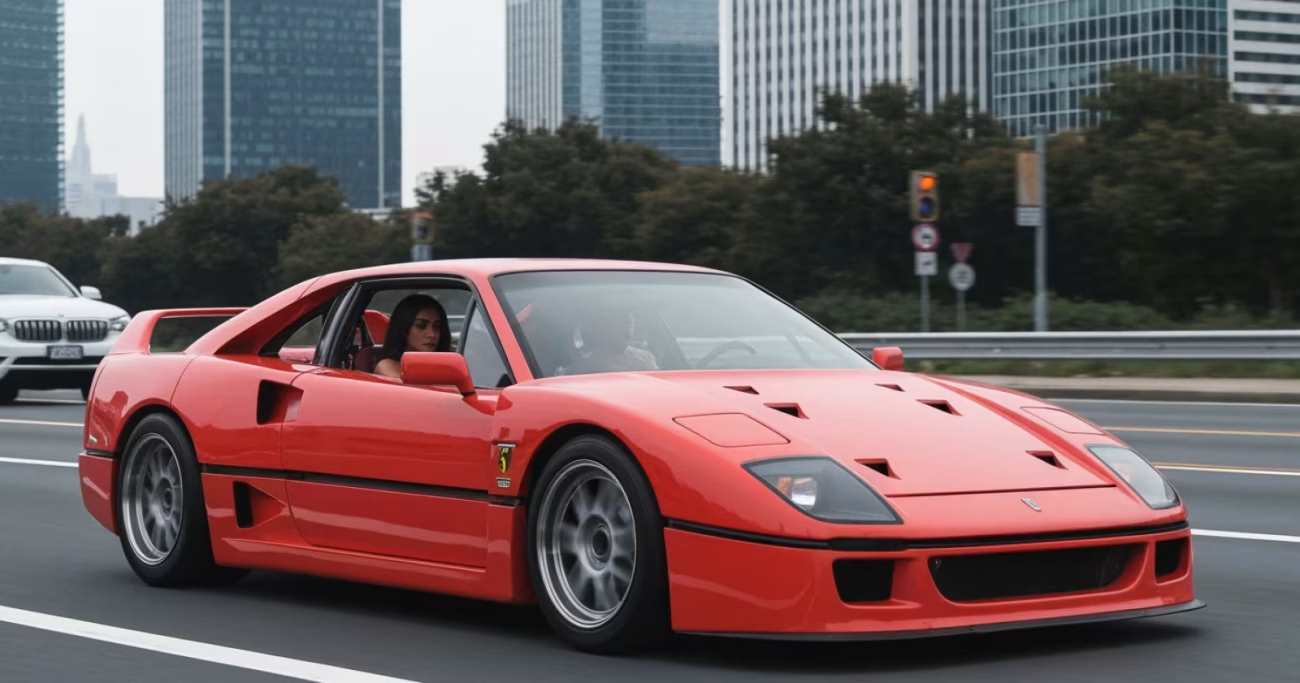
Most drivers announce a new relationship with a dinner reservation or a paparazzi photo. Lewis Hamilton announced his with Kim Kardashian by sliding a Ferrari F40 through the streets of Tokyo in the dead of night. That’s one way to do it.
The clip hit social media this week and immediately went viral — not just because of who was in the passenger seat, but because of what Hamilton was driving. The Ferrari F40 is not a car you casually drift. It is a raw, notoriously unforgiving machine that has humbled far more experienced drivers than most people will ever meet. Hamilton made it look effortless.
Tokyo, a Skyline, and now an F40 — Hamilton keeps coming back
This is not Hamilton’s first Tokyo appearance. Four years ago, he filmed a high-energy reel in a Nissan Skyline R34 GT-R, cruising the same streets that Fast and Furious made legendary. That clip built serious credibility with the car enthusiast crowd — people who otherwise wouldn’t have much overlap with Formula 1 fanbase demographics.
This time he returned as a Ferrari works driver, and he brought the brand’s most emotionally loaded icon with him. The footage includes stops at Daikoku Parking Area, the famous car meet spot in Yokohama that draws some of Japan’s most dedicated gearheads. Showing up there in an F40 isn’t just a flex — it’s a statement of cultural fluency. Hamilton knows exactly what that location means to the community he was speaking to.
The F40 isn’t a car you just “drive” — here’s why this matters
Let me be direct about something: the Ferrari F40 is genuinely difficult to drive fast. It has no traction control, no stability systems, no electronic safety net of any kind. The twin-turbocharged 2.9-liter V8 produces around 478 hp, and it delivers that power with a lag-and-surge characteristic that catches drivers off guard. A lot of very capable people have spun one into a barrier.
Watching Hamilton throw controlled donuts in one — smoothly, repeatedly, with a passenger in the seat — says something real about his car control. This isn’t a scripted stunt where a professional driver secretly handles the hard parts. The seven-time world champion was behind the wheel, and it showed. The real story here isn’t the celebrity cameo. It’s a reminder of just how complete a driver Hamilton actually is outside an F1 cockpit.
What Hamilton is actually building toward with the F44 concept
There’s a larger narrative running under all of this. Shortly after joining Ferrari in 2026, Hamilton publicly floated an idea he called the “F44” — a modern road car inspired by the F40, built with a manual gearbox. He wants a stick shift. He wants analog feel. He wants the opposite of what most modern hypercars are.
Ferrari hasn’t officially responded to the concept, which leaves two paths open. Either the brand green-lights something internally — which would be extraordinary — or Hamilton pursues it through an aftermarket collaboration. Given his profile, his relationship with the Maranello brand, and the current market appetite for analog supercars, this isn’t as far-fetched as it sounds. The Tokyo reel reads almost like a proof-of-concept: here is a man who genuinely loves this car, genuinely can drive it, and genuinely wants to see its spirit carried forward.
A snapshot of the F40 that started it all
| Spec | Detail |
|---|---|
| Engine | 2.9-liter twin-turbo V8 |
| Power output | 478 hp |
| 0–60 mph | 3.8 seconds (1992 figures) |
| Top speed | 201 mph — first road car to break 200 |
| Production run | 1987–1992, 1,315 units built |
| Driver aids | None — zero electronic assists |
| Current market value | $1.5M–$2M+ depending on provenance |
Hamilton’s 2026 bounce-back makes all of this land differently
Context matters here. Last year was genuinely difficult for Hamilton at Ferrari. The car underperformed, the adaptation period was rough, and he didn’t manage a single podium finish across the entire season. That’s a brutal stat for a seven-time champion. Coming into 2026, things have shifted. He’s already secured a podium in just his third race of the year, and the momentum feels real.
That on-track recovery makes the personal-life chapter feel earned rather than distracting. Hamilton going viral for drifting an F40 through Tokyo hits differently when he’s also back on the podium at Ferrari. It paints a picture of someone who has found his footing again — both professionally and personally. The Tokyo reel is a mood board as much as it is a social media post. And whatever comes next with the F44 concept, this week gave it a pretty compelling visual pitch.
If you’ve ever wanted to see what a Formula 1 champion looks like fully in his element — not in a press conference, not in a paddock interview, but sideways in a priceless Italian supercar at midnight in Japan — this is the clip. Go find it, watch it twice, and then go look up what a Ferrari F44 with a stick shift might actually cost. Because I think it’s coming, and I think you’ll want to be paying attention when it does.
