
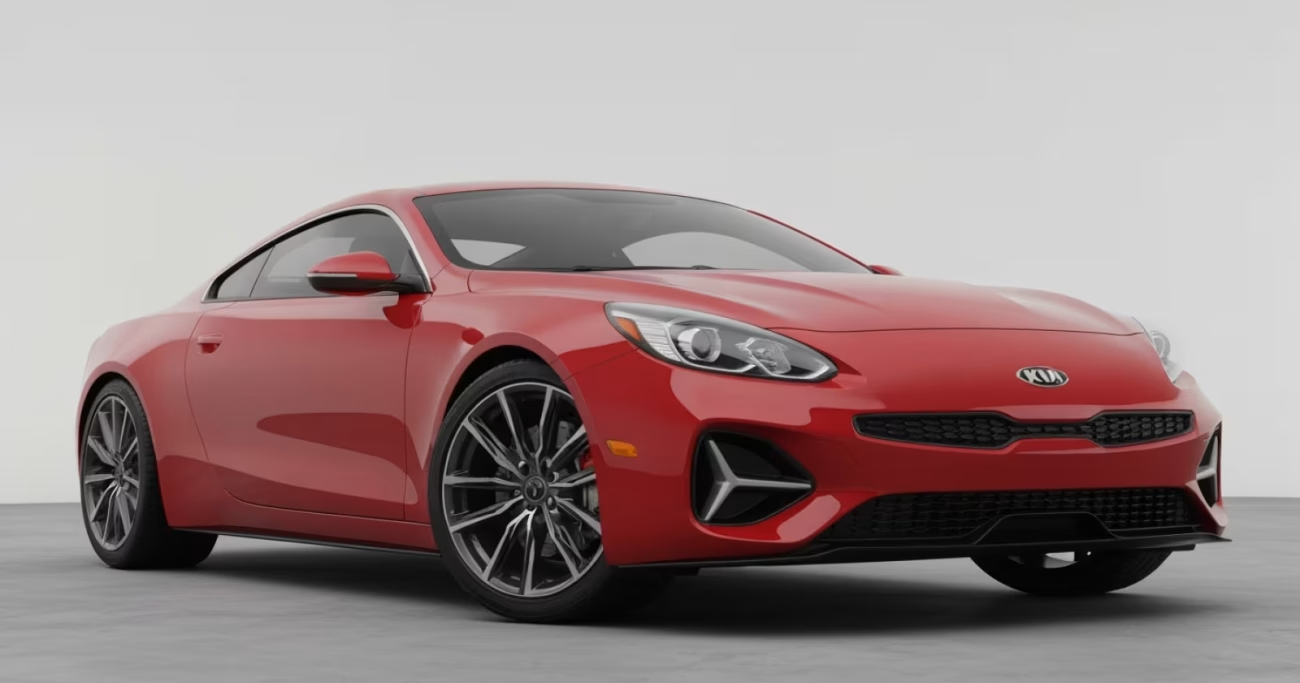
Kia just stood up in front of investors in Seoul and announced one of the most aggressive product plans any automaker has put on paper in years. Nine new combustion models, 14 electric vehicles, 13 hybrids, and a target of selling over 1 million vehicles in the US alone — all by 2030.
That’s not a roadmap. That’s a declaration of war on the entire segment.
What Kia just promised investors changes the entire race
During CEO Investor Day in Seoul, Kia Corporation president Ho Sung Song laid out a growth strategy that makes most rival five-year plans look cautious by comparison. The brand sold 852,155 vehicles in the US in 2026. By 2030, it wants 1.02 million — a jump that would push its American market share from 5.2% to 6.2%.
Globally, the numbers are even bigger. Kia aims to grow from 3.13 million vehicles sold in 2026 to 4.13 million by 2030, targeting 4.5% global market share. To get there, the brand isn’t betting on one segment. It’s flooding every segment at once.
| Metric | 2026 Baseline | 2030 Target |
|---|---|---|
| US Vehicle Sales | 852,155 units | 1.02 million units |
| US Market Share | 5.2% | 6.2% |
| Global Sales | 3.13 million | 4.13 million |
| Global Market Share | ~4% | 4.5% |
| New ICE Models Globally | — | 9 new models |
| EV Lineup Size | Current limited | 14 models |
| Hybrid Models (US) | 4 models | 8 models (doubled) |
| Annual BEV Sales Goal | — | 1 million globally |
| Commercial PBV Sales Goal | — | 232,000 units |
The body-on-frame Tasman news is the one US buyers need to hear
Here’s the real story for American shoppers: a version of the Tasman body-on-frame pickup platform is coming to the US, and it’s bringing hybrid and extended-range EV variants with it. That’s a massive deal. Right now, Kia has zero presence in the body-on-frame space stateside.
That truck platform also opens the door to a legitimate off-road SUV — something Kia has never really had. The brand currently has no answer to the Ford Bronco or Jeep Wrangler. With a truck frame confirmed for the US, that conversation changes entirely. An off-road-capable SUV built on that platform is no longer a question of “if” but “when.”
Doubling US hybrid models is the smartest move nobody is talking about
While the EV headlines grab attention, the real volume play is Kia’s plan to double its US hybrid lineup from 4 models to 8 by 2030. Hybrids are currently the fastest-growing powertrain segment in America, and Kia already has strong footing with the Niro, Sportage, Sorento, and Carnival. Eight models would put it toe-to-toe with Toyota‘s hybrid depth.
The brand is also accelerating its core SUV lineup faster than most buyers realize. A second-generation Seltos arrives for 2027 with hybrid options. An all-new Telluride three-row SUV lands in 2027. The K4 hatchback joins for 2026. And a fifth-generation Sorento — delayed partly because the current model is still selling so well — is slotted for 2027 or 2028. The pipeline is genuinely packed.
Why Hyundai’s internal rivalry with Kia is about to get very uncomfortable
When Hyundai Motor Group acquired a controlling stake in Kia back in 1998, Kia was considered the smaller sibling. That dynamic has been shifting for years, but this investor day signals something sharper. Kia is now leaning into autonomous driving, robotics, and software-defined vehicles as primary growth drivers — the same territory Hyundai has been staking out for itself.
The catch nobody is fully addressing yet is product overlap. Nine new ICE models, 14 EVs, and a doubling of hybrids means Kia and Hyundai will inevitably be competing for the same customers in several segments. The Hyundai Palisade and Kia Telluride already sit uncomfortably close. Add 8 more models on each side and the internal cannibalization risk becomes a very real strategic problem for the parent group.
The US lineup gaps Kia still needs to fill before 2030
I’ve been watching Kia’s US portfolio closely, and a few holes stand out. The Soul is gone, leaving a gap below the K4 that a quirky, affordable hatchback could fill again. The Niro has lost its EV and plug-in hybrid variants, leaving only the standard hybrid — a puzzling retreat in a segment where electrified options are growing. And the EV3, which is arriving later in 2026, is a genuinely exciting small electric SUV that could move real volume if priced correctly.
The EV2 is heading to Europe this year but almost certainly won’t come to the US, at least not initially. That’s a missed opportunity in the affordable EV entry segment, where buyers are desperately looking for something under $25,000. If Kia can eventually bring a US-spec version of that vehicle here before 2030, it adds a weapon nobody else in the segment currently has.
Why this matters
- Kia targeting 6.2% US share puts it in direct collision with Honda and Nissan.
- 8 US hybrid models by 2030 challenges Toyota’s segment dominance directly.
- A body-on-frame truck with EREV variant is unlike anything in the mainstream segment.
The verdict: Kia’s 2030 plan is the most specific and credible growth roadmap the brand has ever published. It rewards enthusiasts watching for a real off-roader, family buyers who want more electrified options, and industry watchers tracking the slow erosion of Toyota and Honda’s hybrid lock. If even 70% of this plan executes on schedule, Kia will look like a fundamentally different brand by the end of the decade. The little brother has officially outgrown the comparison.
If you’re considering a new SUV or truck in the next 2 to 4 years, I’d strongly recommend watching Kia’s announcements closely — the best models in this pipeline may not be on sale yet, but they’re closer than you think. Bookmark this brand now before everyone else catches up.
