
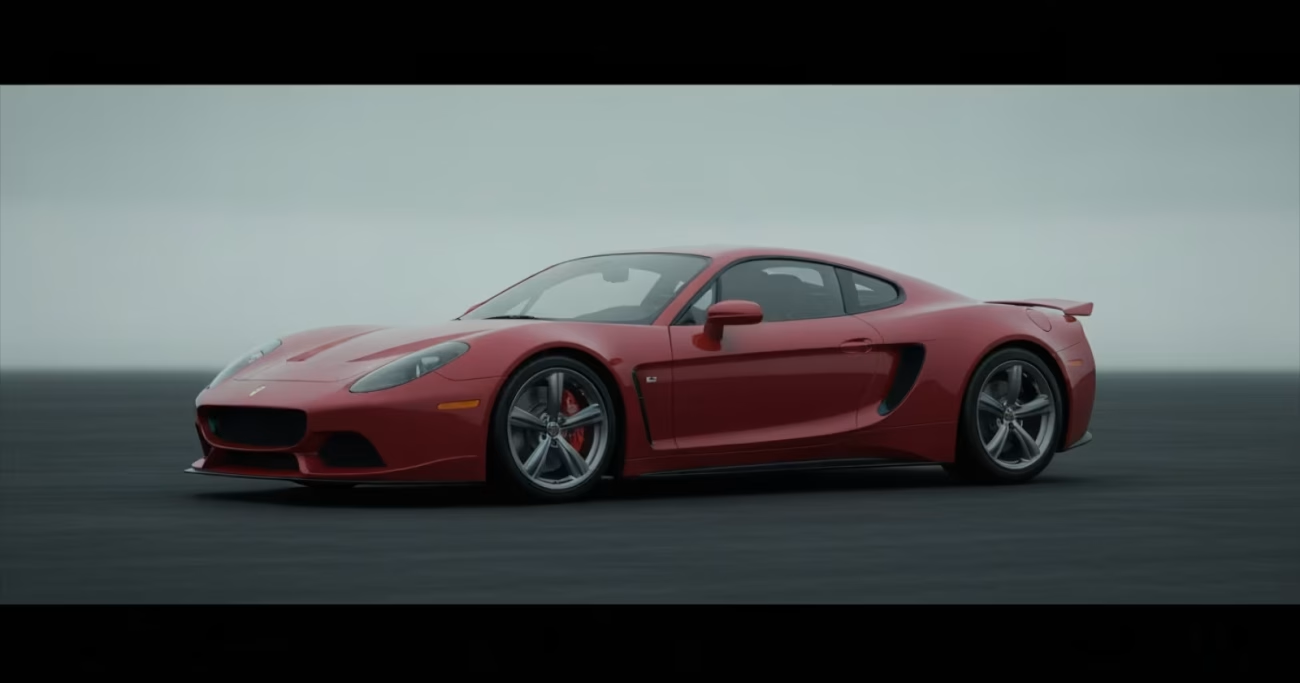
Ferrari has patented a crash-safety idea that sounds backwards at first glance. In a hard angled impact, part of the front suspension could be designed to give way on purpose.
That is not a sign of weakness. It is a way to keep the chassis from folding into the space where people sit.
Ferrari is betting on controlled failure
The wild part is how intentional this is. Ferrari is not trying to make wheels fly off in normal driving; it is trying to make the suspension detach in a very specific crash scenario.
Here’s the catch: the worst front-end impacts are not always clean, straight hits. If one front wheel takes the blow first, the load can shove the suspension rearward and into the body structure.
Ferrari’s filing says that kind of angled strike can create different forces on each front wheel. The leading wheel gets hammered first, and that can trigger a partial collapse of the chassis if the load path is bad enough.
The real story is that Ferrari wants the damaged section to escape the crash path instead of becoming part of it. By letting a key mount fail in a controlled way, the car may preserve more of the cabin structure.
The safety trick hides in plain sight
The suspension does not simply fall apart. Ferrari has kept the core architecture familiar, with the control arm still mounted through a bushing that lets it pivot and absorb vibration like a normal setup.
What changes is the bar that anchors that mount to the body. Ferrari has built in weakened zones so the part can separate under crash loads, but stay intact during ordinary driving.
That is the real story: the system is meant to fail only when the forces get ugly enough. In a severe offset impact, the front attachment point could be pushed out of the wheel well and away from the cabin shell.
That matters because it reduces the chance of the suspension forcing its way back into the chassis. In other words, the part that would normally become the problem is designed to get out of the way.
Why crash rules make this idea matter
Ferrari is clearly reading the same test book as every other automaker. The U.S. uses offset barrier testing, and the IIHS still evaluates scenarios where only one front wheel strikes first.
Those tests expose the exact kind of asymmetrical load Ferrari is targeting. If the new mount helps the car manage that energy better, it could support lighter structures without sacrificing compliance.
Here’s the catch: this is still a patent, not a promise. Patent filings protect ideas, and automakers file them long before any production decision is made.
Even so, the logic is strong. Ferrari has long lived at the intersection of speed, low mass, and structural obsession, so a safety system that trades a sacrificial mount for cabin protection fits the brand’s engineering mindset.
Honda proves the idea is not fantasy
Ferrari is not inventing the concept of a controlled separation from nothing. Honda has already shown that a similar approach can be engineered for production use, which makes Ferrari’s filing feel a lot less theoretical.
That matters because it moves the idea from pure stunt to plausible hardware. The challenge is not whether a part can be made to break on cue; the challenge is making it survive potholes, curbs, and years of hard use without false failures.
The real story for enthusiasts is that this may help preserve the kind of cars Ferrari still builds. A safety solution that adds less weight than brute-force reinforcement could matter for V12 models and other high-performance platforms.
For industry watchers, the message is even bigger. Ferrari is showing that supercar safety may not mean making everything stronger; sometimes it means deciding exactly what is allowed to fail first.
| Model | Power | Safety approach | Edge |
|---|---|---|---|
| Ferrari patent concept | Not disclosed | Controlled suspension detachment | Protects cabin in angled crashes |
| Honda production example | Varies by model | Similar controlled failure strategy | Shows the idea can reach production |
| Typical Ferrari road car | V8 or V12 performance | Traditional rigid crash structure | New patent could add targeted protection |
That table tells the story cleanly: Ferrari is not chasing headline horsepower here. It is chasing smarter crash behavior, and that can be just as exotic in the supercar world.
The verdict is simple. This is one of the most interesting Ferrari patents in years because it tackles a real crash problem without obvious weight penalties. If it reaches production, it could influence how other performance brands think about offset-impact protection in 2026 and beyond. Ferrari is proving that sometimes the safest engineering move is knowing what to let go.
If this kind of engineering fascinates you, keep watching Ferrari patents closely. The next breakthrough may not be more power at all, but a smarter way to survive the hit.
