
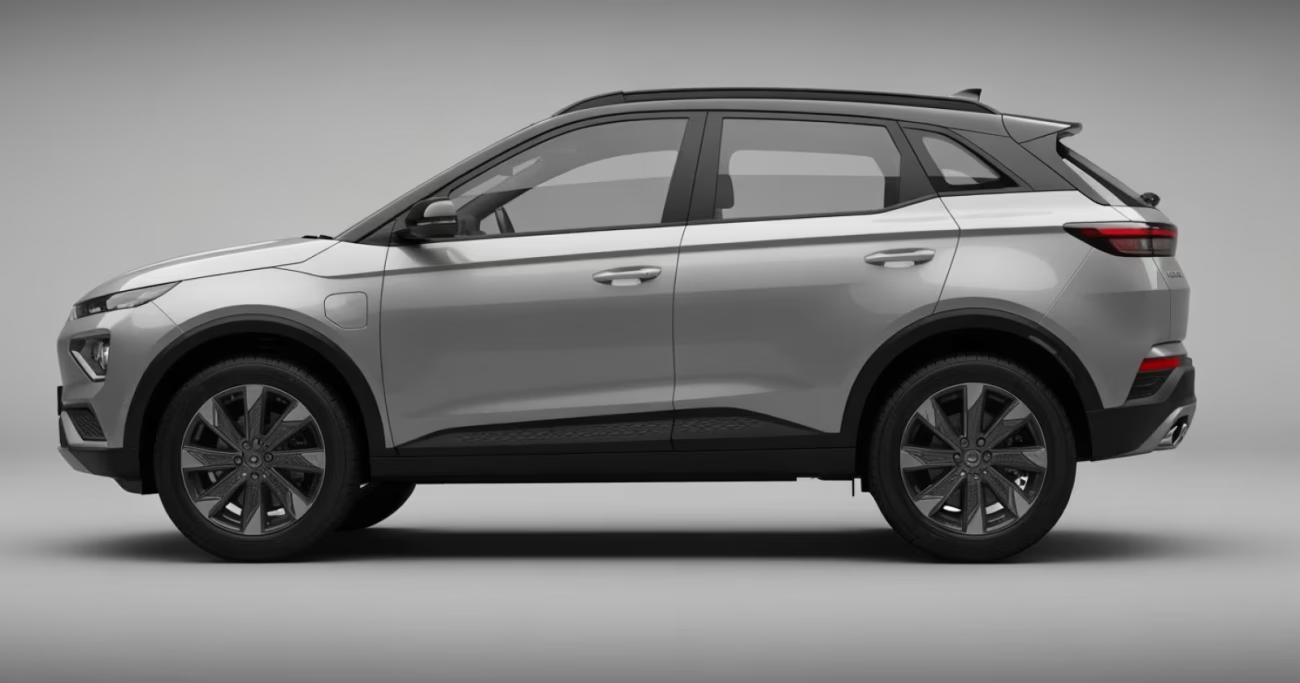
Hyundai’s next mass-market EV for India is starting to look far more serious than a regular teaser cycle. From the latest spy shots and renders, I can already see a compact electric SUV that feels built to challenge the segment’s biggest names without trying too hard.
What makes this one interesting is the positioning. It is expected to sit below the Creta Electric, which immediately tells me Hyundai wants a more affordable, city-friendly electric SUV for Indian buyers who still want the premium feel.
Spy shots point to a boxy, practical shape
The test mules have been seen in India and South Korea under heavy camouflage, but the overall silhouette is easy to read. It has that tall-boy stance, upright body, and planted proportions that usually work well in Indian traffic because they give a strong road presence without making the vehicle feel oversized.
From the render based on those sightings, I can imagine a properly modern Hyundai design language. The pixel-style DRLs, the quad-dot Hyundai identity treatment, and the low-set headlights all make the front end look futuristic, while still keeping it familiar enough for mainstream buyers.
Why I think Hyundai is aiming squarely at the sub-4m EV crowd
This is not a niche experiment. Hyundai appears to be building a made-in-India EV for India first, with export plans also in the picture, and that usually means the company wants volume. A compact electric SUV in this space has to balance price, range, practicality, and feature load, and that is exactly where Hyundai usually plays its strongest game.
Inside, I expect a cabin that feels more upscale than its footprint suggests. Dual 12.3-inch screens, a curved display housing, a steering wheel with a column-mounted gear selector, and premium materials all sound very believable for a Hyundai EV trying to steal attention from established rivals.
| Expected detail | What the spy shots suggest |
|---|---|
| Body style | Compact electric SUV with tall, boxy stance |
| Design highlights | Pixel LED DRLs, flush handles, chunky cladding |
| Cabin tech | Dual 12.3-inch screens, ADAS, 360-degree cameras |
| Battery estimate | Around 40 kWh |
| Range estimate | About 400 km to 500 km |
| Likely rivals | Tata Nexon EV, Punch EV, Mahindra XUV 3XO EV |
The details I would watch closely
Some of the smallest design cues often matter the most on a vehicle like this. Flush door handles, geometrical alloy wheels, functional roof rails, and thick cladding around the wheel arches all suggest Hyundai wants a proper SUV look rather than a softened crossover shape.
At the rear, the render points to a connected plaque area for the tail-lights, but not necessarily a fully connected light signature. That kind of subtle distinction matters because it helps the EV look contemporary without falling into gimmick territory.
I also find the likely feature list very convincing for Indian buyers. Level-2 ADAS, 360-degree cameras, all-four disc brakes, adjustable regenerative braking, powered front seats, ventilated front seats, and premium audio would instantly make this model feel well-equipped if Hyundai prices it smartly.
What performance could look like
Based on the brief, a single electric motor powering the front wheels makes the most sense for this segment. If Hyundai manages sub-10-second 0-100 km/h performance, that would be enough to make the SUV feel lively in the city and confident on the highway without chasing performance-car territory.
The battery may be around 40 kWh, and if that translates into a real-world range in the 400 km to 500 km zone, this EV could become a very practical choice for daily use. That kind of number matters in India because buyers want enough range for office runs, weekend errands, and the occasional highway trip without constant charging anxiety.
Features like V2L and V2V would be a smart addition too. In an Indian urban setting, those features can make an EV feel useful in ways that go beyond basic commuting, especially for buyers who want flexibility during power cuts or outdoor use.
How I see it against the competition
The main rivals are obvious. Tata Nexon EV remains the benchmark for mass-market EV familiarity, Punch EV brings urban practicality, and Mahindra’s upcoming electric entries could add extra pressure in the same space.
What Hyundai brings to the table is a reputation for polish. If the final production model keeps the render’s bold shape and combines it with a smart cabin, I think it can appeal strongly to Indian buyers who want an electric SUV that feels modern without looking too experimental.
There is also the timing angle. Since testing has already started, a launch later in 2026 or in 2027 feels realistic, and that gap only increases speculation. For me, that makes the current spy-shot stage even more valuable, because it gives us the first real hints about Hyundai’s next EV strategy for India.
My take on the road ahead
If Hyundai gets the pricing right, this could be one of the most important electric SUVs in its lineup for India. It has the right ingredients for a strong Discover story too: mystery, spy shots, a fresh render, a clear rival set, and a product that could hit the sweet spot for urban Indian families.
I’m watching this one closely because it feels like the kind of EV that could move the segment forward without scaring mainstream buyers away. If you follow Indian EV launches as closely as I do, keep an eye on this Hyundai because the next update may matter a lot more than the camouflage suggests.
Stay tuned, because once more details emerge, I’d want to compare it directly with the Nexon EV and the rest of the sub-4m electric pack before making a final call.
