
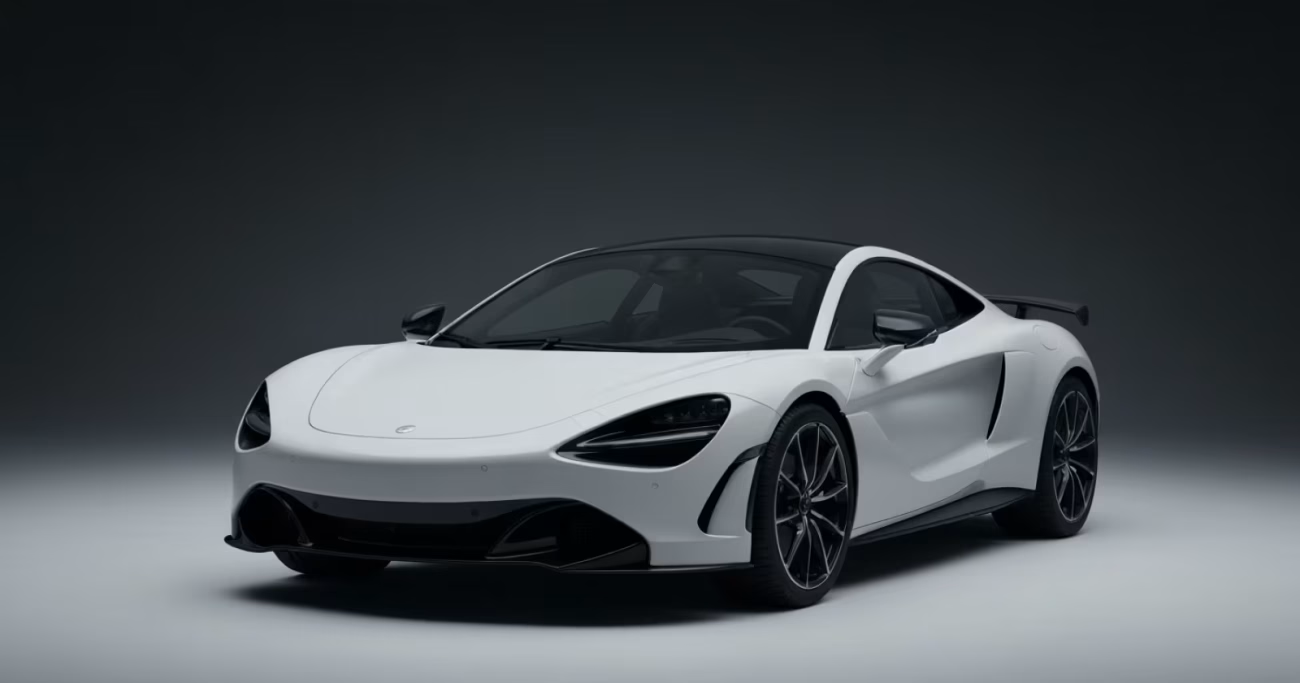
McLaren is about to blow up everything we thought we knew about the brand — and I don’t mean a new wing package. The Woking marque is set to reveal a whole new lineup of production cars this summer, and an SUV is sitting right at the center of the rumor pile.
This isn’t a drill. McLaren Group Holdings CEO Nick Collins confirmed to Autocar that the company will begin publicly “unpacking” its plans for multiple new models before 2030, with the reveal timed to coincide with the start of deliveries for the monstrous 1,258-horsepower W1 hypercar. The timing is deliberate. The message is loud.
Why McLaren entering the SUV market changes the entire game
For years, McLaren sat on the sidelines while Ferrari launched the Purosangue, Lamborghini printed money with the Urus, and Porsche turned the Cayenne into its bestseller. That restraint cost McLaren dearly — the company simply didn’t have the financial muscle to enter those segments. That’s no longer the case.
CYVN Holdings, the Abu Dhabi government-backed investment group that now holds a majority stake in McLaren Automotive, brings what insiders are calling “almost bottomless pockets” to the table. The merger with Forseven — a 700-engineer British startup that had been quietly developing luxury models — gave McLaren a development team, a product roadmap, and the capital to actually execute it. All of those vehicles will now wear the McLaren Speedmark badge.
Collins confirms no EVs — and the reasoning is sharper than you’d expect
Here’s the catch that purists will love: Collins made it crystal clear that a full electric McLaren won’t happen until “customers want one.” That’s a direct quote. And he backed it up with hard market evidence — Mercedes slashing prices across its EQ lineup and Lamborghini walking back the electric Lanzador are both signs the high-performance EV market isn’t delivering on its promise yet.
The real story here is that McLaren is watching its competitors burn cash on EVs and choosing a different path. Whether the upcoming models use the proven twin-turbo V8 or an entirely new powerplant hasn’t been confirmed. But the internal combustion engine isn’t going anywhere at Woking — at least not before 2030.
Ferrari charges $400,000 for a Purosangue — McLaren could undercut that
The luxury performance SUV market is staggeringly lucrative, and that’s exactly why McLaren wants in. The Ferrari Purosangue starts north of $390,000. The Lamborghini Urus S sits around $250,000. A McLaren SUV pitched somewhere in that space — backed by legitimate supercar DNA — could carve out serious territory fast.
What McLaren isn’t saying publicly is how soon this SUV could actually arrive. Collins spoke of previewing “a brand-new car” rather than a full production reveal this summer, which means the timeline could stretch well into the late 2020s. Dealerships have reportedly already been briefed on the plans, which tracks — you don’t start W1 deliveries and leave your network in the dark about what comes next.
| Model | Engine | Power | Est. Price | Segment Edge |
|---|---|---|---|---|
| McLaren W1 | 4.0L V8 Hybrid | 1,258 hp | $2,100,000 | Halo car credibility |
| Ferrari Purosangue | 6.5L V12 | 715 hp | ~$390,000 | Brand prestige |
| Lamborghini Urus S | 4.0L V8 Biturbo | 657 hp | ~$250,000 | Volume leader |
| McLaren SUV (rumored) | TBC (ICE confirmed) | TBC | TBC (~$300,000?) | Lightweight focus |
The one detail about Forseven nobody is talking about enough
Forseven wasn’t just a startup — it was a 700-person engineering operation founded in 2022 and funded specifically to develop luxury vehicles outside McLaren’s traditional two-seat formula. When CYVN merged it into McLaren Group Holdings, those engineers and that IP didn’t disappear. They became McLaren’s secret weapon for entering segments it had never touched before.
That’s not a minor footnote. That’s the structural reason why a McLaren SUV is actually plausible now rather than just a fantasy render on an enthusiast forum. Collins effectively inherited a fully staffed product development pipeline and pointed it squarely at the luxury SUV segment. The question isn’t whether McLaren can build one anymore. The question is how quickly — and how good — it will be.
Why this matters
- McLaren’s ICE commitment challenges the industry’s EV-or-nothing narrative
- A McLaren SUV would force Ferrari and Lamborghini to defend new territory
- CYVN’s backing means McLaren’s expansion is now financially credible, not just theoretical
The verdict
McLaren is no longer a one-trick supercar pony — it’s a brand with deep pockets, 700 new engineers, and a clear mandate to grow. The SUV rumor has more structural support behind it than any McLaren expansion story in the past decade. Enthusiasts who feared electrification can breathe easy for now, while luxury SUV buyers should start paying attention. If McLaren delivers a performance SUV with even half the focus it put into the W1, Ferrari and Lamborghini will feel it. This summer’s reveal won’t just be about one new car — it’ll be the opening chapter of a very different McLaren.
If you’re tracking the luxury performance SUV market or following McLaren’s comeback story closely, now is the time to put the brand back on your watchlist. Share this with any McLaren fan who thinks the W1 is the whole story — because it’s clearly just the beginning.
