
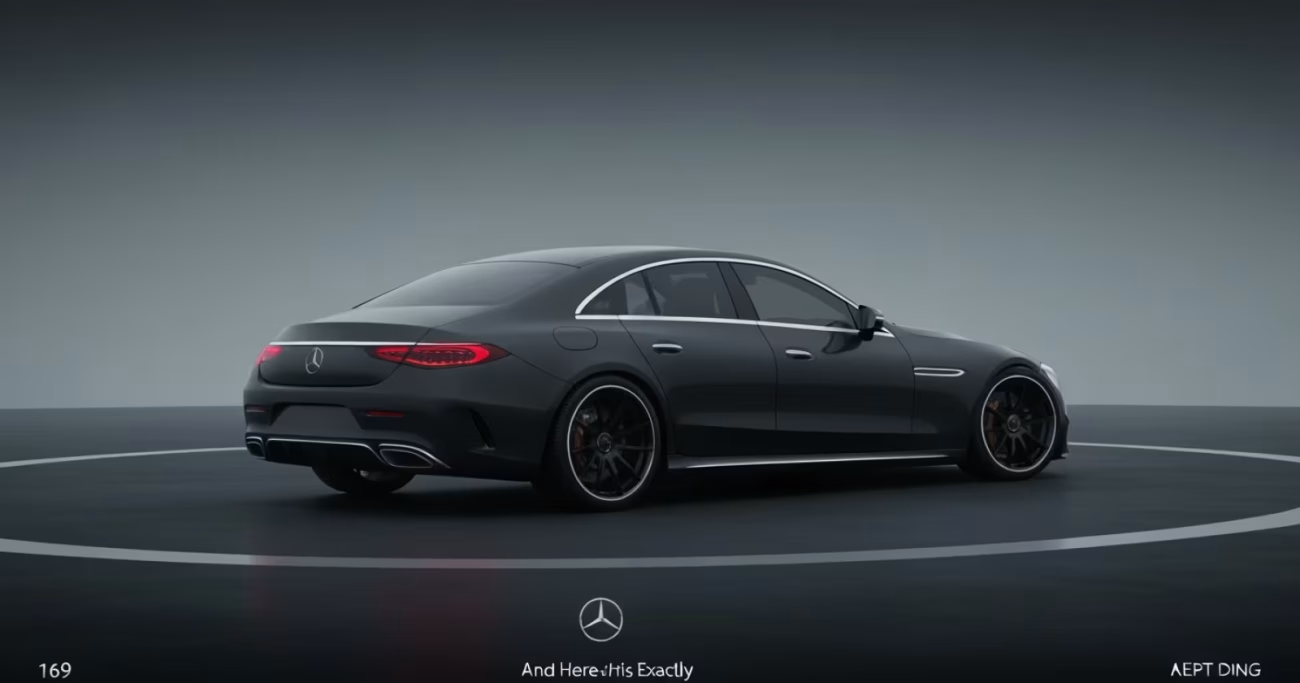
Most automakers building electric performance cars quietly buried the idea of drifting somewhere around the battery warranty clause. Mercedes-AMG decided to engineer around that problem entirely, and the result is one of the most technically ambitious sedans heading to market in 2026.
The all-electric AMG GT 4-Door has been testing in Northern Europe through winter conditions, and fresh technical details are now surfacing ahead of its spring launch. What’s coming into focus is a car that doesn’t just tolerate AMG’s performance DNA — it was specifically rebuilt around it.
1,341 hp and three motors that know when to argue with each other
The concept version of the AMG GT 4-Door demonstrated up to 1,341 hp, though AMG hasn’t locked in the final production figure yet. What’s confirmed is the powertrain architecture: three axial-flux electric motors, a motor type known for exceptional power density in a compact package. That setup allows the car to run in configurable rear-wheel-drive or all-wheel-drive modes depending on what the driver demands.
Axial-flux motors are a meaningful choice here. They respond faster and rev harder than conventional radial motors, which matters enormously when you’re trying to replicate the kind of throttle feel AMG built its reputation on. This isn’t a single-motor EV with a sport mode toggle — it’s a three-motor system designed to behave like a driver’s car from the ground up.
The Agility Control system is what actually keeps drift mode alive
Here’s where things get genuinely interesting. AMG’s new driving-dynamics framework runs through three distinct layers: Response Control, Agility Control, and Traction Control. Response Control adjusts how the motors react to accelerator pedal inputs across different drive modes. That part is fairly standard for modern performance EVs.
Agility Control is the real story. It manipulates power distribution between axles and wheels in real time to artificially alter the car’s handling balance — shifting between the feel of a shorter or longer wheelbase, dialing from mild understeer to controlled oversteer on command. In practical terms, that means drift mode isn’t gone. It’s been rebuilt into the physics of the car’s software architecture. Traction control takes it further still, offering nine selectable levels that mirror the granular setups previously found in the AMG GT R and GT Black Series — two cars that were obsessively tuned for track use.
A braking setup that breaks from convention and a suspension that has to deliver
AMG has also confirmed an unconventional braking configuration: carbon-ceramic discs up front paired with steel rotors at the rear. That combination is unusual. Carbon-ceramics typically appear on all four corners in high-performance applications, so the asymmetric setup suggests AMG is tuning brake bias and feel with considerable precision, likely optimizing regenerative braking behavior at the rear without compromising pedal feel.
The suspension system is equally layered. Adjustable air springs work alongside semi-active roll bars and configurable dampers — a setup that needs to be this sophisticated given the power figures involved. The Porsche Taycan and Audi e-tron GT both run highly developed suspension architectures, and AMG isn’t entering this segment to finish third. The promise is a car that rides comfortably in traffic and tightens up meaningfully when pushed toward its limits on track.
The battery tech designed to survive both a track day and a desert crossing
Battery thermal management is one of the less glamorous but most consequential challenges in performance EVs. AMG addressed it with direct cell cooling using a non-conductive oil that flows around each individual cell. The goal is stable operating temperature regardless of ambient conditions — whether that’s repeated hot laps, sub-zero commuting, or sustained high-speed driving in extreme heat.
That level of thermal control matters for performance consistency. EVs that overheat their batteries during track use become progressively slower as the system throttles power output to protect the cells. If AMG’s cooling system works as described, the GT 4-Door should be one of the few electric performance sedans that doesn’t visibly fade under sustained track conditions. That claim still needs real-world verification, but the engineering intent is clear.
At a glance
| Spec | Detail |
|---|---|
| Peak power (concept) | 1,341 hp |
| Motor configuration | 3 axial-flux electric motors |
| Drive modes | Configurable RWD and AWD |
| Traction control levels | 9 selectable settings |
| Brakes | Carbon-ceramic front / steel rear |
| Suspension | Air springs + semi-active roll bars + configurable dampers |
| Current gas model price range | $102,000 – $200,500 |
How it stacks up against the Taycan and e-tron GT
The Porsche Taycan Turbo GT sits at around 1,092 hp and has already proven itself as a credible track performer — it held a Nürburgring production EV record. The Audi RS e-tron GT peaks closer to 912 hp in its highest trim. On raw power figures alone, the AMG GT 4-Door’s 1,341 hp concept number clears both by a wide margin, though production outputs may differ. Where AMG is genuinely differentiating itself is in the depth of driver configurability — nine traction levels, an Agility Control system with variable handling balance, and a motor layout that allows true rear-wheel-drive operation. Neither the Taycan nor the RS e-tron GT offer that combination in a single package.
Pricing is where AMG’s advantage disappears. The current combustion AMG GT 4-Door runs from $102,000 to $200,500, and the electric version will almost certainly exceed that ceiling. The Taycan Turbo GT starts around $230,000, so this segment isn’t competing on value — it’s competing on bragging rights and engineering credibility.
Why this matters
- Drift mode in EVs is now an engineering challenge, not a marketing casualty
- Three-motor axial-flux setups are redefining what performance architecture looks like
- AMG is proving legacy performance brands can evolve without abandoning their identity
The verdict
I’ve followed AMG’s slow build-up to this car with equal parts skepticism and genuine curiosity, and what’s emerged from the winter testing period is more technically coherent than I expected. The Agility Control system is a legitimate engineering solution to a real problem — how do you preserve driver engagement when you remove the mechanical drama of a combustion engine? AMG’s answer is software-defined physics, and it’s more convincing than a “sport mode” badge on a battery pack.
The price will be extraordinary, the competition from Porsche is fierce, and the production power figure still needs confirmation. But if you care about where performance car engineering is heading in the electric era, the AMG GT 4-Door is the most important sedan Mercedes has announced in years. If AMG delivers even 80 percent of what these specs promise, Porsche has a serious problem on its hands.
Spring 2026 can’t arrive fast enough — keep this one on your radar and follow the launch coverage closely, because the final specs could shift everything we think we know about electric performance sedans.
