
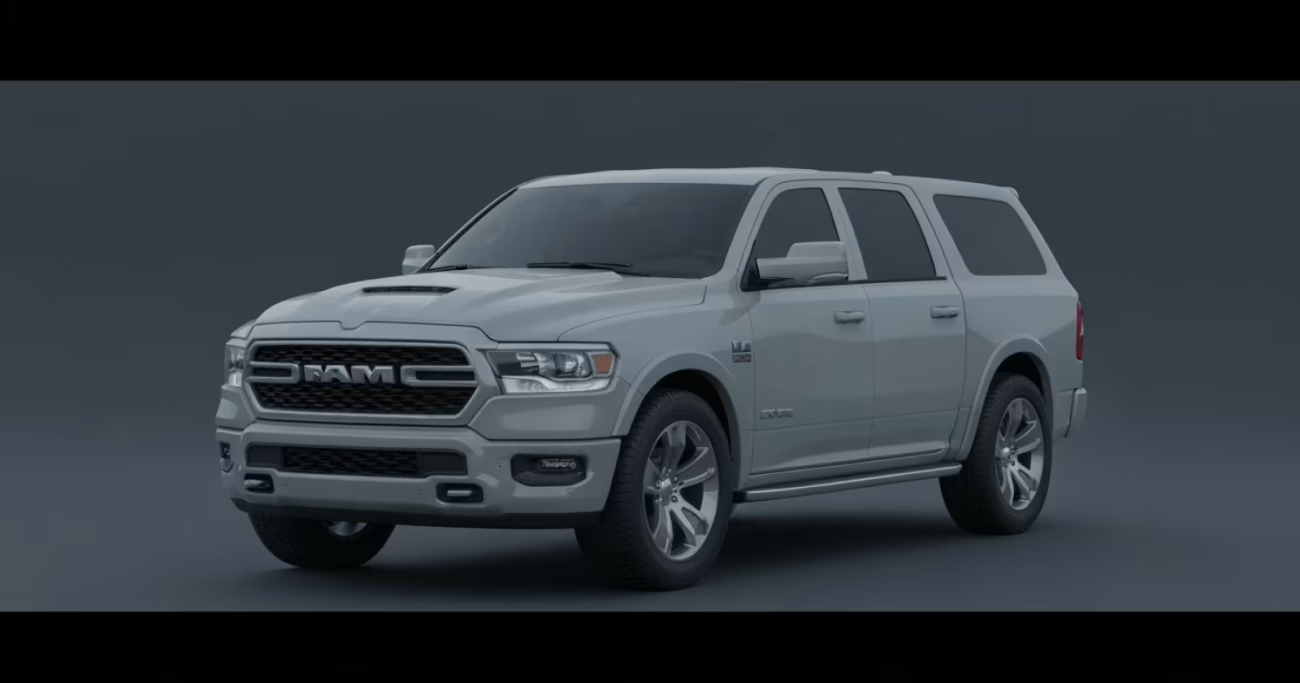
A V8 that looked nearly finished is now powering about 40% of Stellantis light-duty sales in the US. The problem is not demand anymore — it is getting enough Hemi engines built fast enough.
I see this as one of the sharpest reversals in the truck market right now, because Ram, Dodge, and Jeep are not just bringing back an engine. They are rebuilding an entire supply chain that was switched off.
| Spec | Detail |
|---|---|
| Current Hemi mix | About 40% of Stellantis US light-duty sales |
| Production target | Roughly 100,000 additional Hemi units |
| Main bottleneck | Supplier lines and Saltillo assembly capacity |
| Key plant | Saltillo, Mexico, with help from Dundee, Michigan |
| Big buyer signal | 40% of pickup shoppers may skip brands without a V8 |
| Gas guzzler tax | Not currently hitting US Stellantis trucks and SUVs |
Why Ram’s V8 comeback changes everything
The real story is not just that the Hemi is back. It is that Stellantis appears to have underestimated how deeply its truck and performance buyers still cared about eight cylinders.
For a while, the 3.0-liter Hurricane inline-six looked like the future across the company’s big vehicles. On paper, it made sense, offering strong output and better alignment with tightening emissions pressure.
But paper does not rumble at idle. Ram buyers, Jeep loyalists, and Dodge performance fans have always treated the Hemi as more than a spec line, and I think Stellantis is now admitting that emotional pull still moves metal.
Tim Kuniskis, now steering Ram and the North American brands, has been unusually blunt about the mistake. Production in Saltillo was shut down and repurposed, suppliers were turned off, and parts pipelines dried up.
The catch is Mexico cannot restart overnight
Here’s the catch: bringing back a famous engine is much easier in a press release than inside a factory. If the assembly line is gone and suppliers have moved on, the comeback starts with machinery, tooling, contracts, workers, and time.
Kuniskis said the company needs to grow output by roughly another 100,000 units. That is not a small adjustment; that is the difference between a symbolic return and a real volume comeback.
Saltillo, Mexico, remains central to the story, but it cannot carry the load alone right away. Stellantis also moved to add Hemi output at Dundee, Michigan, which tells me the company knows this demand spike is not just temporary noise.
The awkward part is that Ram may have to live through a messy mix before supply catches up. Dealers could have the wrong configurations at the wrong time, while shoppers who specifically want a V8 may face longer waits or fewer choices.
Ford and Chevy should take this seriously
What Ram is not saying too loudly is that the Hemi comeback is also a direct challenge to Ford and Chevrolet. Full-size truck buyers compare engines with almost tribal loyalty, and a missing V8 can turn into a lost sale before the test drive starts.
Stellantis says 40% of pickup buyers will not even consider a brand without a V8 option. I believe that number explains almost everything about the company’s sudden urgency.
Ford still has V8 power in the F-150 lineup, and Chevrolet continues to lean on its small-block heritage in the Silverado. Ram, however, risked looking like the brand that walked away from the loudest part of the truck identity.
Now the company is trying to flip that narrative. If Ram can offer Hemi availability alongside Hurricane power and electrified options, it can pitch choice instead of retreat.
The fuel-price problem has not gone away
There is still a reality check here. Fuel prices remain painful in many parts of the US, and a big V8 is never going to be the rational answer for every buyer.
But trucks and SUVs are protected from one issue that hits some performance cars: the federal gas guzzler tax. That matters because Ram and Jeep shoppers can chase more power without facing the same penalty structure that can apply to certain cars.
Dodge may not be as insulated once more Hemi-powered performance models arrive. Future SRT cars could face a different equation, especially if the power figures climb and fuel-economy numbers drop.
Still, I do not think the Hemi comeback is about pretending efficiency no longer matters. It is about Stellantis deciding that one-size-fits-all powertrain planning was costing it credibility with its most loyal customers.
Freedom of choice is now the sales pitch
Antonio Filosa’s broader message is “freedom of choice,” and that phrase is doing a lot of work. It allows Stellantis to keep hybrids, EVs, six-cylinders, and V8s in the conversation without sounding like it is abandoning the future.
That strategy also fits the current regulatory mood in the US, where emissions pressure has eased compared with the direction automakers expected a few years ago. When the rules shift, product planning shifts with them.
I think this is why the Hemi revival feels bigger than nostalgia. It shows how quickly Detroit can pivot when buyers reject a forced transition and when the political climate gives automakers more room to maneuver.
The coming SRT push across Dodge, Ram, and Jeep could turn the V8 from a legacy engine into a halo tool again. If the supply chain holds, the Hemi may become Stellantis’ loudest marketing weapon.
The verdict is simple for truck buyers
Ram’s biggest challenge is no longer convincing people they want a Hemi. It is building enough of them after shutting down the ecosystem that made the engine possible.
For enthusiasts, this is an exciting correction. For industry watchers, it is a warning that automakers can misread demand when they move faster than their core customers are willing to follow.
Ford and Chevrolet should not panic, but they should pay attention. A Ram lineup with stronger V8 availability, more SRT attitude, and a clear choice-based strategy is far more dangerous than one trying to explain why the old magic had to disappear.
If I were shopping a full-size truck or waiting on a performance SUV, I would watch Hemi allocation closely over the next several months. Check dealer inventory, compare engine availability, and move early if the configuration you want appears, because this comeback is already bigger than Stellantis expected.
