
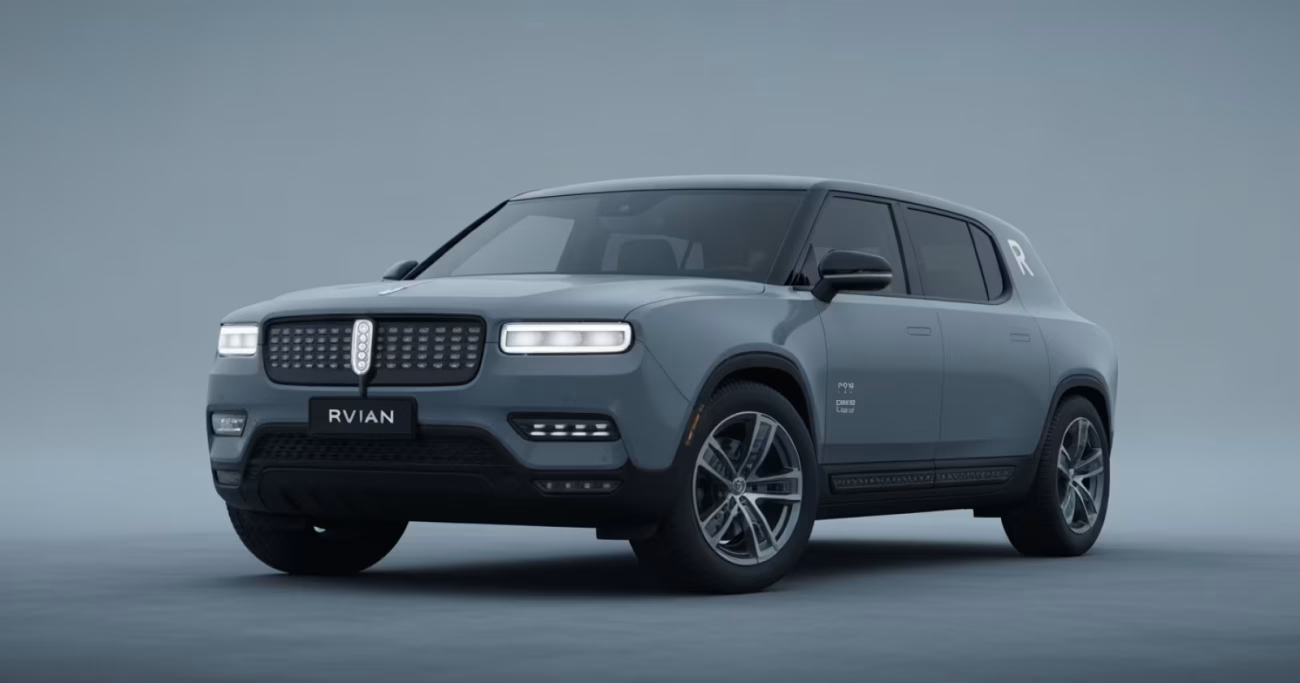
Rivian says the R2 will cost 50% less to build than its flagship R1. That single number explains why the company thinks this SUV can reach a much broader market.
The real story is not a cheaper badge. It is a full reset of how Rivian designs, wires, and assembles an EV.
Rivian just cut the bloat out
The biggest surprise is how much material simply vanished from the R2 program. Rivian says it removed 2.3 miles of wiring harness through a zonal computing layout, which spreads control duties across several computers instead of forcing one central brain to handle everything.
That matters because wiring is heavy, expensive, and hard to package. Here’s the catch: fewer wires do not just save money, they also make assembly cleaner and future repairs more predictable, at least in theory.
The R2 also slashes high-voltage cabling by 70% after Rivian consolidated power conversion from 5 units into 1. That kind of consolidation is where the real story lives, because it shows the company is no longer only chasing performance; it is chasing manufacturability.
For a brand that once built a halo truck and SUV with a lot of premium complexity, this is a major shift. It says Rivian has learned that scale comes from simplification, not just ambition.
The drivetrain is getting far leaner
Rivian says its new Maximus drive units have 41% fewer parts than the current Enduro setup. The inverter is built into the lid, and the unit shares a coolant system, which trims both complexity and cost in one move.
That is the kind of engineering decision that changes a launch from interesting to viable. What Rivian isn’t saying outright is that every part removed from the bill of materials makes the company less exposed to margin pain as production rises.
This is especially important after earlier losses were tied to the brutal economics of launching a new EV brand. In 2023, Rivian was widely reported to be losing $33,000 on every vehicle sold, and the R2 is the answer to that pressure.
In other words, the R2 is not just a smaller Rivian. It is the vehicle designed to make Rivian’s business model work.
Suspension savings signal a new mindset
Rivian says it achieved a 70% cost saving by moving from a double wishbone front suspension to a MacPherson setup. That is less glamorous than a new battery chemistry or a wild horsepower claim, but it may be more important.
Suspension choices shape cost, packaging, and weight all at once. The real story is that Rivian is now making the same hard tradeoffs every high-volume automaker has to make, rather than overengineering every corner of the vehicle.
That can sound like compromise, but it is really maturity. As EVs move from novelty to mainstream product, the winning brands will be the ones that can reduce mass and complexity without losing the character buyers expect.
Rivian appears to understand that equation better now than it did with the first R1 models. The R2 is built to be cheaper, lighter, and easier to scale, which is exactly what an expanding EV lineup needs.
The R1 price gap tells the whole story
For shoppers, the comparison is already revealing. A used 2022 Rivian R1S can now be found at steep discounts, while the R2 is being positioned around a $45,000 production cost target that supports a far more accessible market entry.
That gap changes the brand’s entire ladder. Instead of only serving buyers who can absorb a premium price, Rivian is building toward a volume model that can compete with the broader EV field.
| Model | Build cost / pricing signal | Engineering approach | Edge |
|---|---|---|---|
| Rivian R2 | About $45,000 production cost target | Zonal computing, 1 power conversion unit | Lowest-cost path to scale |
| Rivian R1 | 50% higher cost structure | More wiring, more parts, premium architecture | Established flagship capability |
| Tesla Model Y | Lower-cost mainstream EV benchmark | High-volume manufacturing focus | Proven scale advantage |
| Ford Mustang Mach-E | Competitive mainstream pricing | Conventional EV packaging | Dealer reach and market familiarity |
If I look at the segment from an industry angle, Rivian is signaling that premium EV engineering has to become modular EV engineering. That is a big shift, and it could push rivals to rethink how much complexity they are carrying just to preserve image.
There is also a weight angle here. Less wiring, fewer parts, and simpler hardware should help range and efficiency, which are becoming just as important as acceleration in the EV market.
The verdict Rivian’s R2 is the clearest proof yet that the company is moving from boutique EV maker to serious volume contender. Enthusiasts should care because the brand is trying to preserve its identity while cutting the fat that made early products so expensive. Industry watchers should care even more, because this is the blueprint for how a new automaker survives the jump from hype to scale. Rivian’s future now depends on whether this leaner formula can deliver the same appeal at a far lower cost.
If this kind of engineering shift matters to you, keep an eye on how Rivian prices the R2 against the rest of the EV field, because the next phase of the brand will be defined by affordability as much as image.
