
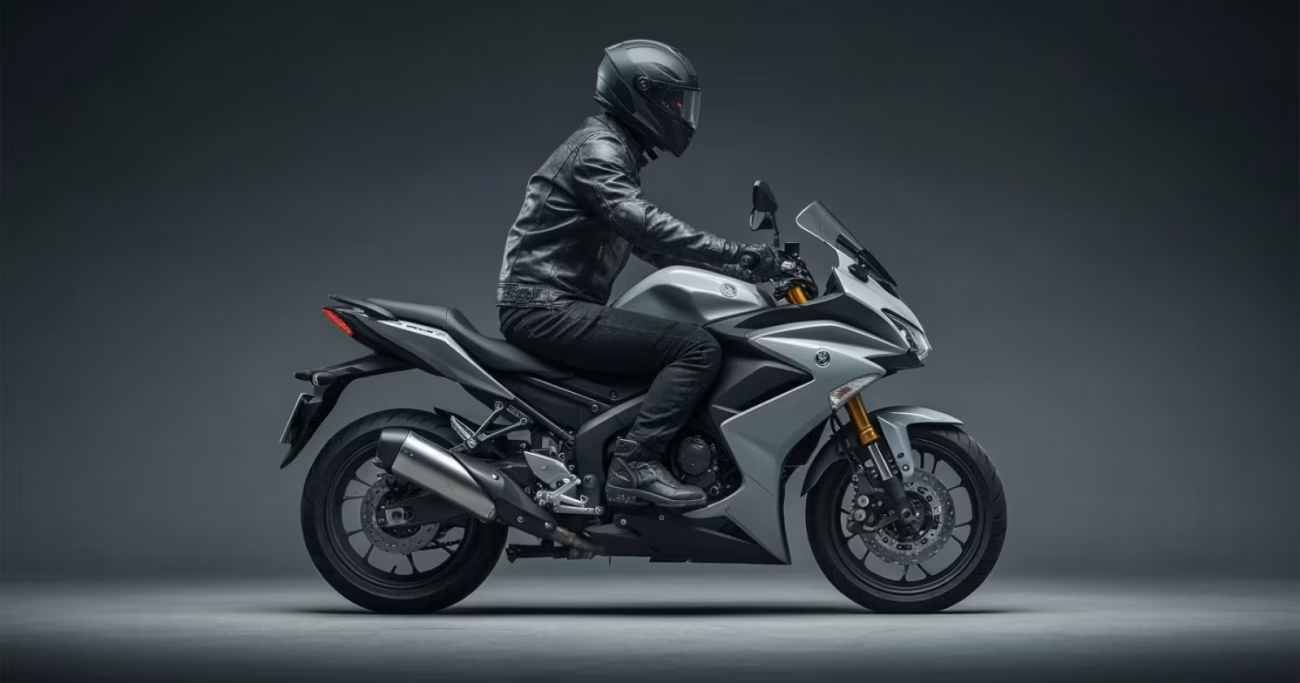
Yamaha has taken a surprisingly car-like step in the motorcycle world, and I think it could reshape how premium bikes behave on Indian roads. What makes this more interesting is that the system does not just slow the bike down, but tries to manage the whole process with far more intelligence than a regular cruise setup.
The idea sounds simple on paper, yet it is anything but simple for a two-wheeler. On a bike, you do not have seat belts, four wheels, or the same kind of natural stability a car enjoys, so every little input has to be handled with far more care.
What Yamaha is trying to do
From what I am seeing in the patent, Yamaha is building an automatic Adaptive Cruise Control system that goes beyond the usual bike ACC setup. It is designed to work with the company’s Y-AMT transmission and uses the bike’s electronics to manage throttle, braking, gear shifts, clutch action and even semi-active suspension responses.
That is a big deal because traditional bike ACC systems are usually more limited. They help maintain distance and may assist with some controlled slowing, but the rider often still needs to handle the harder braking moments. Yamaha’s approach appears to move closer to a true automation layer, where the bike itself reacts in a more complete and coordinated way.
For me, the most important part is the algorithmic logic behind it. Yamaha is not just copying what cars do and shrinking it down. It is trying to recreate how an experienced rider would manage deceleration, which is exactly the kind of thinking that could make the feature feel natural instead of awkward.
How the system is expected to behave
In the patent flow, when front radar detects a slower vehicle ahead, the bike’s ECU starts reducing throttle smoothly. At the same time, Y-AMT gets involved and begins shifting gears and operating the clutch so the engine does not stall while the bike slows down.
I find that part especially clever because engine behavior matters a lot on motorcycles. If the revs drop badly or the drivetrain gets unsettled, the whole ride can feel nervous. Yamaha’s system seems built to avoid that by making braking, shifting and throttle closure happen together in a much more polished manner.
If the situation needs stronger stopping force, the system can use both front and rear brakes. The patent also suggests that the semi-active front suspension can stiffen to reduce front-end dive, which should help keep the bike composed during sudden deceleration.
| Feature | What Yamaha’s system appears to manage |
|---|---|
| Throttle control | Gradual reduction when traffic ahead slows |
| Transmission | Automatic gear changes through Y-AMT |
| Clutch action | Assists smooth deceleration without stalling |
| Braking | Front and rear brake coordination for stronger slowdowns |
| Suspension | Semi-active front end stiffening to reduce dive |
Why this matters for Indian riders
In India, premium motorcycles are increasingly being used for long-distance highway runs, weekend touring and dense urban commuting. That makes a system like this especially relevant, because our riding conditions often change fast and unpredictably.
I can easily imagine how useful this could be on a highway with variable traffic or on a long expressway stretch where the rider wants a bit of fatigue relief. At the same time, Indian roads also bring sudden lane changes, mixed vehicle speeds, pedestrians and two-wheelers from every angle, so a system that reacts smoothly could make a real difference in rider confidence.
Yamaha also seems to be thinking ahead on safety compliance. As regulations get stricter and buyers become more aware of active safety tech, features like this may become a major differentiator in the mid-tier and premium motorcycle space.
How it compares with existing premium bikes
There are already advanced ACC systems on motorcycles like the Ducati Multistrada V4 and BMW R 1300 GS, but those setups are not fully autonomous in the way Yamaha’s patent suggests. In many cases, the rider still has to take over in stronger braking situations or when the road gets too complex for the assist logic to handle alone.
That is where Yamaha’s concept stands out. If it works as described, the rider may mainly need to steer and balance, while the bike manages a much larger part of the speed-control process. For touring riders, that could feel like a massive leap in convenience and safety.
Of course, there is also a practical side to this story. I would expect such a system to be expensive, especially if Yamaha packages it with Y-AMT, electronic suspension and radar-based assistance. For now, this looks more like a glimpse into the future than an everyday feature for entry-level bikes.
What I expect next
In my view, Yamaha is clearly building toward a more intelligent motorcycle lineup, and this patent fits neatly into that direction. The brand has already been exploring AI-led ideas and future-ready powertrain concepts, so automatic ACC feels like part of a bigger strategy rather than a one-off experiment.
If Yamaha brings this to production, I would expect it to start with higher-end motorcycles first. Mid-tier and premium bikes are the most likely candidates because that is where buyers are more willing to pay for advanced electronics, especially when the benefit is real-world comfort and safety.
What excites me most is not just the feature itself, but the direction it points to. Bikes are slowly becoming smarter, and Yamaha’s patent suggests a future where riding assistance becomes far more seamless, far more predictive and a lot closer to the sophistication we already associate with cars.
If you follow premium motorcycles, touring tech or future safety systems, I think this is one development worth watching closely. Keep an eye on Yamaha’s next electronics-heavy models, because if this idea reaches production, it could change the conversation around what a modern motorcycle is capable of doing.
