
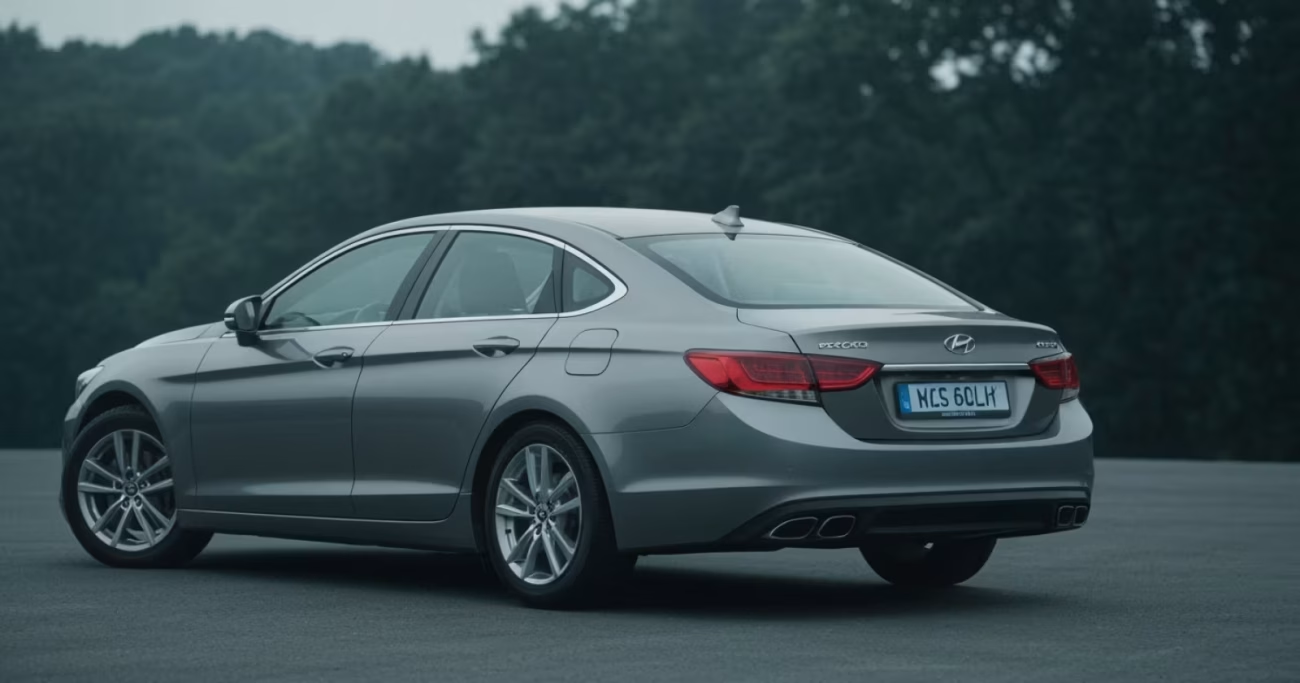
Hyundai just made one of the boldest manufacturing commitments any foreign automaker has ever put on the table in the United States. The number is $26 billion, the timeline is 2028, and the jobs figure attached to it — 25,000 — is the kind of headline that makes domestic rivals sit up straight.
I’ve covered automaker press conferences long enough to know when a company is reading from a PR script versus when it actually has receipts to back up the rhetoric. Standing at the 2026 New York Auto Show, Hyundai Motor Company CEO José Muñoz presented both — and the industry needs to pay attention.
Hyundai’s $26 billion bet dwarfs 40 years of prior US spending
Here’s the number that stopped me cold: in just the next 2 years, Hyundai will invest more money in US operations than it has in the entire 40 years it has operated here. The company has already poured over $20 billion into America since 1986. The new $26 billion pledge through 2028 nearly doubles that entire historical total in a fraction of the time.
The real story isn’t just the dollar figure — it’s what that money is building toward. By 2030, 80% of every Hyundai vehicle sold in the United States will be manufactured on American soil. That is not a vague aspiration. Muñoz said it plainly on stage, and the infrastructure plans already in motion give it credibility. A new steel mill in Louisiana is part of the package, and Hyundai North America president Randy Parker was direct: “Hyundai body-on-frame vehicles will be designed in America, developed for America, built in America, using American Hyundai steel.”
58 new models by 2030 means Hyundai has no room to slow down
The product pipeline feeding this investment is staggering. Hyundai previously announced 36 new or updated models coming to the US market in the next several years. At the New York show, Muñoz added 22 more from luxury brand Genesis, bringing the combined total to 58 models by 2030. That is not a number you hit by playing it safe.
To put that in perspective, that averages out to roughly 10 to 12 new or significantly refreshed vehicles per year across Hyundai and Genesis combined. The company’s 2 existing US plants — the Alabama facility that builds the Santa Fe, Tucson, Santa Cruz, and Genesis GV70, plus the newer Georgia EV plant assembling the Ioniq 5 and Ioniq 9 — cannot absorb that volume alone. Expansion isn’t optional here. It’s mathematically required.
| Detail | Stat |
|---|---|
| Total US investment pledge | $26 billion through 2028 |
| New direct jobs created | 25,000 |
| Total jobs currently supported in US | 570,000 |
| US-built models target by 2030 | 80% of all US sales |
| New and updated models by 2030 | 58 (Hyundai + Genesis) |
| Current US manufacturing plants | 2 (Alabama + Georgia) |
| New facility announced | Steel mill, Louisiana |
The Boulder concept signals Hyundai is coming for Jeep’s lunch
The centerpiece of Hyundai’s New York presence was the Boulder concept — a rugged, body-on-frame SUV that looked engineered specifically to provoke Jeep Wrangler buyers. Presented as a directional concept rather than a confirmed production model, the Boulder was still anything but subtle. The implication was clear: Hyundai is entering the serious off-road segment, and it intends to do it on American terms.
The frame underneath the Boulder matters as much as the body on top of it. That same body-on-frame architecture will almost certainly underpin Hyundai’s confirmed midsize pickup truck, which is already in development. This isn’t Hyundai tiptoeing into truck territory — it’s a full structural commitment to competing in the most profitable segment of the American auto market. Parker’s language on stage reinforced that this is a cultural statement, not just a product launch.
What Hyundai isn’t saying about tariffs — but doesn’t need to
The word “tariffs” was never spoken during Hyundai’s 20-minute press conference. It didn’t need to be. Every announcement — domestic manufacturing expansion, American steel, local job creation — reads as a direct response to the tariff pressure reshaping global auto production in 2026. The company is building a shield, and it’s doing it loudly enough that no one can miss the point.
Here’s the catch, though: ambition this large carries real risk. Other automakers have cancelled EV programs and absorbed billion-dollar losses without much deterrent effect, and 2026 sales trends across the industry are looking uncertain. Hyundai’s recent Q1 2026 record sales give it credibility and financial runway, but the road to 2030 is long. The plan is compelling. Execution, as always, is where it gets complicated.
How it stacks up
| Automaker | US Investment Pledge | US-Built Target | New Models Pipeline | Edge |
|---|---|---|---|---|
| Hyundai Motor Group | $26B through 2028 | 80% by 2030 | 58 models | Scale + speed |
| Toyota | ~$14B announced 2023-2026 | ~60% approx | ~20 models | Hybrid depth |
| Ford | ~$50B EV total (global) | Majority domestic | Selective launches | Truck dominance |
Why this matters
- 80% domestic production insulates Hyundai from future tariff swings
- 25,000 new jobs reshapes Hyundai’s political standing in the US
- 58 models in 4 years puts pressure on every mainstream rival’s lineup
The verdict
Hyundai just repositioned itself from “Korean import brand” to genuine American manufacturing powerhouse — and it did it with numbers large enough to force every domestic automaker to respond. The $26 billion pledge, the 25,000 jobs, the 80% domestic production target: these aren’t marketing lines, they’re structural commitments backed by plants already in the ground. Truck buyers, SUV shoppers, and EV early adopters all have reason to watch what Hyundai builds next. If the company executes even 80% of what it announced in New York, the competitive landscape in 2030 will look dramatically different from today.
If you’ve been sleeping on Hyundai as a serious player in American automotive culture, this is the wake-up call. Follow the brand’s US expansion closely over the next 24 months — the product and job announcements are just getting started.
