
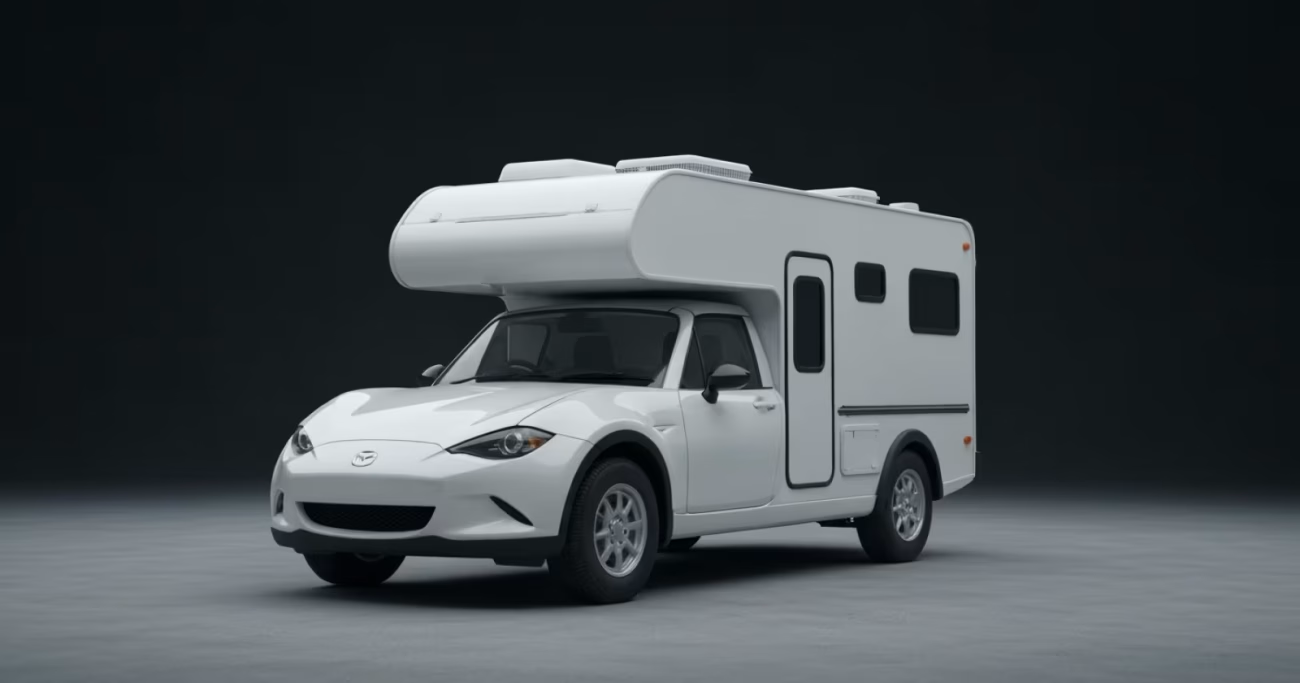
Somewhere between a golf cart and a proper campervan, there exists a tiny electric box on wheels that’s shorter than a Mazda MX-5 — and it wants to be your next holiday home. German firm Ari Motors has built what may genuinely be the smallest camper currently on sale in Europe, and the catch is it isn’t even legally classified as a car.
I’ve been watching the micro-mobility and compact camper space for a while now, and the Ari 458 Pro stops me in my tracks every time I look at it. Not because it’s elegant or powerful — it’s neither — but because it represents a genuinely odd solution to a very real problem: how do you go camping when you can’t afford, or don’t want, a full-size van conversion?
This camper sits in a class most drivers have never heard of
The Ari 458 Pro lives in the L7e category — heavy quadricycles, in plain English. That means it operates outside the stricter safety and construction standards applied to conventional passenger cars. It’s a niche that’s well-established in parts of Europe but almost invisible to mainstream buyers.
What that classification means in practice is a vehicle powered by a single electric motor producing just 20 hp (15 kW), with a top speed capped at 70 km/h (44 mph). The largest available battery delivers up to 230 km (143 miles) of range. For context, that’s slower than most motorway-adjacent A-roads in Germany allow — so this thing is firmly in the countryside-and-campsite lane.
At 3,820 mm long, it’s shorter than cars you’d never call big
The numbers here are worth sitting with for a moment. The Ari 458 Pro measures just 3,820 mm (150.4 inches) bumper to bumper. A current Fiat 500e — already one of the tiniest EVs you can buy — stretches to 3,632 mm, so the Ari is slightly longer than that. But it’s still shorter than a Mini Cooper hatch at 3,858 mm and undercuts the Mazda MX-5 ND at 3,915 mm.
That’s a two-seat roadster. The Ari 458 Pro is shorter than a two-seat roadster — and it’s supposed to sleep people. The rear module, which Ari describes as a compact living space, offers 2.8 square meters (30 square feet) of usable floor area with a maximum interior height of 1.85 m (72.8 inches). You can stand up inside it, which is more than you can say for most tent setups.
Here’s the catch — you buy an empty box and furnish it yourself
The entry price for the camper variant opens at €30,381 (approximately $35,100) in Germany. That sounds reasonable until you find out what’s included — which is, essentially, not much. The camper ships as an empty rear module with a water system, fresh and wastewater tanks, and 230-volt sockets. There’s no bed, no seating, no table, no kitchenette, and no toilet.
Ari Motors does offer a “minimalist” interior conversion assembled at its Borna facility near Leipzig — but at the time of writing, the company has not shown a single photo of what that conversion actually looks like. Buyers who want a complete, functional camper will need to source furniture and fittings independently. For some overlanding enthusiasts, that freedom is the point. For buyers expecting a turnkey product, it’s a significant asterisk.
| Spec | Detail |
|---|---|
| Length | 3,820 mm (150.4 in) — shorter than a Mazda MX-5 |
| Motor output | 20 hp (15 kW) single electric motor |
| Top speed | 70 km/h (44 mph) |
| Max range | 230 km (143 miles) — largest battery option |
| Living area | 2.8 sq m (30 sq ft) with 1.85 m (72.8 in) headroom |
| Base LCV price | €15,790 (~$18,200) before taxes |
| Camper version price | €30,381 (~$35,100) in Germany |
| Vehicle class | L7e heavy quadricycle — not a conventional car |
The platform behind this camper comes with more versatility than you’d expect
Here’s the real story behind the 458 Pro: the camper is just one of more than 30 body configurations Ari offers on the same platform. The same underlying vehicle can be ordered as a box van, food truck, flatbed, tipper, or even a compact garbage truck. That breadth of configuration is unusual for a vehicle this small, and it points to a commercial fleet DNA that runs deeper than the camping version lets on.
Up front, the cab equipment is predictably sparse — electric windows, central locking, Bluetooth connectivity, a digital instrument cluster, and a reversing camera. Air conditioning is optional, as are solar charging and a trailer coupling. The face of the vehicle carries the same cheerful, undersized look as the rest of Ari’s lineup, and like several other products in that range, it’s widely believed to be sourced from a Chinese manufacturing partner. Ari hasn’t been explicit about that relationship, which is worth keeping in mind when assessing long-term parts and service support.
What Ari Motors has built here is less a finished camping product and more a compelling proof of concept — a reminder that the L7e category, largely ignored by mainstream media, is quietly spawning genuinely creative micro-mobility solutions. If you’re the kind of person who travels slow, packs light, and likes building out your own space from scratch, the 458 Pro camper deserves a serious look. Head to Ari Motors’ website, explore the configuration options, and start thinking about what you’d actually put inside that 30-square-foot box.
