
March 2026 just dropped one of the most dramatic two-wheeler sales scorecards India has seen in years — and if you follow the electric segment, the numbers will genuinely surprise you. One EV brand more than doubled its sales while another nearly collapsed, and that contrast alone tells you everything about where India’s two-wheeler market is headed.
I’ve been tracking monthly two-wheeler retail data for a while now, and honestly, this month stands out. Total retail sales hit 19,51,006 units — a 28.68% jump year-on-year over the 15,16,150 units recorded in March 2026. Month-on-month, that’s a 14.73% rise over February 2026’s 17,00,505 units. These aren’t soft numbers. This is a market firing hard on every cylinder.
Hero, Honda, TVS Lead The Pack
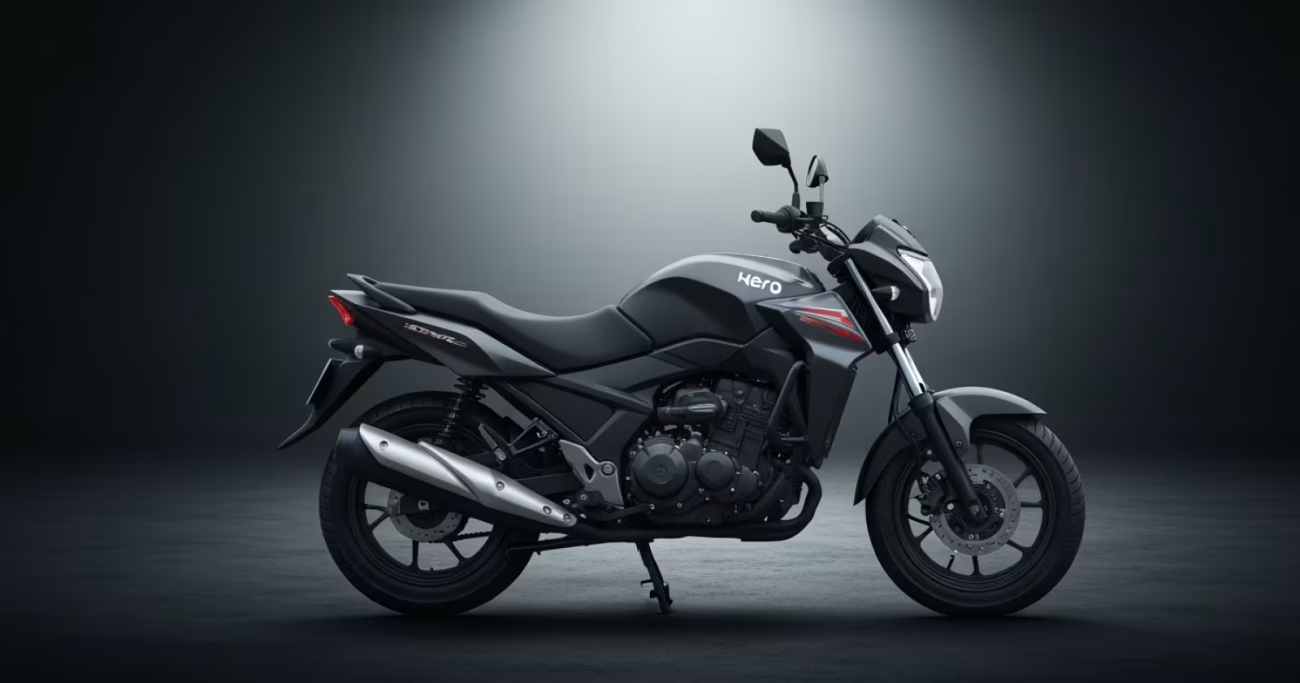
Hero MotoCorp held its throne in March 2026, selling 5,41,857 units and commanding a 27.77% market share. For context, they moved 4,36,598 units in March 2026 — that’s a growth of over 1 lakh units in a single year. Hero’s grip on rural and semi-urban India remains absolutely unshakeable, and this month proved it again.
Honda followed closely with 4,75,313 units, up sharply from 3,57,548 units. TVS Motor Company came in third with 3,74,602 units, lifting its market share to 19.20%. Bajaj Auto posted 2,16,253 units versus 1,71,866 units last year — solid, consistent growth. Suzuki reported 98,412 units, while Royal Enfield registered 96,510 units, riding on strong demand from its 350cc lineup.
The EV Showdown Nobody Predicted
This is where March 2026 gets genuinely dramatic. Ather Energy exploded to 35,736 units — more than double the 15,650 units it posted in March 2026. That is a stunning turnaround, and Ather’s consistent product quality and expanding fast-charge network clearly paid off this month.
Ola Electric, on the other hand, crashed hard. Sales fell to 10,118 units from 23,634 units in March 2026 — a decline of nearly 57%. This isn’t a blip. Combined with its FY26 full-year data showing a drop from 3,44,300 units to just 1,64,295 units, it’s clear that Ola’s quality and service issues have directly punished its retail numbers. Meanwhile, Ather’s FY26 tally hit 2,39,178 units, up 83% year-on-year. The contrast is stark and says a lot about how Indian buyers are making more informed EV choices now.
Full FY26 Picture: A Market In Growth Mode
Looking at the complete financial year, total two-wheeler retail sales reached 2,14,20,386 units in FY26 — a 13.40% rise over FY25’s 1,88,89,595 units. Both urban and rural markets contributed equally to March’s surge, with urban sales up 28.84% and rural up 28.57%. That kind of balanced growth across geographies suggests this isn’t just a metro phenomenon — demand is genuinely broad-based.
For FY26, petrol and ethanol-powered vehicles still dominated with a 93.30% share. Electric two-wheelers accounted for 6.54% of the full-year pie, while CNG bikes remained marginal at 0.16%. Electric is growing, but the combustion engine still owns this market by a massive margin.
March 2026 Two-Wheeler Retail Sales — Brand-Wise Breakdown
| Brand | March 2026 (Units) | March 2026 (Units) | FY26 Total (Units) |
|---|---|---|---|
| Hero MotoCorp | 5,41,857 | 4,36,598 | 60,83,248 |
| Honda MSIL | 4,75,313 | 3,57,548 | 53,61,458 |
| TVS Motor | 3,74,602 | — | 40,46,666 |
| Bajaj Auto | 2,16,253 | 1,71,866 | 22,49,778 |
| Suzuki | 98,412 | — | 11,40,730 |
| Royal Enfield | 96,510 | — | 11,08,597 |
| Yamaha India | 65,705 | — | 7,15,564 |
| Ather Energy | 35,736 | 15,650 | 2,39,178 |
| Ola Electric | 10,118 | 23,634 | 1,64,295 |
| Greaves | 7,965 | — | 61,563 |
| Classic Legends | 4,617 | — | 45,409 |
What The Numbers Actually Mean For You
India Yamaha Motor posted 65,705 units in March and a steady 7,15,564 units for FY26. Classic Legends, the maker of Jawa and Yezdi motorcycles, contributed 4,617 units this month and 45,409 units for the year. River Mobility showed impressive momentum — just 4,247 units in FY25 versus 22,354 units in FY26, which is a brand worth watching in the affordable EV space.
The bigger story here is consumer confidence. When both urban and rural buyers are spending on two-wheelers simultaneously, it signals strong wage growth and financing penetration in Tier 2 and Tier 3 cities. The festive cycle also tends to carry demand into March, and this year that tailwind was clearly visible in the numbers.
If you’re in the market for a new two-wheeler right now — whether it’s a commuter, a 350cc tourer, or an electric scooter — this data tells you the brands that buyers across India trust most. And if you’re eyeing an EV, the Ather vs Ola divergence is one of the clearest market signals we’ve seen in years. Drop your thoughts in the comments below, share which brand you’d pick in 2026, and bookmark this page for next month’s numbers — because at this rate of growth, April 2026 is going to be equally interesting.
